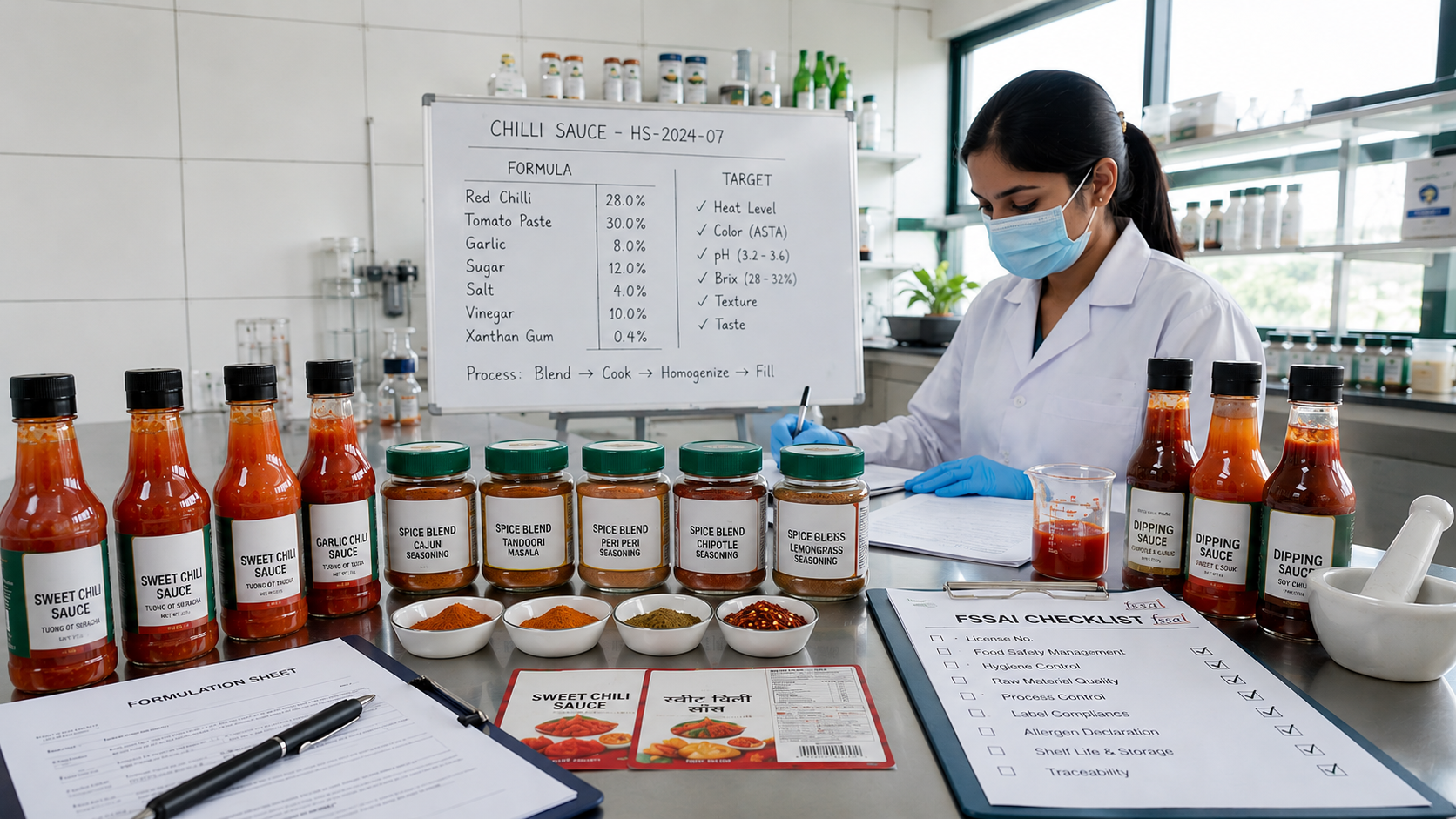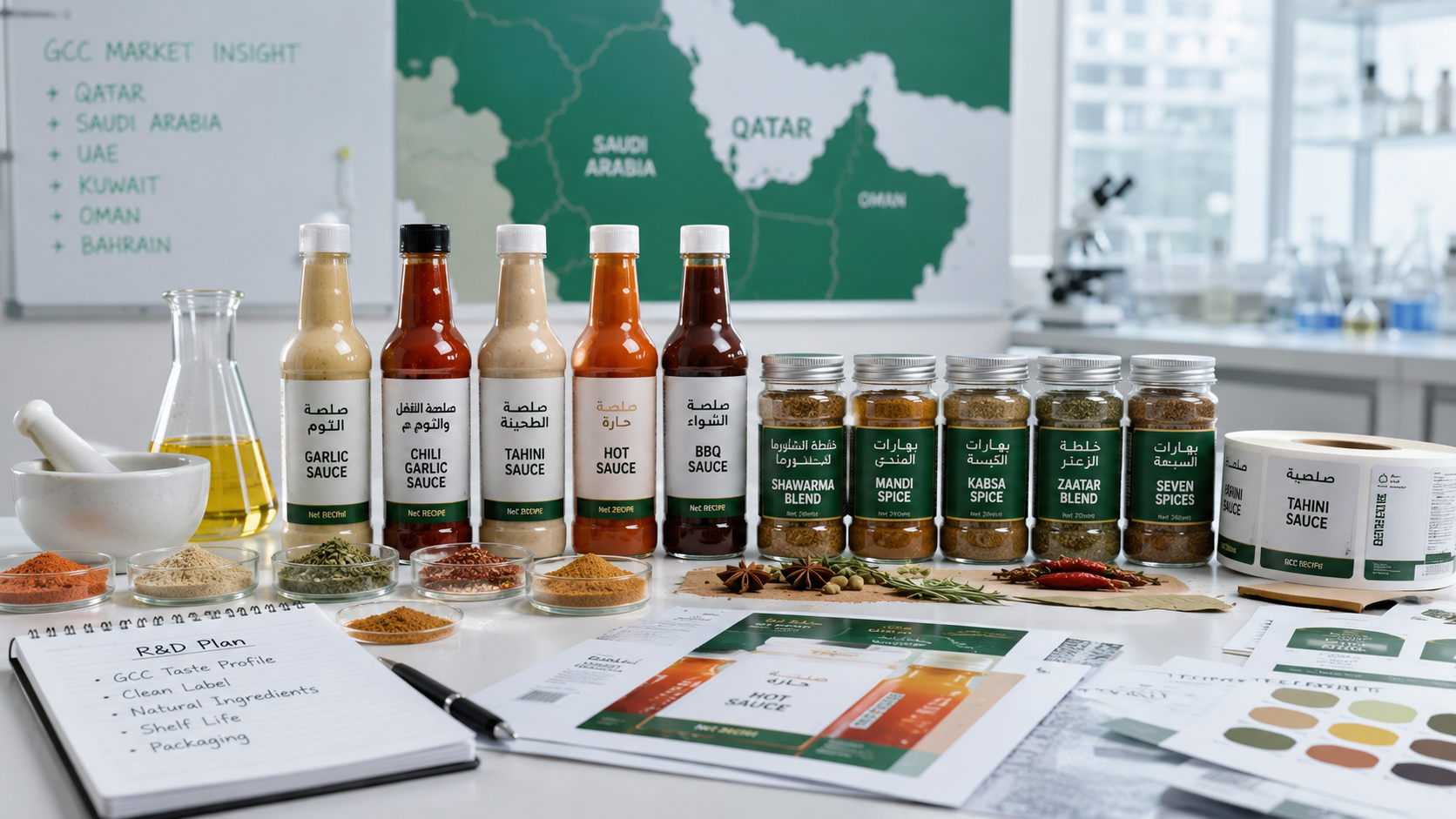


Nigeria is a large, flavor-forward market with a significant Muslim consumer base, but Halal certification alone is not enough. Seasoning businesses should prepare clear formulas, ingredient records, heat- and humidity-resistant packaging, realistic pricing, suitable sales channels, and a capable importer before moving toward commercial shipments.
Why should Nigeria matter to seasoning and sauce businesses?
Nigeria is attractive not only because of market scale, but because consumers are used to bold, spicy, aromatic flavors and frequent seasoning use. The opportunity is real for sauces, spice blends, marinades, food-service formats, and private-label products, but only when price, packaging, channel, and importer fit the market.
Nigeria is one of the most important African markets for food businesses to watch. It has strong consumption potential, diverse food culture, a large Muslim community, and clear demand for seasonings, sauces, dipping sauces, packaged foods, convenient products, and food-service ingredients.
For Vietnamese seasoning businesses, the appeal is not only population size. Consumers are familiar with spicy, rich, aromatic flavors. Seasonings are widely used in grilled dishes, stews, rice dishes, fish, meat, snacks, and street food.
If a product is prepared properly, chili sauce, garlic sauce, marinades, seasoning powders, dipping sauces, plant-based sauces, and private-label products may all have opportunities. But Nigeria should not be approached through oversimplification.
The market is broad, strongly segmented, price-competitive, and complex in distribution. Regional differences are significant. A product that tastes good in Vietnam may not fit Nigeria if the flavor is not strong enough, the price is not realistic, the label is unclear, the packaging is weak, or the importer does not have enough capability.
For Hoa Sen Foods, the first question is not simply: “Does Nigeria have a large population?” The earlier question should be: is this product clear enough in formula, ingredients, Halal status, taste direction, price, label, shelf life, packaging, and distribution channel to enter Nigeria?
Which product groups can be considered for Nigeria?
The strongest starting point is usually a focused product set, not a full catalog. Products should be easy to understand, clearly useful in Nigerian dishes or food service, strong in flavor, and manageable in Halal, packaging, pricing, and documentation risks.
- Chili sauce, garlic sauce, and Asian-style spicy sauces for fried foods, chicken, fish, grilled meat, and snacks.
- Marinades, spice rubs, and seasoning mixes for grilled fish, chicken, beef, rice, soups, and stews.
- Soy sauce, plant-based dipping sauces, and vegan sauces that may reduce Halal risk.
- Small, trial-friendly pack sizes for grocery stores or traditional markets.
- Food-service formats for restaurants, hotels, central kitchens, and local food manufacturers.
- Private-label products for Nigerian importers, retail chains, or distributors.
How should Halal be understood in Nigeria?
Nigeria has a very large Muslim community, but it is not one uniform Islamic market. Halal should be defined by region, sales channel, and consumer group. For seasoning products, the key is not only the certification mark, but the formula, ingredients, process, and supporting evidence.
If a product targets Northern Nigeria, Muslim communities, Halal restaurants, retail chains serving Muslim consumers, or distributors focused on Muslim buyers, Halal is a highly important factor.
If the product enters Lagos or multi-religious channels, Halal can still be a trust advantage, especially for imported products or plant-based products. Hoa Sen Foods looks at this question in practical terms: can the product prove Halal suitability when an importer, inspection body, or customer asks for evidence?
That evidence comes from four control layers: the formula, the ingredient chain, the production process, and the certification, labeling, and import dossier. If one layer is weak, documentation may slow down or trust with the partner may be lost.
How is Nigeria different from Pakistan, the UAE, Oman, and GCC markets?
Nigeria differs from GCC markets in three major ways: clearer consumer segmentation, higher price sensitivity, and the continuing importance of traditional channels. Seasoning products that want to travel far in Nigeria need strong flavor, clear pricing, durable packaging, and an importer capable of handling the market.
Compared with Pakistan, Nigeria has a large Muslim community but is not a uniform Muslim market. A Halal strategy should be connected to the region and sales channel instead of being applied broadly to the whole country.
Compared with the UAE or Oman, Nigeria can be more price-sensitive, more complex in logistics, more dependent on traditional channels, and more varied across consumer segments. The UAE has more modern import and retail systems and a more international consumer base. Nigeria requires closer thinking about distribution, registration, counterfeit risk, storage, and product rotation speed.
Compared with GCC markets, Nigeria also has a very strong local food culture. Consumers are not looking only for a product labeled “Halal.” They need products that fit local dishes, fit daily price expectations, are easy to use, and give a clear reason to replace or complement local alternatives.
Why should the seasoning industry be especially careful in Nigeria?
Seasonings may look simple from the outside, but they often contain many small components that can create Halal, labeling, allergen, and stability risks. For Nigeria, companies should examine flavorings, flavor enhancers, fermented ingredients, hot-humid packaging performance, peanut and sesame allergens, and shared production processes.
A bottle of sauce, a jar of paste, a seasoning pouch, or a spice blend may contain many small ingredients. To achieve stable taste, attractive color, appealing aroma, suitable texture, workable shelf life, and feasible cost, a formula may use flavorings, food acids, stabilizers, flavor enhancers, preservatives, colors, enzymes, or fermented ingredients.
In Nigeria, risk also comes from hot and humid conditions and long distribution routes. Dry seasonings may absorb moisture, clump, or lose aroma. Sauces and dipping sauces may leak, separate, swell at the cap, change color, or lose flavor if packaging is not suitable.
Nigeria also requires careful attention to allergens. Peanuts, sesame, soy, gluten, or related ingredients should be reviewed closely if they appear in the formula. Suya and yaji culture creates opportunities for spice blends, but if peanut or sesame is used and the label is unclear, risk increases.
Consulting view: for a market like Nigeria, a plant-based formula, bold flavor, clear documentation, and durable packaging are often safer starting points than formulas with many animal-derived flavors or additives that are difficult to trace.
Which products should a business choose first for Nigeria?
A business should not bring its entire catalog into Nigeria at the beginning. It should choose one to three lead products with strong taste, lower Halal risk, trial-friendly pricing, heat- and humidity-resistant packaging, and clear use in Nigerian dishes or food-service operations.
The first product should be easy to understand and easy to use. A spicy sauce with a clear flavor, a marinade that works well for chicken, fish, or grilled meat, or a seasoning mix that can be used for rice, stew, soup, and bean dishes is more practical than a long catalog without a lead product.
For mass channels, small pack sizes may help consumers try the product more easily. But small packs do not automatically mean good margin because packaging cost per unit can be high. Pricing must be calculated from the start.
For food service, larger pack sizes, consistent quality, and volume-based pricing become more important than retail packaging. This can be a good entry route for new products because chefs or central kitchens can test the product in real dishes.
How should a company choose the Nigeria entry channel before certification?
The sales channel determines the formula, price, packaging, label, and documentation. A product for Northern Muslim consumers is different from one for Lagos. A product for grocery stores is different from one for HORECA. Choosing the channel first prevents certification, packaging, or MOQ decisions based on guesswork.
For modern retail, a business needs a clear label, attractive packaging, suitable size, barcode, nutrition information if required, shelf life, and a display plan. For traditional markets or grocery stores, price, small format, packaging durability, and rotation speed are more important.
If the target is food service, restaurants, central kitchens, or F&B chains, the company should prioritize larger pack sizes, stable quality, volume-based pricing, and reliable supply. If the target is the Muslim or Halal channel in Northern Nigeria, formula, certification, distributor trust, and community confidence require closer handling.
Private label is also worth considering. A Nigerian importer may want its own label, flavor, price point, or pack size. In that case, R&D capability, recipe confidentiality, stable packaging, and technical documentation support become clear advantages of a contract manufacturing partner.
Comparison table: which Nigeria entry channel should be selected before certification?
Each channel brings different requirements for formula, pack size, pricing, and documentation. The table below helps businesses quickly see what should be prepared before sample development, packaging artwork, or certification partner selection.
| Channel / area | Opportunity | What to prepare | Risk if rushed |
|---|---|---|---|
| Northern Nigeria / Muslim consumers | Clear Halal trust and demand for religiously suitable food | Formula, certification, label, and reputable distributor | Using a certification not accepted by the market or making unsupported claims |
| Lagos / major cities | Retail, HORECA, restaurants, and imported products | Packaging, pricing, product difference, and importer capability | High price without a strong enough reason to choose the product |
| Traditional markets / grocery stores | Broad purchasing power and potential volume | Small pack sizes, good pricing, durable packaging, and distribution | MOQ and price not fitting product rotation speed |
| Food service | Easy testing in real dishes; suitable for sauces and marinades | Larger formats, consistent quality, and volume-based pricing | Focusing only on retail packaging while missing kitchen needs |
| Private label | Importers can request their own flavor, label, and pack size | Recipe confidentiality, R&D, MOQ, and technical dossier | Unclear recipe ownership and certification responsibilities |
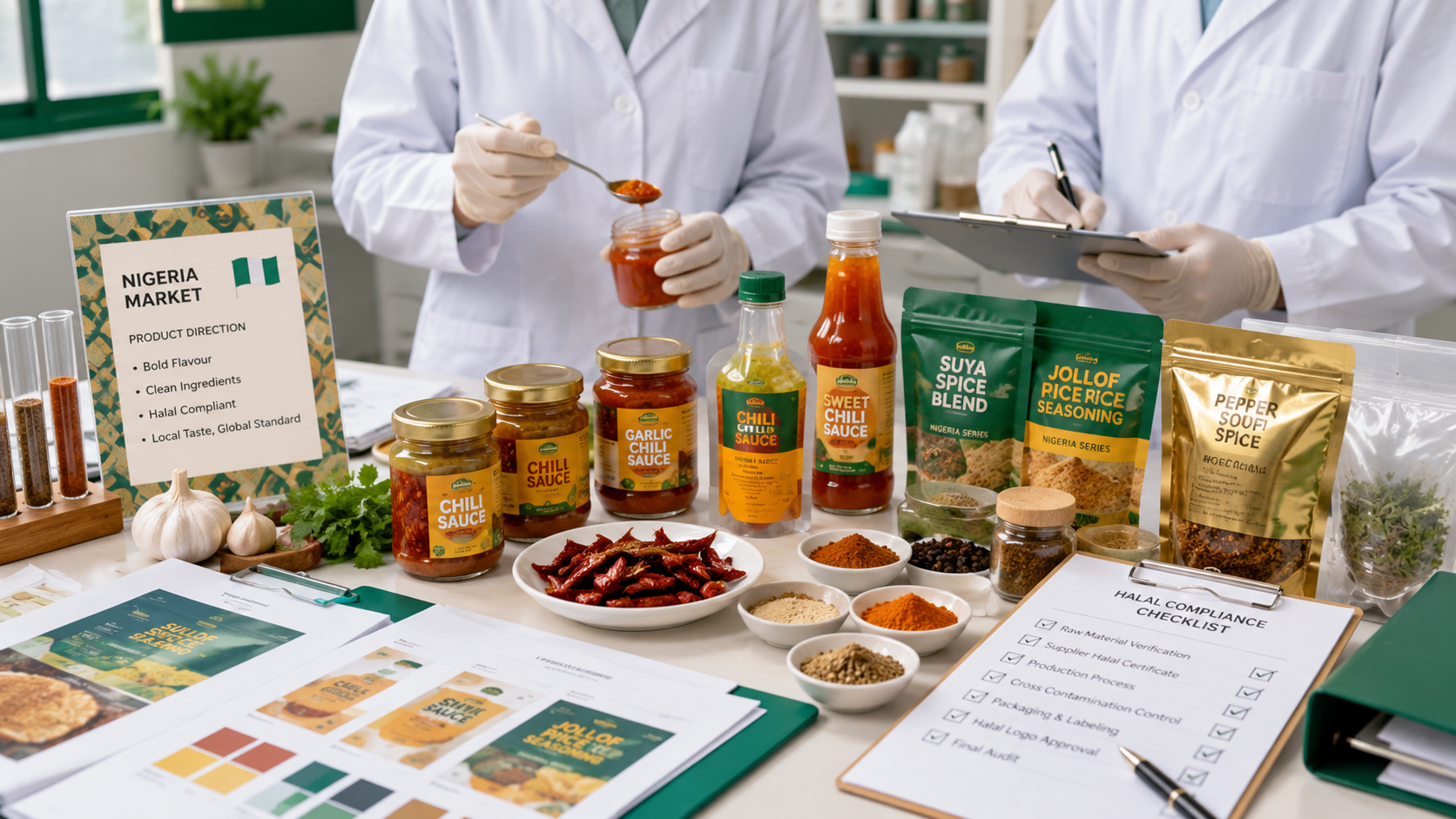
What is the 10-step roadmap for preparing seasoning products for Nigeria?
A practical roadmap does not start with packaging print or certification. Businesses should first define the sales channel, importer, lead products, and formula dossier. Certification, labeling, and a trial production batch should come after the foundation is clear.
- Define the region and sales channel: Lagos, Abuja, Northern Nigeria, Muslim/Halal channels, supermarkets, traditional markets, food service, or private label.
- Work early with the Nigerian importer to confirm NAFDAC/SON requirements if applicable, Halal expectations, label requirements, import documents, pricing, and distribution.
- Select one to three lead products with strong flavor, lower Halal risk, realistic pricing, and reorder potential.
- Create a detailed formula table for each ingredient: commercial name, technical name, supplier, usage rate, function, origin, Halal status, specification, and COA if available.
- Classify ingredient risks into low, medium, and high so issues can be addressed before dossier submission.
- Revise the formula through R&D if an ingredient is not Halal-suitable, difficult to trace, or pushes the cost beyond market ability.
- Control production and cross-contamination risk: raw material receiving, weighing, mixing, heating, filling, packing, retained samples, and batch coding.
- Select a suitable Halal certification body according to importer requirements and product scope.
- Prepare market-ready labeling: ingredients, additives, allergens, net weight, origin, manufacturer, shelf life, storage conditions, batch code, barcode, and evidence-backed claims.
- Run trial production, check the batch dossier, and treat the first shipment as a commercial test, not merely an order.
What documents should seasoning companies prepare?
A strong dossier helps a business move faster with importers, certification bodies, and testing partners. More importantly, it helps the R&D team see where the product is strong, where evidence is missing, and what should be resolved before larger-scale production.
| Document group | What to prepare |
|---|---|
| Product dossier | Product name, description, detailed formula, production process, quality criteria, testing records if available, shelf life, storage conditions, product images, and packaging format. |
| Ingredient dossier | Ingredient list, specifications, COA if available, Halal certificates if available, plant/animal/microbial/synthetic origin, additives, processing aids, and supplier commitments. |
| Factory dossier | Factory layout, production flow, sanitation, cross-contamination control, batch control, retained samples, deviation handling, complaints, recall process, and personnel training records. |
| Packaging and label dossier | Label artwork, English or importer-required language version, nutrition information, claims and claim evidence, packaging specifications, barcode, carton, batch code, and expiry date. |
| Commercial dossier | Importer, sales channel, priority region, target price, MOQ, delivery terms, volume plan, reorder plan, and market-test strategy. |
What mistakes do Vietnamese seasoning businesses often make when entering Nigeria?
The biggest mistake is treating Nigeria as a large but simple market. In reality, a business must handle region, Halal, price, packaging, local taste, distribution, and copying risk at the same time. Missing one point can slow the whole project.
- Assuming Nigeria only requires Halal while the product still needs the right taste, price, label, channel, importer, and shelf life.
- Failing to segment the market and using one strategy for Lagos, Abuja, Northern Nigeria, and traditional channels.
- Using a Halal certificate before the importer confirms acceptance.
- Keeping the formula unclear by listing only “flavoring,” “additives,” or “flavor enhancers” without proper records.
- Setting a price that does not fit the target segment, especially in mass-market channels.
- Using packaging that cannot handle heat, humidity, long transport, and real storage conditions.
- Setting an MOQ too high for the first order, making market testing difficult for the importer.
- Skipping taste testing with local users or food-service channels before larger-scale production.
- Ignoring counterfeit, packaging-copying, or recipe-leakage risks after the product shows sales potential.
Where can Hoa Sen Foods support businesses preparing for Nigeria?
Hoa Sen Foods is best suited to the foundation stage: listening to market goals, developing samples, reviewing formula risks, optimizing taste, pack size, and cost, controlling production, and preparing technical information so clients can work with importers or certification partners.
As a production and R&D back-end partner for seasoning and food brands, Hoa Sen Foods can support clients with product ideas for the Nigerian market, formula development for seasonings, dipping sauces, sauces, pastes, dipping salts, and packaged products, sample testing, and adjustment based on feedback.
Hoa Sen Foods can also help with basic ingredient-risk review, production and packaging control, and preparation of technical information for clients to work with importers, testing partners, or suitable certification bodies. Client formulas, volumes, and commercial information should be protected from the beginning.
Hoa Sen Foods should not be understood as a Halal certification body. For official certification requirements for Nigeria, businesses need to work with an authorized certification body and confirm suitability with the importer or relevant authority. A product that wants a smoother certification process still needs to begin with a clear formula, clear ingredients, a controlled process, and proper documentation.
Quick map: what are the 5 control layers before entering Nigeria?
Before shipping, a business should check the product across five layers: formula, ingredient dossier, production, label and packaging, and commercial readiness. If one layer is weak, it should be corrected before moving forward instead of exposing the problem during import or sales.
| Layer | Control question | Required result |
|---|---|---|
| 1. Formula | What is inside the product? Are there Halal, allergen, or animal-origin risks? | The formula is clear and has alternatives when needed. |
| 2. Ingredients | Does each ingredient have a specification, COA, Halal certificate if needed, and origin information? | The dossier is sufficient for importer explanation. |
| 3. Production | Does the process control cross-contamination, sanitation, batch coding, retained samples, and traceability? | Production is stable and backed by operating evidence. |
| 4. Label and packaging | Does the label include ingredients, allergens, shelf life, storage, claims, and heat-humidity packaging performance? | Import, complaint, and damage risks are reduced. |
| 5. Commercial readiness | Are the region, channel, price, pack size, MOQ, and importer clear? | The market-test plan is realistic. |
Nigeria is a large market with a bold seasoning culture, growing packaged-food demand, and a very important Muslim consumer base. But it is not an easy market if a company only looks at population size and ignores region, price, taste, label, shelf life, certification, packaging, and distribution.
A seasoning product that wants to enter Nigeria needs a clear formula, clear Halal logic, a clear label, clear quality control, and clear commercial planning. When these foundation questions are answered early, the journey into Nigeria becomes much less risky.
Hoa Sen Foods is ready to support clients from the first preparation steps, so a flavor idea does not stop at a good sample, but can become a safe, stable, distinctive product with enough foundation to approach a large African market like Nigeria. Visit hoasenfoods.vn or contact Hoa Sen Foods to discuss your formula, sample testing, and suitable contract manufacturing plan.
Download the in-depth Halal guide for the Nigerian market
FAQ
Should Vietnamese seasoning businesses start Nigeria with Halal products?
Halal should be treated as part of a trust strategy, especially when targeting Northern Nigeria or Muslim consumers. However, Halal does not replace taste, pricing, packaging, sales channel, shelf life, or a suitable importer.
Which products are easiest to test in Nigeria?
Chili sauces, garlic sauces, grill marinades, seasoning mixes, plant-based dipping sauces, and food-service products can be practical starting points. The product should have a clear taste, work with Nigerian dishes, and use a pack size suitable for a test order.
Is packaging important for the Nigerian market?
Yes. Heat, humidity, long transport, and real storage conditions can make dry seasonings clump, sauces leak, products separate, or aromas fade. Packaging should be tested before commercial production.
Is Hoa Sen Foods a Halal certification body?
No. Hoa Sen Foods is an R&D and production back-end partner for seasoning and food products. For official certification, businesses should work with an authorized certification body and confirm acceptance with the importer or relevant authority.
When should a company consider private label for Nigeria?
Private label is suitable when an importer or distributor understands the sales channel and wants a product with its own flavor, pack size, price, or label. In this case, recipe ownership, confidentiality, MOQ, and certification responsibility should be agreed clearly from the beginning.