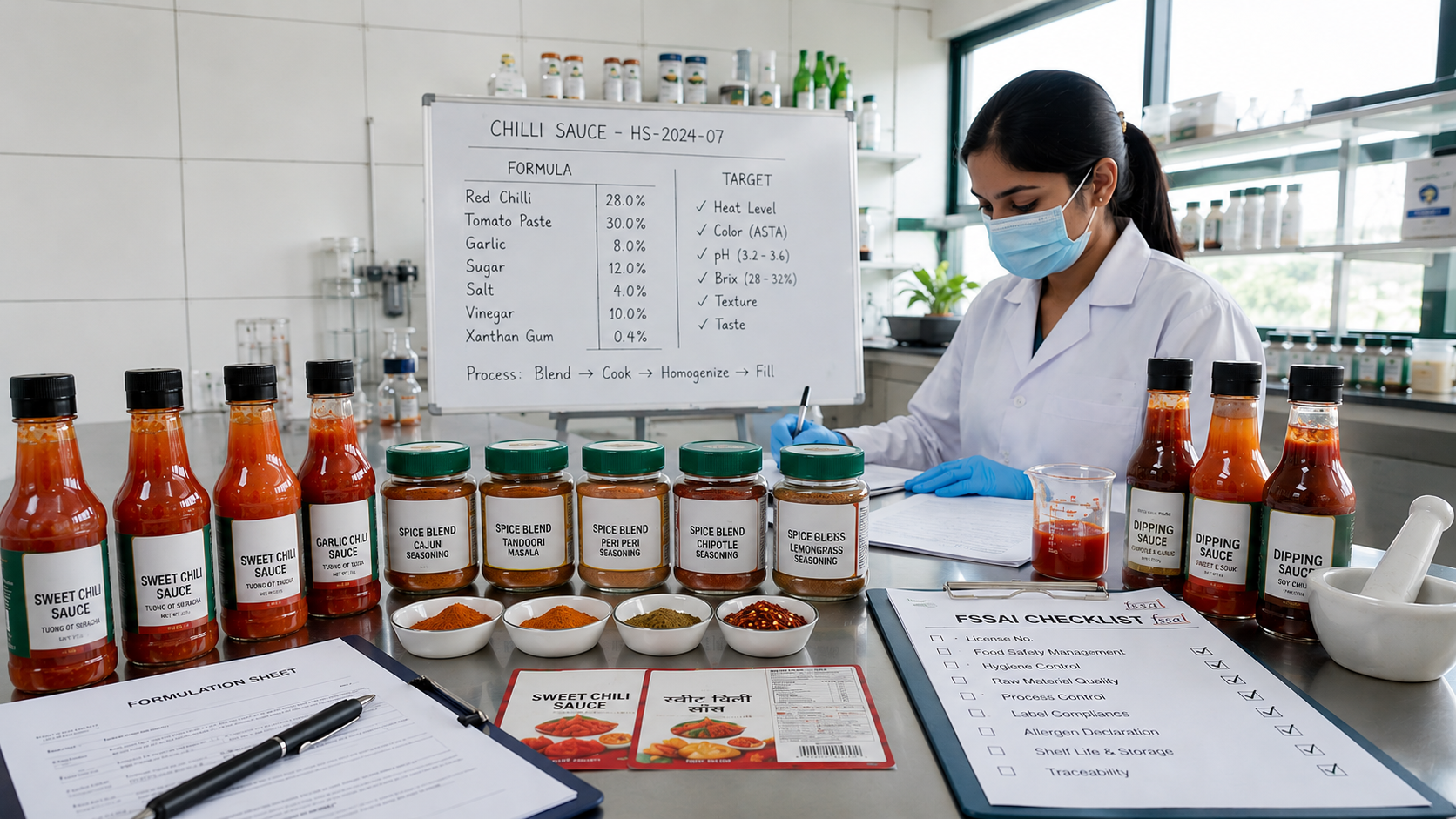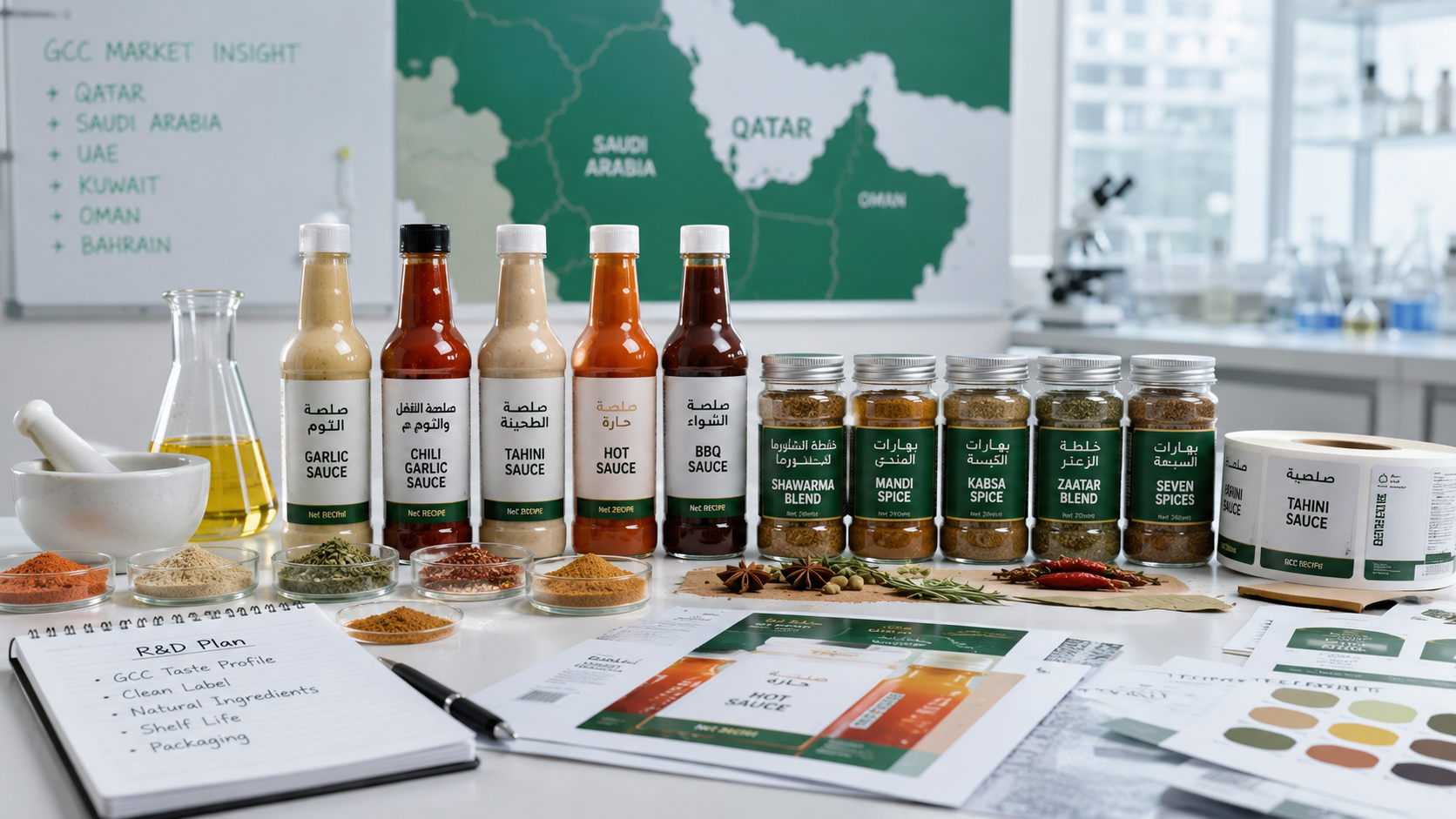


Oman is a GCC market worth studying for seasonings, dipping sauces, sauces and private-label food products. A business should not enter it by guesswork. Before the first shipment, prepare the formula, ingredient files, Halal basis, Arabic/English label, heat-resistant packaging, shelf life, MOQ and a capable importer.
Oman is not as loud as the UAE, not as large as Saudi Arabia, and not mentioned as often as Qatar or Kuwait. For Vietnamese food businesses, especially those producing seasonings, dipping sauces, sauces, soy-based products, seasoning powders, dipping salts, marinades or private-label products, Oman is a GCC market that deserves serious research.
Oman sits at a sea gateway to the Arabian Sea, connecting the Gulf, the Indian Ocean, East Africa and South Asia. Its Muslim food culture makes Halal a foundation of food trust. The market also includes local consumers, expatriate communities, migrant workers, restaurants, hotels, supermarkets, imported food shops and specialized distributors.
For the seasoning sector, Oman is interesting because its taste profile sits at a crossroads. Local cuisine carries Arab, Indian, East African and long maritime trade influences. Consumers are familiar with rice, meat, fish, seafood, dates, aromatic spices, grilled dishes, stews, sauces, chutneys and mixed spices. That gives businesses a base for studying dipping sauces, chili sauces, soy sauce, marinades, seafood seasoning, spice blends, plant-based products and private label.
Oman should not be approached by assumption. A product may taste good in Vietnam, look attractive on shelf and have a reasonable price, yet still struggle if the business has not prepared properly for Halal, Arabic/English labeling, ingredient documentation, shelf life, heat-resistant packaging, certification, the importer and channel strategy.
Why should Oman matter for the seasoning industry?
Oman may not be the largest consumer market in the Gulf, but it offers practical advantages for Vietnamese seasoning businesses that move step by step. The opportunity is strongest when the product is easy to understand, suitable for local food habits, supported by a clear importer and prepared with proper documents.
- Oman belongs to the GCC space, where consumers are familiar with imported foods and care about Halal, origin, safety and labeling.
- Its seaports and logistics system can support packaged food distribution when the business works with an experienced importer.
- The mix of Arab, South Asian and East African taste profiles can create a testing ground for Asian seasonings, as long as the product fits local dishes.
- Restaurants, hotels, food service, supermarkets and imported food shops can become entry channels before mass retail expansion.
- A moderate market size allows a business to test one to three key products, measure feedback, improve the product and then expand the portfolio.
For seasonings, potential opportunities may include chili sauce, garlic sauce, sweet-and-sour sauce, tamarind sauce, soy sauce, dipping sauce, marinades for grilling, seafood seasoning, dipping salts, spice blends, seasoning mixes, plant-based lines, food-service pack sizes and private-label products for Omani importers.
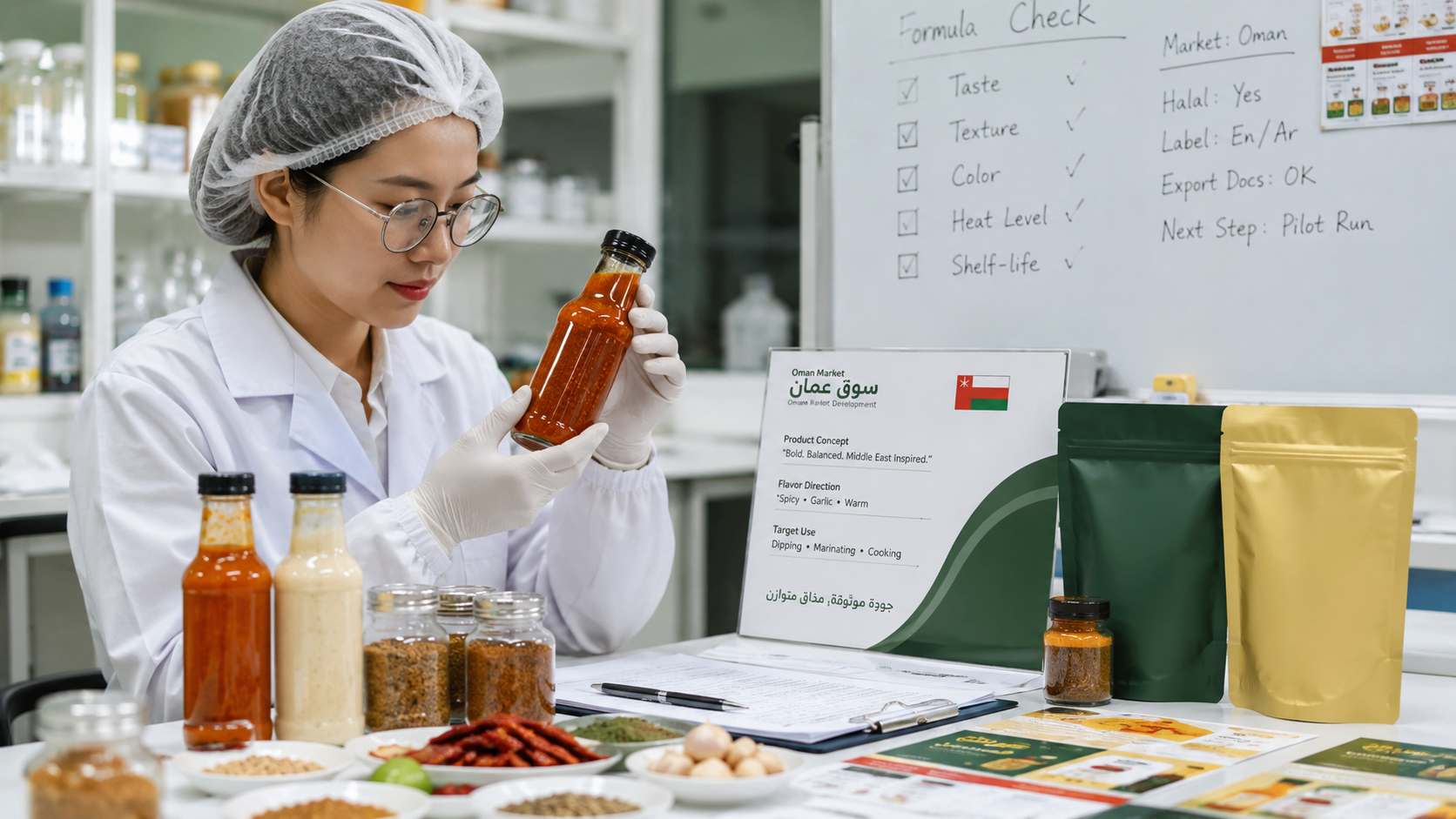
How should Halal be understood in the Oman context?
Oman is a Muslim market, so Halal is not a secondary factor. For imported foods, Halal sits at the center of trust. With seasonings, Halal should not be treated as a single logo on the label. It should be managed as a control system across formula, ingredients, production, certification and import requirements.
| Control layer | Questions the business should ask | Meaning for seasoning products |
|---|---|---|
| Formula | Does the product contain alcohol, pork-derived ingredients, gelatin, enzymes, emulsifiers, flavorings or animal-origin additives? | This helps identify risks from R&D before sample development and cost calculation. |
| Ingredient chain | Does each ingredient have a specification, COA, Halal certificate when needed and supplier information? | This creates evidence when the importer or certification body asks for documentation. |
| Production process | Is there any cross-contamination risk with non-Halal ingredients? Are cleaning, retained samples and batch codes clear? | The product is not only “clean in formula” but also made under controlled production conditions. |
| Certification, labeling and import | Will the Omani importer accept the Halal certificate? Is the Arabic/English label suitable? | This prevents the business from certifying or printing packaging based on assumptions and then having to redo the work. |
The Halal risks in seasonings usually do not come from salt, pepper, chili, garlic or sugar. They often come from small components: flavorings, carriers, solvents, flavor enhancers, enzymes, fermented ingredients, food colors, preservatives, stabilizers, emulsifiers, processing aids and direct-contact packaging.
How is Oman different from the UAE, Bahrain and Saudi Arabia?
A business that has studied the UAE, Bahrain or Saudi Arabia should not copy that strategy into Oman. Oman has a calmer market rhythm, a more moderate scale and a need for practical channel choices. It still sits within the GCC space, but local importer confirmation matters.
- Not as hyper-international as Dubai: the product should fit local consumption life and real importer needs, not just rely on being an imported product.
- Cross-cultural taste: the product should work with rice, meat, fish, seafood, grilled food, stews, family meals and restaurant menus.
- MOQ needs careful planning: the first order should help the importer learn the market, not force a large volume too early.
- Hot climate and long-distance transport: packaging, shelf life, color stability, aroma, viscosity, leakage, swollen caps and clumping need careful testing.
- Still part of the GCC space: regional requirements can be referenced, but procedures should not be assumed to be identical to the UAE, Bahrain or Saudi Arabia.
Which products should a business choose first for Oman?
Do not send the whole portfolio to Oman at the beginning. A safer path is to choose one to three key products with lower Halal risk, clear ingredient files, heat-resistant packaging, suitable MOQ and a defined sales channel. The first product group should be easy to test and reorder.
| Product group | Application opportunity | Points to control |
|---|---|---|
| Chili sauce, garlic sauce and Asian dipping sauces | Can be used with grilled food, fried food, rice, sandwiches, snacks, seafood or restaurant dishes. | Balance heat, sourness, sweetness and saltiness; test packaging, separation and stability. |
| Soy sauce, dipping sauces and plant-based sauces | Can create differentiation through an Asian food story while reducing animal-origin ingredient risk. | Control fermented ingredients, additives, flavor enhancers, salt level and product claims. |
| Marinades, marinade sauces and spice blends | Suitable for restaurants, hotels, food service and consumers looking for convenient cooking. | Make the product easy to use with chicken, beef, seafood and vegetables; avoid competing only on price. |
| Seafood seasonings and seafood sauces | Oman has a maritime food culture, so seafood dipping sauces and fish-grilling seasonings are worth testing. | Test taste with the importer, chefs or food-service channels before scaling production. |
| Private label | Importers may need their own brand, pack size, flavor direction and price structure. | Clarify formula ownership, MOQ, confidentiality, certification responsibility and revision conditions. |
Why should the entry channel be chosen before certification?
Before certification or packaging print, the business should decide where the product will enter the market. The sales channel affects formula, pack size, price, label content and documentation. A retail product, a food-service product and a private-label product may need different decisions from day one.
| Market entry channel | Preparation needed | Practical note |
|---|---|---|
| Modern retail | Clear label, strong packaging, barcode, nutrition information, shelf life, retail price and display plan. | Suitable for products with good packaging and a clear product story. |
| Food service, restaurants and hotels | Larger pack sizes, volume-based pricing, consistent quality and regular delivery. | May matter more than retail when the product needs to be experienced in real dishes. |
| Private label | Formula ownership, packaging design, certification responsibility, MOQ, sample-development time and confidentiality. | Terms should be clarified early to avoid disputes after the product sells well. |
| Online channel | The product still needs to be valid for import, label, claim, food safety and Halal if Halal is declared. | Online selling does not remove regulatory responsibilities. |
| GCC expansion | Check whether documents, certificates, labels and formulas may be reused in the UAE, Saudi Arabia, Qatar or Bahrain. | Do not assume one documentation set works for every GCC market. |
What is the 10-step roadmap for preparing seasonings for Oman?
A structured roadmap reduces the risk of redoing formulas, labels, packaging or certification work. The sequence should start with importer and channel confirmation, then move into product selection, formula documentation, ingredient risk review, production control, certification choice, labeling and a pilot shipment.
- Confirm the sales channel and importer: work early with the Omani importer to verify Halal, labeling, import documents, pack size, shelf life, price and distribution.
- Select key products: prioritize compact, easy-to-understand products that are simple to test, easy to reorder and have the strongest Halal control basis.
- Create a detailed formula sheet: each ingredient should include commercial name, technical name, ingredient code, supplier, origin, usage ratio, function, source, Halal status, specification, COA and risk notes.
- Classify ingredient risk: group ingredients into low, medium and high-risk categories so the business can handle risks before submission.
- Work again with ingredient suppliers: request specifications, COA, Halal certificates if available, origin commitments and notice of changes in ingredient source or process.
- Redevelop the formula if needed: if an ingredient is unsuitable or cannot be proven, reformulate with ingredients that have clearer files.
- Control production and cross-contamination: review receiving, storage, weighing, mixing, heating, filling, packaging, cleaning, retained samples and batch coding.
- Choose a suitable certification body: confirm that the Halal certification body is accepted by the Omani importer and that the scope covers the product group.
- Prepare Arabic/English labeling: include ingredients, additives, allergens, net weight, origin, manufacturer, shelf life, storage, usage instructions, nutrition when applicable, batch code, barcode and evidence-backed claims.
- Run a pilot production and first shipment: a trial batch helps check formula, sensory quality, stability, packaging, label, batch file, process and real cost. The first shipment should be treated as a commercial pilot.
What documents should a seasoning business prepare?
Documentation gives the importer, testing partner or certification body a basis for trust. The file should cover the product, ingredients, factory process, packaging and commercial plan. It should also make clear what is already available, what needs supplier confirmation and what must be reviewed before shipment.
| Document group | Recommended contents |
|---|---|
| Product file | Vietnamese/English product name and proposed Oman name; product description; formula; process; quality criteria; test results if available; shelf life; storage conditions; product and packaging images; packing specification. |
| Ingredient file | Ingredient list; specification; COA; Halal certificates if available; plant, animal, microbial or synthetic origin; additive information; supplier commitments; files for important alternative ingredients. |
| Factory and process file | Factory layout; production flow; sanitation; cross-contamination control; batch control; retained samples; deviation, complaint and recall handling; personnel training; water, pest, hygiene and maintenance control. |
| Packaging and label file | Label artwork; Arabic/English version; nutrition information if applicable; claims and claim evidence; food-contact packaging specification; barcode; packing size; carton images, batch code, shelf-life marking and pallet details if needed. |
| Commercial file | Importer; sales channel; target price; MOQ; delivery terms; production plan; reorder plan; market testing strategy; potential expansion into other GCC markets. |
What mistakes do Vietnamese seasoning businesses often make in Oman?
The common mistakes are not only technical. They also come from weak assumptions about market size, MOQ, claims, packaging and local taste. A business that prepares carefully can reduce importer hesitation and avoid costly rework after labels, certificates or production files have already been prepared.
- Assuming Oman is small, so requirements must be simple. A moderate market size does not mean loose preparation is acceptable.
- Using a Halal certificate that the importer does not accept. The wrong certification body may force the business to redo the process.
- Lacking formula transparency. Terms such as “flavoring,” “additive” or “flavor enhancer” need clear documentation.
- Setting an MOQ that is too large for the market. The first order should help the importer learn the market and reduce risk.
- Using packaging that is not tested for long-distance transport and hot climate conditions. Sauces, soy-based products, dipping sauces and dry seasonings all need stability checks.
- Making excessive claims. Claims such as “100% natural,” “healthy,” “organic,” “Halal certified,” “no preservative,” “vegan” or “sugar-free” all need evidence.
- Ignoring GCC expansion. If Oman is used as a test step, the business should consider future requirements in the UAE, Saudi Arabia, Qatar or Bahrain.
- Not testing the product with local taste. A product that tastes good in Vietnam may not be suitable for Oman.
Where can Hoa Sen Foods support businesses preparing for Oman?
Hoa Sen Foods can support the groundwork as a production and R&D backbone for seasoning and food brands. Its role is not Halal certification. It can help clients refine ideas, develop formulas, test samples, adjust feedback, control production and prepare technical information for importers or certification partners.
As a production and R&D partner for seasoning and food brands, Hoa Sen Foods can work with clients in foundational stages: advising product ideas for the Oman market, developing formulas, producing samples, adjusting based on feedback, optimizing taste, pack size, packaging and production cost, reviewing basic ingredient risks, controlling production and packaging, and preparing technical information so clients can work with importers, testing units or suitable certification bodies.
Oman is a GCC market worth considering for Vietnamese seasoning businesses. It may not be the largest market, but it has a useful location, a cross-cultural food culture, clear Halal food demand and opportunities for seasonings, sauces, dipping sauces, spice blends, food-service products and private label if the business moves with discipline.
Do not treat Oman as “easy” in the sense that little preparation is enough. For seasoning products, risks sit inside each additive, flavoring, processing aid, package and supplier file. Careful preparation matters.
- Clear formula: know what the product contains, where each ingredient comes from and where risks may appear.
- Clear Halal basis: ingredients, additives, flavorings, processes and certificates should give the importer a reason to trust the product.
- Clear label: packaging should fit language, ingredient, nutrition, shelf-life, batch code, storage, allergen warning and claim requirements.
- Clear quality: the product should remain stable through long-distance transport, storage and real distribution conditions.
- Clear commercial plan: channel, price, pack size, shelf life, MOQ and distribution strategy should fit the market.
Hoa Sen Foods is ready to support clients from the first preparation steps, so a flavor idea does not stop at a good-tasting sample. With the right foundation, it can become a safe, stable, distinctive and market-ready product for a GCC market such as Oman.
FAQ
Does Oman require Halal for seasoning products?
For imported food entering a Muslim market such as Oman, Halal is highly important. Specific requirements may vary by product group, sales channel and importer. A business should confirm requirements early with the importer and a suitable certification body.
Do plant-based products still need Halal review?
Plant-based products usually carry lower risk, but they still need review. Flavorings, carriers, solvents, fermented ingredients, additives and cross-contamination risk during production can still affect Halal suitability.
Which product should a business start with when entering Oman?
Start with one to three key products. They should have lower Halal risk, be easy to use with local dishes, have heat-resistant packaging, fit a suitable MOQ and have a clearly defined channel.
Which languages should a product label for Oman use?
A business should prepare Arabic/English labeling based on importer requirements. It should not print large packaging volumes before the label content has been confirmed.
Does Hoa Sen Foods provide Halal certification?
No. Hoa Sen Foods is not a Halal certification body. Hoa Sen Foods can support R&D, formulation, sample testing, production, packaging and foundational technical information so clients can work with a suitable certification body.
Download the in-depth Halal guide for the Oman market: Download the Oman Halal guide