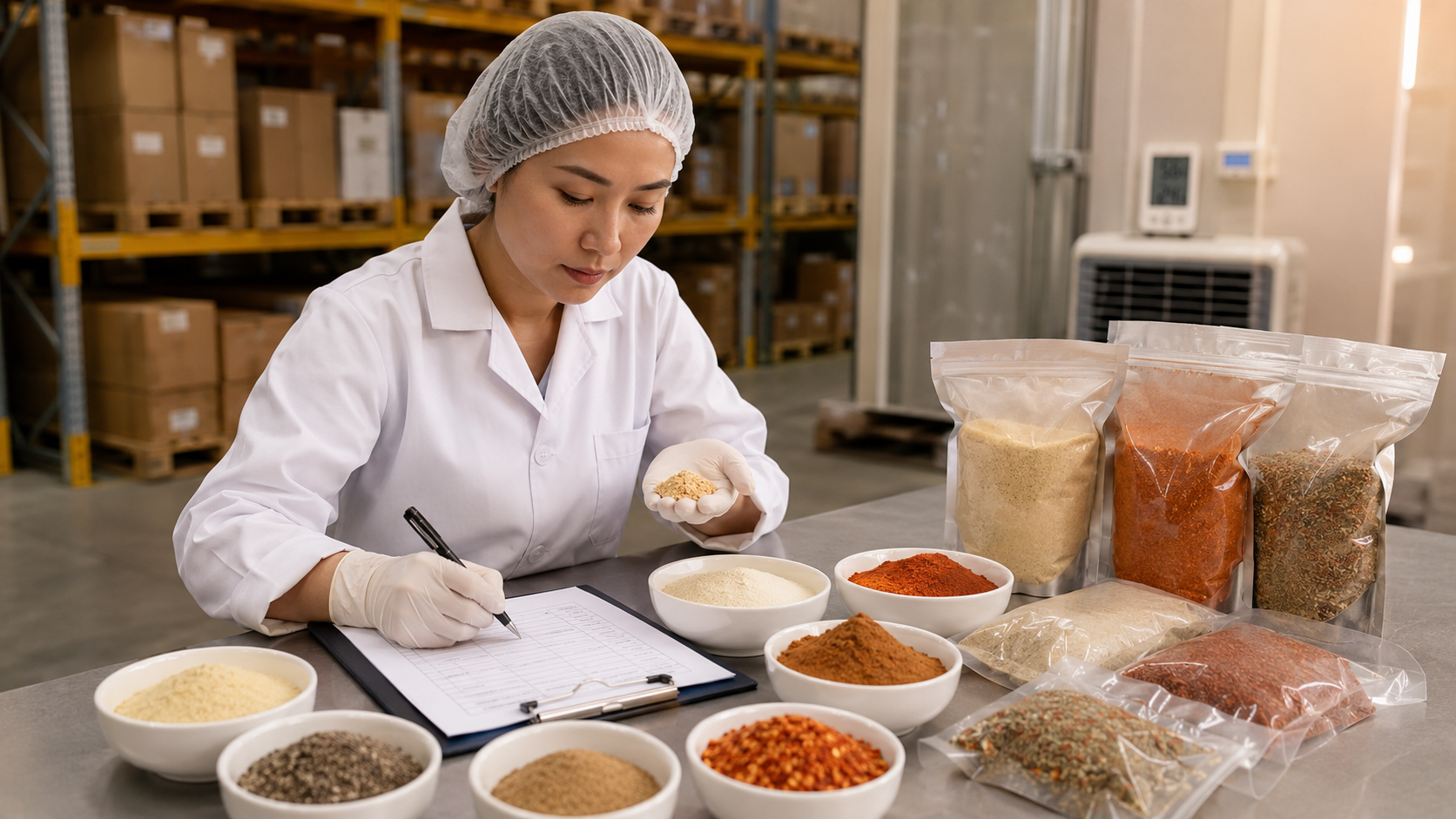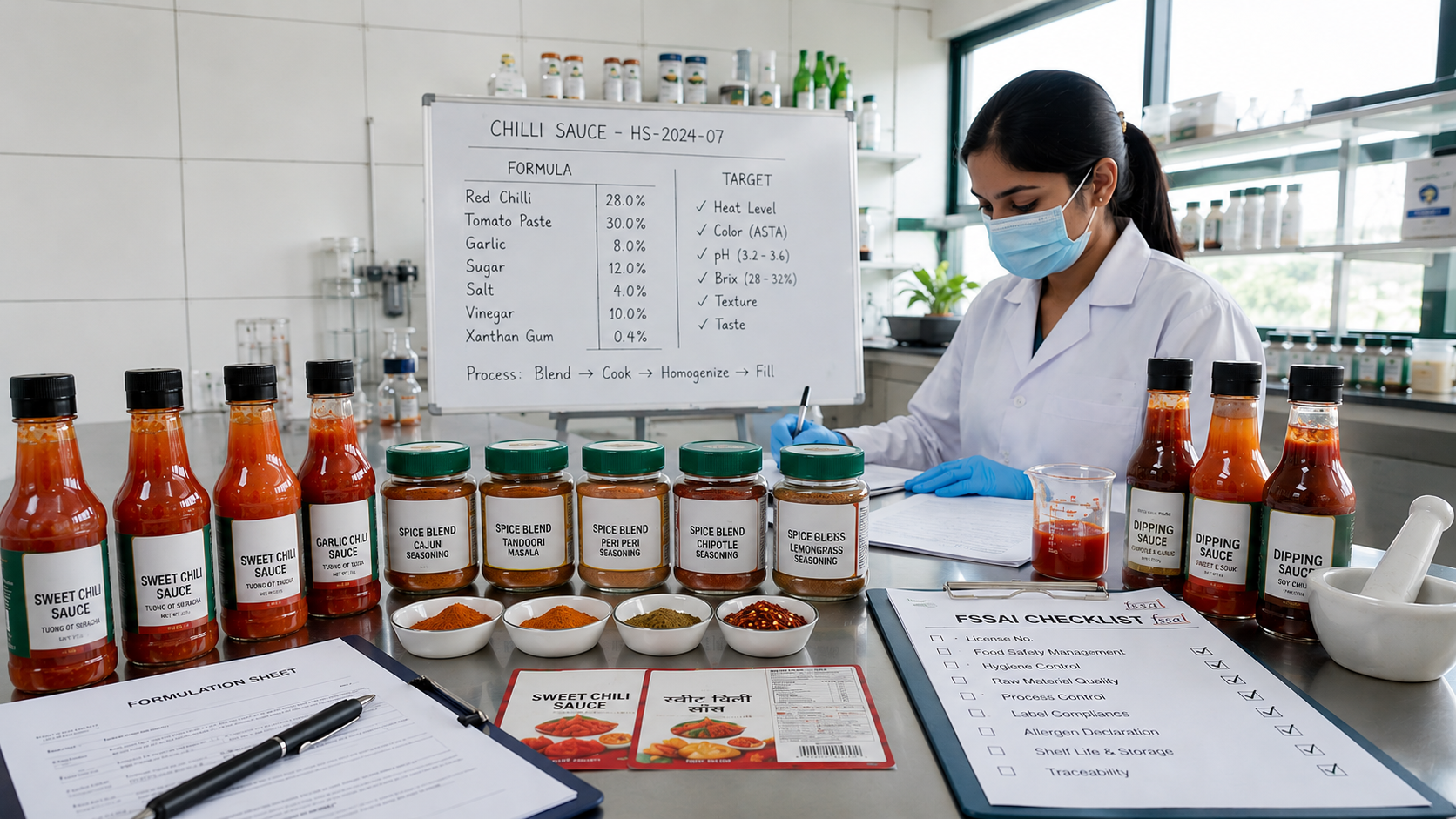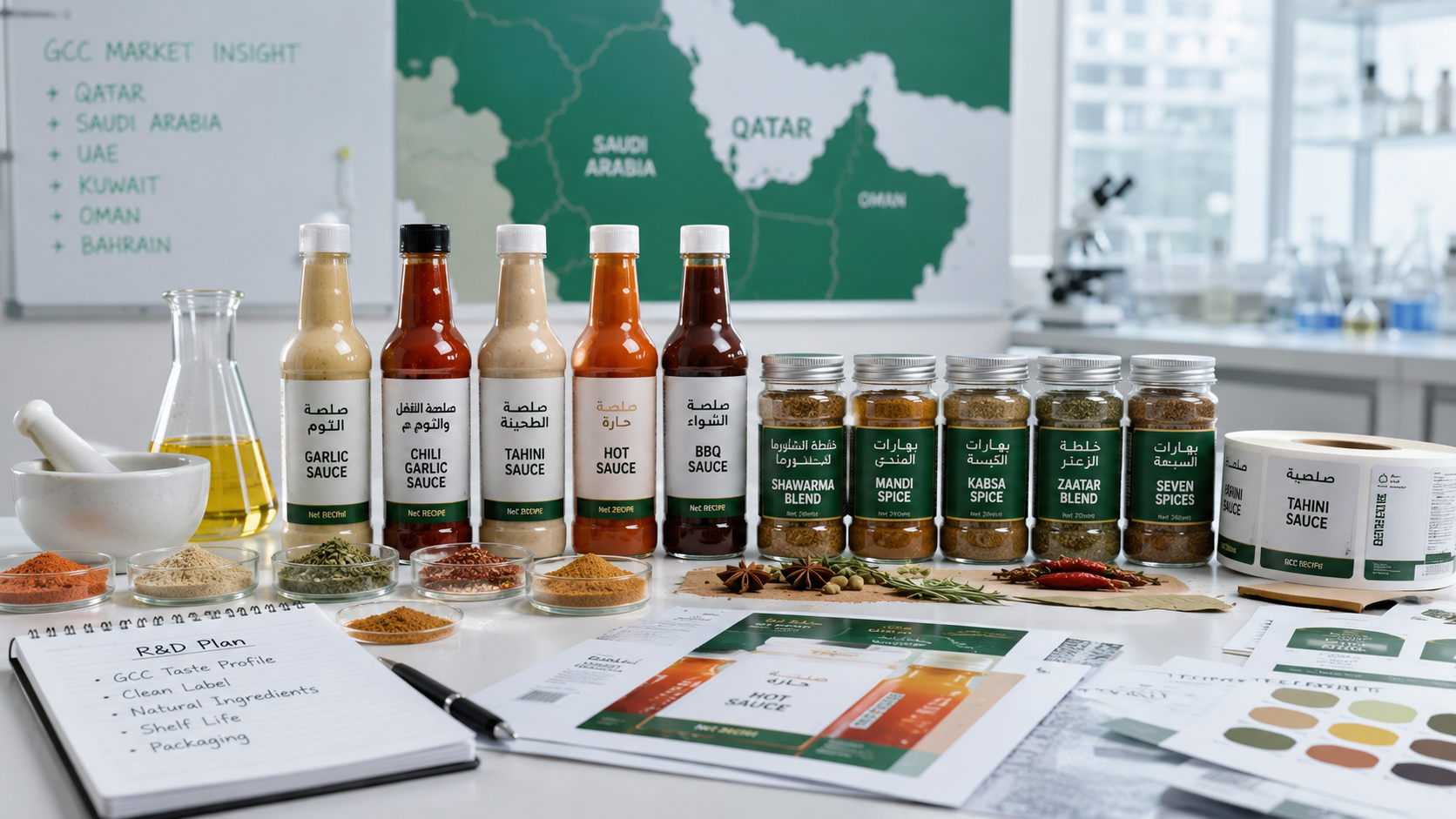


Bahrain is not the largest market in the Gulf, but it can be a practical test market for Vietnamese seasoning businesses when the product already has a clear sales channel, capable importer, Halal dossier, Arabic/English label plan, realistic MOQ, and packaging suitable for long-distance transport and hot conditions.
For seasoning, sauce, dipping sauce, dipping salt, spice powder, marinade, or private-label businesses, Bahrain deserves attention because it sits within the GCC commercial space, is close to Saudi Arabia, and has retail, restaurant, hotel, imported-food, and international-consumer channels.
This market can help a business learn how to operate in a Gulf environment before thinking about larger markets. But the point should be stated clearly: Bahrain is small, not simple. A product that tastes good in Vietnam may still face problems if the label is not right, the ingredient dossier is thin, the Halal certificate is not accepted by the importer, the MOQ is too high, or the packaging cannot handle transport and heat.
The opportunity in Bahrain is rarely about sending the entire product catalog at once. A more realistic path is to select one to three lead products, test importer feedback, choose the right channel, then expand step by step.
- Chili sauce, garlic sauce, tamarind sauce, and Asian-style spicy sauces.
- Soy sauce, plant-based dipping sauce, chili sauce, ketchup, or fully plant-based sauces.
- Grill marinades, seafood seasonings, spice blends, and seasoning mixes.
- Food-service formats for restaurants, central kitchens, and hotels.
- Private-label products for importers or distributors in Bahrain.
How should businesses understand Halal for seasoning products entering Bahrain?
For Bahrain, Halal should not be treated as a sticker on the package. Businesses need evidence from the formula, ingredient chain, production process, label, and certification. The largest risks often sit in flavorings, additives, solvents, fermented ingredients, direct-contact packaging, and cross-contamination controls.
In the seasoning industry, many ingredients appear in small percentages but strongly affect the Halal dossier. Salt, pepper, chili, sugar, garlic, and onion are usually easier to understand. The difficult part is flavoring, carriers, flavor enhancers, enzymes, fermented ingredients, food colors, preservatives, emulsifiers, stabilizers, processing aids, and food-contact packaging.
The better question is not: “Is this product Halal?” The better question is: does this product have enough documentation to prove Halal suitability when the importer, control authority, or customer asks for evidence?
| Control layer | What the business should check | Common risk |
|---|---|---|
| Formula | Ingredient list, additives, flavorings, processing aids, and the origin of each component. | Alcohol, pork derivatives, gelatin, animal enzymes, or animal-derived flavorings are discovered too late. |
| Ingredient chain | Specifications, COA, Halal certificates if available, supplier data, country of origin, and change-control commitments. | The supplier changes ingredient origin, the certificate expires, or the dossier is too unclear for review. |
| Production | Cross-contamination control, sanitation, batch codes, retained samples, production records, and traceability. | A shared line is used with higher-risk ingredients but cleaning records and evidence are weak. |
| Certification and label | Accepted certification body, Arabic/English label content, claims, and importer information. | The business prints labels or starts certification based on assumptions and must later redo the work. |
How is Bahrain different from the UAE, Saudi Arabia, and Qatar?
Do not copy a UAE, Saudi Arabia, or Qatar strategy directly into Bahrain. Bahrain is smaller, influenced by Gulf trade, suitable for a step-by-step entry model, and requires realistic MOQ planning. A smaller market does not make Halal, labeling, and documentation requirements lighter.
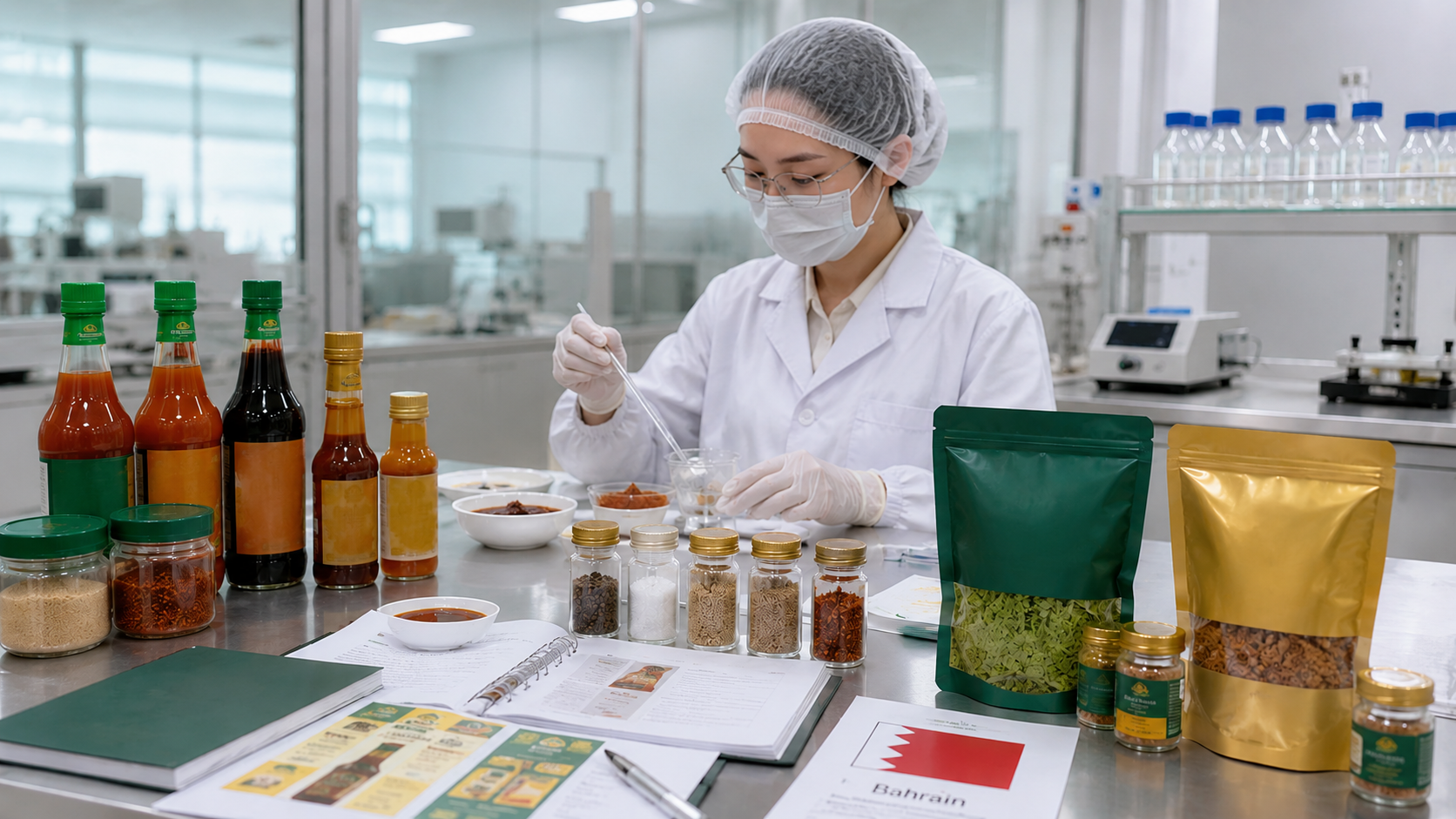
Bahrain can be viewed as a GCC test market, but it should not be seen as a shortcut. A shipment to Bahrain still needs the right product, the right dossier, and the right importing partner.
If a business wants to use Bahrain as a first step before expanding into Saudi Arabia, the UAE, Kuwait, or Qatar, it should ask early: can the current formula, label, certification, and claims be reused, or will they need to be redesigned?
A key difference is MOQ. For a smaller market, the first order should be compact enough for the importer to test, but still large enough for production to make sense. This is an R&D and pricing question, not only a sales question.
| Aspect | Bahrain | Implication for seasoning businesses |
|---|---|---|
| Market size | Smaller than some Gulf markets. | Do not export too many SKUs at the start. Prioritize one to three lead products and a realistic MOQ. |
| Sales channels | Retail, food service, hotels, restaurants, and imported-food channels. | Choose the channel before designing the formula, pack size, and packaging. |
| Label language | Arabic and English requirements need practical confirmation. | Do not mass-print packaging before the importer confirms the label. |
| Regional expansion | Can be a learning step for GCC markets. | Design dossiers and claims with future expansion in mind, but do not assume one setup works for every GCC country. |
Which products should businesses choose first for Bahrain?
The first product should not simply be the company’s favorite item. It should have lower Halal risk, be easy to explain to the importer, fit the selected channel, use stable packaging, require a manageable MOQ, and have a clear chance of reordering.
For Bahrain, the first product should answer three practical questions: is the dossier easy to prove, is the product easy to test-sell, and can it expand into a product line later? A sauce with an unusual flavor but weak flavoring documentation may be less useful than a plant-based formula with clearer ingredients and room for adjustment.
- Chili sauce and Asian dipping sauce: suitable when they can be used with grilled food, fried dishes, rice, sandwiches, snacks, seafood, or restaurant dishes.
- Dipping sauce and soy sauce: can create differentiation through an Asian flavor story, but fermented ingredients, salt level, additives, and flavorings must be controlled.
- Marinades and seasoning sauces: should be tested with food service, restaurants, hotels, or F&B chains before broad retail rollout.
- Dry seasonings and spice blends: have advantages in transport and shelf life, but should avoid direct price competition with generic blends.
- Private label: suitable when the importer wants its own label, format, price level, and a product with a clear technical dossier.
If the client has limited Halal export experience, a plant-based formula or a formula with fewer animal-origin components is often a safer starting point. This does not solve every Halal requirement, but it can reduce several risk areas in the early stage.
Which formula and packaging risks should be reviewed carefully?
Seasonings are easy to underestimate because the product may look simple. In reality, the risk often sits in small components: flavorings, umami bases, fermented ingredients, additives, stabilizers, food-contact packaging, and shared production lines.
A bottle of sauce or a seasoning pouch can contain many micro-ingredients. One unclear flavoring, carrier, solvent, or processing aid may make the whole dossier difficult to prove. Businesses should not wait until submission to check these points. At that stage, formula, label, and packaging corrections are usually more expensive.
| Risk group | Question before production | Preferred action |
|---|---|---|
| Flavorings and aroma compounds | What is the origin? Are there carriers, solvents, animal components, or complex base notes? | Request specification, COA, and Halal certificate if available. Avoid vague “flavour” descriptions. |
| Flavor enhancers and umami bases | Are yeast extract, hydrolyzed protein, nucleotides, amino acids, or enzymes used? | Check ingredient origin, fermentation process, and processing aids. |
| Fermented ingredients | Does the formula include soy sauce, vinegar, paste, fermented sauce, or yeast extract? | Do not assume suitability or non-suitability. Request data and supplier confirmation. |
| Animal-origin components | Are gelatin, collagen, animal fat, meat extract, animal enzymes, or meat flavorings present? | Prioritize suitable alternatives with clear evidence. If the ingredient cannot be proven, reformulate. |
| Direct-contact packaging | Are bottles, caps, seals, films, pouches, inks, or adhesives suitable for food contact and transport conditions? | Test leakage, separation, discoloration, odor change, cap swelling, and durability in hot storage. |
| Shared production | Is there cross-contamination risk from higher-risk ingredients on the same line? | Keep sanitation procedures, records, batch codes, retained samples, and traceability clear. |
How should businesses choose a Bahrain entry channel before certification?
Before certification or packaging print, the business needs to know which channel the product will enter. Modern retail, food service, online channels, and private label each require different pack sizes, prices, labels, dossiers, MOQs, and sample-development decisions.
Choosing the channel at the end is an expensive mistake. If a business develops a polished retail bottle but the importer wants food-service packaging, the cost and packaging plan may have to be rebuilt. If the target is private label, formula ownership, certification responsibility, sample-adjustment timelines, label artwork, and confidentiality should be agreed from the start.
| Bahrain entry channel | What to prepare | When it fits |
|---|---|---|
| Modern retail | Attractive packaging, clear label, barcode, nutrition information if applicable, shelf life, retail price, and display plan. | When the product has an easy-to-understand story, flexible usage, and a reasonable price. |
| Food service / restaurants / hotels | Larger formats, volume-based pricing, consistent quality, delivery capability, and technical dossier. | When the product is new to consumers but can be used first by chefs or central kitchens. |
| Private label | Formula ownership, packaging design, certification scope, MOQ, sample adjustment terms, and confidentiality. | When the importer wants its own label, taste direction, or price level. |
| Online | Import compliance, label, claims, food safety, and Halal evidence if a Halal claim is made. | Useful for feedback testing, but not a way to bypass regulations. |
What are the 10 preparation steps for Halal seasoning products entering Bahrain?
The Bahrain roadmap should begin with sales channel and importer confirmation, then move into product selection, formula, ingredients, R&D, production, certification, labeling, and trial shipment. Doing the work in the right order helps avoid wrong labels, wrong certification choices, or an oversized first batch.
- Define the sales channel and importer. Work early with the Bahrain importer to confirm Halal certification expectations, label requirements, import dossier, pack size, shelf life, price, and distribution route.
- Select lead products. Prioritize compact, easy-to-understand products with test potential, reasonable MOQ, and reorder possibility.
- Create a detailed formula table. Each ingredient should include commercial name, technical name, item code, supplier, origin, function, Halal status, specification, COA, and risk notes.
- Classify ingredient risk. Separate ingredients into low-, medium-, and high-risk groups so issues are handled before dossier submission.
- Work with suppliers again. Request specifications, COA, Halal certificates if available, origin commitments, and notification when ingredients change.
- Reformulate when needed. If a component is unsuitable or cannot be proven, replace it with a better-documented ingredient instead of protecting it at all costs.
- Control production and cross-contamination. Review receiving, storage, weighing, mixing, heating, filling, packing, batch coding, retained samples, and sanitation.
- Select the right certification body. Confirm with the Bahrain importer about certification body, scope, and acceptance conditions before starting.
- Prepare Arabic/English labels. Labels should include product name, ingredients, additives, allergens if any, net weight, origin, manufacturer, production date, expiry date, storage, nutrition information if applicable, batch code, barcode, and evidence-backed claims.
- Run trial production and monitor the first shipment. Treat the first shipment as a commercial test: track taste feedback, packaging performance, price acceptance, complaints, stock rotation, storage, and reorder potential.
Which dossier should be prepared before working with a Bahrain importer?
A strong dossier helps the business negotiate more professionally and reduces risk when the goods travel far. The dossier does not serve certification only. It also supports B2B selling because the importer needs to understand the product, factory, ingredients, packaging, label, and commercial terms.
| Dossier group | What should be included |
|---|---|
| Product dossier | Vietnamese/English product name, proposed Bahrain name, product description, formula, production process, quality criteria, test records if available, expected shelf life, storage conditions, product images, and packaging format. |
| Ingredient dossier | Ingredient list, specifications, COA if available, Halal certificates if available, plant/animal/microbial/synthetic origin, additives, processing aids, supplier commitments, and replacement options for key ingredients. |
| Factory and process dossier | Factory layout, production flow, sanitation procedures, cross-contamination control, batch control, retained samples, deviation handling, complaints, recall procedures, personnel training, water control, pest control, hygiene, and maintenance. |
| Packaging and label dossier | Label artwork, Arabic/English version, nutrition information if applicable, claims and claim evidence, food-contact packaging specifications, barcode, carton images, batch code, expiry marking, and pallet information if needed. |
| Commercial dossier | Importer, sales channel, target price, MOQ, delivery terms, volume plan, reorder plan, market-test strategy, and possible expansion to Saudi Arabia, the UAE, or other GCC markets if suitable. |
What mistakes do Vietnamese seasoning businesses often make when entering Bahrain?
The biggest mistake is treating Bahrain as too simple because it is small. Other common mistakes involve unconfirmed Halal certificates, unclear formulas, oversized MOQ, weak packaging for hot conditions, excessive claims, and no early thinking about possible GCC expansion.
- Assuming Bahrain is small, so requirements must be simple. A smaller market does not mean a lighter dossier.
- Using a Halal certificate before the importer confirms acceptance.
- Writing generic “flavoring,” “additive,” or “flavor enhancer” descriptions without clear records.
- Setting an MOQ too large for the importer’s market-testing ability.
- Using packaging that cannot withstand transport, heat, or real storage conditions.
- Using claims such as “100% natural,” “healthy,” “organic,” “Halal certified,” “no preservative,” “vegan,” or “sugar-free” without evidence.
- Failing to consider GCC expansion, causing labels, certifications, or packaging to be redesigned later.
For the first product, the business should accept a smaller but clearer start. A manageable trial shipment, a clean dossier, an importer-confirmed label, and real product feedback are more valuable than a large shipment without a solid foundation.
Where can Hoa Sen Foods support businesses in the Bahrain Halal journey?
Hoa Sen Foods can support the foundation stage: product idea consulting, formulation R&D, sample testing, taste optimization, pack-size planning, packaging, cost optimization, production control, packing, and technical-information preparation. Hoa Sen Foods is not a Halal certification body.
As a production and R&D back-end partner for seasoning and food brands, Hoa Sen Foods is suitable for clients who need to turn an idea into a product that can be produced, controlled, and presented to an importer or certification partner.
- Consulting product ideas based on the Bahrain market and intended sales channel.
- Developing formulas for seasonings, dipping sauces, sauces, pastes, dipping salts, or packaged food products.
- Testing samples, adjusting taste, and optimizing based on importer or target-user feedback.
- Optimizing pack size, packaging, and production cost according to a suitable MOQ.
- Reviewing basic ingredient risks before the certification process.
- Controlling production, packing, retained samples, and batch codes.
- Preparing technical information for clients to work with importers, testing partners, or suitable certification bodies.
- Protecting client formulas, volumes, and business information.
One point should be clear: Hoa Sen Foods does not replace a Halal certification body. For official Bahrain requirements, businesses should confirm with the importer, a competent certification body, and an export-consulting partner. But a product that wants a smoother certification process should begin with a clear formula, clear ingredients, controlled production, and a proper dossier.
What are the 5 control layers before shipping seasonings to Bahrain?
Before export, the business should review the product across five layers: formula, ingredient dossier, production, label and packaging, and commercial readiness. If one layer is still weak, it should be corrected first. The first shipment should not become the first time the business discovers a basic error.
| Control layer | Question to answer |
|---|---|
| 1. Formula | What is inside the product? Are there Halal-risk ingredients? Can they be replaced with clearer alternatives? |
| 2. Ingredient dossier | Does every ingredient have a specification, COA, Halal certificate if needed, supplier data, and clear origin? |
| 3. Production | Does the process control cross-contamination, sanitation, batch codes, retained samples, packing, and traceability? |
| 4. Label and packaging | Does the product have Arabic/English labeling, ingredients, nutrition information, expiry date, batch number, storage conditions, allergen warnings, and suitable claims? |
| 5. Commercial readiness | Are the sales channel, price level, pack size, importer, MOQ, and market-test plan clear? |
Bahrain is a market worth testing, but it should be tested through preparation. For seasoning, dipping sauce, sauce, or private-label products, the deciding factor is not only good taste. The business needs a clear formula, clear Halal logic, clear labeling, clear quality control, and clear commercial planning before the first shipment.
Hoa Sen Foods is ready to work with clients from product ideation, recipe R&D, sample testing, pack-size optimization, contract manufacturing, packaging, and technical-information preparation, so clients can work with importers or suitable certification partners more confidently.
Visit hoasenfoods.vn or contact Hoa Sen Foods to discuss your seasoning and food-product development needs for the Bahrain market.
Download the in-depth Halal guide for the Bahrain market
FAQ
Should a business obtain Halal certification before finding a Bahrain importer?
It should not proceed based on assumptions. The business can prepare the foundation dossier first, but it should confirm the certification body, certification scope, and label requirements with the Bahrain importer before official implementation.
Is a plant-based seasoning product automatically Halal-suitable?
No. A plant-based formula can reduce risk, but it does not automatically prove Halal suitability. The business still needs to check flavorings, additives, solvents, fermented ingredients, shared production processes, and supplier documentation.
Is Bahrain suitable for testing private-label seasoning products?
It can be suitable when an importer or distributor has a clear need. Private label requires early agreement on formula direction, label ownership, MOQ, packaging, certification responsibility, and confidentiality.
Which label languages should be prepared for Bahrain?
The source article emphasizes Arabic and English labeling. Businesses should confirm mandatory content, expiry-date format, claims, and importer information with the Bahrain partner before printing packaging.
Does Hoa Sen Foods issue Halal certification?
No. Hoa Sen Foods is not a Halal certification body. Hoa Sen Foods can support R&D, formula development, production, packaging, and technical information so clients can work with importers, testing partners, or suitable certification bodies.
Author
| Author | Hoa Sen Foods Content Team [to be added] |
| Expertise | Seasoning and food contract manufacturing, recipe R&D, sample development, production, packaging, and private-label support. |