

Standing at the massive Jebel Ali Port in Dubai last year, a distributor opened the heavy steel doors of a 20-foot shipping container. He was expecting perfectly blended, premium dry rubs ready for the retail shelf. Instead, he found an absolute disaster. Because the manufacturer hadn’t properly dried the garlic powder, the entire shipment had turned into solid, unusable bricks of seasoning during the long ocean transit from Asia.
From what we’ve seen, this specific logistical nightmare destroys growing food brands every single week.
They spend thousands of dollars perfecting their unique flavor profiles, securing strict religious certifications, and designing beautiful retail packaging. But here’s the thing. If your product cannot survive the brutal physical realities of global shipping, your beautiful recipe is entirely worthless. Shipping food across the ocean isn’t just a basic logistics problem; it’s a highly complex chemistry challenge.
When you export food products from the humid tropics of Southeast Asia to the scorching deserts of the Middle East, calculating the true shelf life halal seasoning requires is an absolute matter of business survival. Don’t just slap a “Best By” date on a plastic jar and blindly cross your fingers.
To be fair, this isn’t always the case if you’re only selling to a local farmer’s market down the street where the climate is stable. However, the moment your product goes into a dark, unventilated shipping container for a 30-day ocean voyage, the chemical rules change completely.
If you want to build a highly secure, profitable export business, you must master the precise science behind the food preservation export spices require. Read this thorough technical guide carefully today. We’ll break down exactly how heat, moisture, and oxygen destroy your products over time. More importantly, we’ll show you how to use advanced, 100% natural food science to protect your valuable cargo flawlessly, ensuring the shelf life halal seasoning products need is always met.
1. The Core Variables Impacting Shelf Life Halal Seasoning Products
Analyze the specific environmental enemies your product will face directly during transit. Before we can extend the lifespan of a product, we must understand exactly what kills it chemically.
When evaluating the shelf life halal seasoning products possess internationally, four specific physical variables dictate the rapid degradation of your flavor, color, and microbial safety. Mastering the specific food preservation export spices demand means controlling all four simultaneously.
The Silent Killer: Water Activity (Aw)
Look closely at your moisture levels, but understand the deep science behind it. Most amateur manufacturers only measure “Total Moisture Content” during their factory audits. However, professional food scientists strictly measure Water Activity (Aw) to determine the true shelf life halal seasoning timelines.
Water Activity accurately measures the “free” or unbound water available inside the physical spice. This is the specific moisture that dangerous bacteria, yeast, and mold actively use to grow and multiply rapidly. If your spice blend has an Aw level above 0.60, it’s highly susceptible to rapid mold growth. When dealing with the food preservation export spices require, keeping the Aw level incredibly low (usually between 0.20 and 0.40) is the absolute most critical step in preventing spoilage without using harsh chemical preservatives.
Temperature Fluctuations and “Container Sweat”
Consider the brutal logistics journey from Vietnam to the Gulf Cooperation Council (GCC) carefully. A standard shipping container leaving the busy port of Ho Chi Minh City travels across the Indian Ocean for roughly 20 to 30 days.
During the day, the heavy steel container bakes under the intense tropical sun, pushing internal temperatures well above 60°C (140°F). At night, the temperature drops rapidly over the cool, open ocean. Because of these massive, daily temperature swings, the trapped air inside the container hits the dew point constantly.
This dramatic shift causes heavy condensation to form on the metal ceiling and literally rain down on your cardboard boxes. This physical phenomenon, widely known as “Container Sweat,” will instantly ruin any dry powder if the packaging isn’t perfectly sealed. Proper food preservation export spices need must account for this intense localized “rain.”
Oxygen and Rapid Lipid Oxidation
Understand exactly how ambient air destroys flavor completely. Many premium culinary spices, like rich cumin, nutmeg, and black pepper, contain high levels of delicate volatile essential oils.
When these highly valuable oils are exposed heavily to oxygen over several months, they undergo rapid lipid oxidation. This destructive chemical reaction turns the healthy fats rancid, completely destroying the vibrant, fresh aroma of the spice and replacing it with a stale, cardboard-like smell. Protecting your raw ingredients against oxygen is a fundamental rule that food preservation export spices demand for long-term viability. Without it, the shelf life halal seasoning brands promise is completely fake.
UV Light Degradation
Protect your beautiful natural colors fiercely. If you pack a bright red Tandoori seasoning in a completely clear glass jar, it looks beautiful on day one on the factory floor.
However, constant exposure to harsh supermarket fluorescent lighting or natural UV rays breaks down the natural plant pigments (like capsanthin in paprika or curcumin in turmeric) very quickly. Within three short months, that vibrant red turns into a dull, unappetizing brown. Determining the true shelf life halal seasoning products possess means strictly accounting for visual color stability, not just microbial safety.
2. Mastering Food Preservation Export Spices Naturally
Solve these massive chemical and logistical challenges without ever resorting to toxic additives or illegal chemicals.
In the modern global food industry, educated consumers aggressively demand “Clean Labels” from their favorite brands. They completely reject food products filled with synthetic chemical preservatives like Sodium Benzoate or artificial anti-caking agents like Calcium Silicate. So, how exactly do you guarantee a 24-month shelf life halal seasoning product without using cheap chemicals?
You must intelligently use advanced mechanical and physical preservation techniques.
Precision Dehydration Techniques
Start with the raw material directly on the farm. If you put wet ingredients into a sealed jar, the product will inevitably rot.
To achieve world-class food preservation export spices safely, you must dry the raw ingredients perfectly before blending them. We use advanced, low-heat continuous dehydration ovens in our facility. By drying fresh garlic, onion, and fiery chili at highly controlled, low temperatures over a longer period, we safely draw out the free moisture (lowering the Aw) without accidentally cooking or burning the delicate essential oils. This perfect dehydration is the secret to a long shelf life halal seasoning product.
High-Barrier Packaging Materials
Block the outside environment entirely using modern materials. Because you can’t control the intense heat and humidity inside a shipping container, your primary defense is your physical packaging material.
Never use cheap, single-layer Polyethylene (PE) bags for international export runs. They’re highly porous to oxygen and external moisture. Instead, use multi-layered, high-barrier laminates. A standard export pouch should consist of a tough PET outer layer, a middle layer of pure Aluminum foil (to block 100% of moisture, oxygen, and UV light), and a food-grade LLDPE inner sealing layer.
This specific, highly engineered material combination guarantees the exact shelf life halal seasoning products need to sit safely on a supermarket shelf in Riyadh for two solid years. It perfectly executes the mechanical food preservation export spices require.
Vacuum Sealing and Nitrogen Flushing
Put in place modified atmosphere packaging (MAP) to stop dangerous oxidation instantly.
If you leave normal, ambient air inside the spice pouch, the 21% oxygen content will slowly degrade the product over time. For premium blends, professional factories use a brilliant technique called Nitrogen Flushing. Right before the pouch is heat-sealed securely on the machine, a nozzle injects pure, food-grade Nitrogen gas into the bag, pushing all the oxygen out forcefully.
Because Nitrogen is a completely safe, inert gas, it doesn’t react with the food at all. It prevents oxidation perfectly, keeps the volatile oils fresh, and prevents aerobic bacteria from surviving. This specific technique is the absolute gold standard for clean-label food preservation export spices, explicitly maximizing the shelf life halal seasoning profiles.
3. The Hoa Sen Foods Approach to Shelf Life Halal Seasoning
Understand clearly that extending shelf life isn’t a single step glued onto the end of the production line. It’s a highly rigorous, scientific discipline embedded directly into every single stage of the manufacturing process.
At Hoa Sen Foods, we view our highly specific corporate role as your dedicated Caregiver on the loud factory floor. We don’t just blindly mix powders together. We actively engineer your custom recipes to survive the harshest logistical conditions on the planet safely.
When we calculate the exact shelf life halal seasoning products have, we back it up strictly with hard laboratory data and verified food preservation export spices protocols.
Strict Moisture Control During Blending
Control the internal environment completely during the mixing phase. Our blending facilities operate under strict, climate-controlled conditions 24/7.
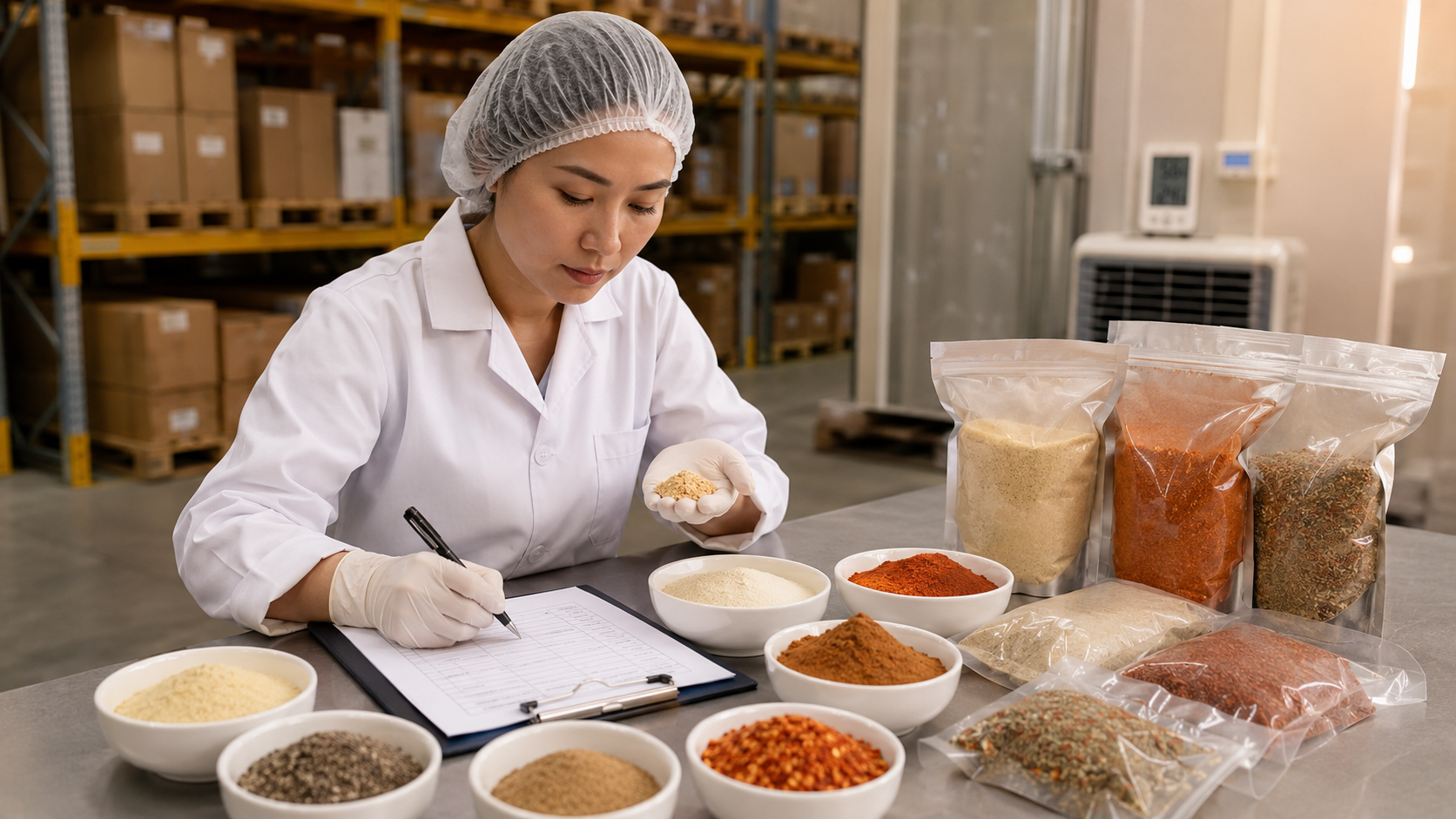
Before any raw material enters our massive industrial ribbon blenders, our Quality Control (QC) team tests it specifically for Water Activity using highly sensitive digital Aw meters. If a batch of raw ginger powder shows a moisture level that is even slightly too high, it’s immediately rejected or sent back for further, intense dehydration.
Because we tightly control the humidity in the blending room, the dry spices don’t actively absorb moisture from the air while they’re being mixed. This meticulous attention to detail forms the absolute bedrock that proper food preservation export spices require to guarantee the shelf life halal seasoning buyers expect.
Advanced Moisture-Proof Retail Packaging
Help your brand succeed flawlessly on the retail shelf by sealing the jars perfectly.
If you choose to use rigid plastic jars instead of foil pouches, we ensure they’re fitted specifically with Induction Heat Seals (IHS). After the jar is physically filled and capped, it passes under an electromagnetic field that melts a foil liner securely across the top opening of the jar. This creates an airtight, hermetic seal that prevents any Gulf humidity from sneaking into the jar during the long ocean transit.
If you want to dive deeper into the strategic commercial choices between pouches, glass, and plastic.
Accelerated Shelf Life Testing (ASLT)
Prove the exact expiration date scientifically before you ever launch the product. You can’t just guess that a product will last two years; you must prove it mathematically to the strict health inspectors.
However, you don’t have two years to sit around and wait before launching your brand. Therefore, we use Accelerated Shelf Life Testing (ASLT). We place your packaged spice blend inside a highly controlled laboratory incubator. By raising the temperature and humidity significantly (usually to 40°C and 75% Relative Humidity), we artificially speed up the chemical degradation process safely.
Because chemical reactions roughly double in speed for every 10°C increase (following the Arrhenius equation), we can accurately simulate a two-year shelf life halal seasoning timeline in just a few short months. This hard data proves our food preservation export spices methods work, allowing you to print a 24-month expiration date on your packaging with absolute, unwavering legal confidence.
4. Why Food Preservation Export Spices Need Halal Compliance
Recognize the deep, unbreakable connection between physical food safety and religious compliance in the Middle East.
When you export to the GCC, you absolutely must maintain strict Halal certification. But here’s the thing. Halal isn’t just about avoiding pork or alcohol. The deep Islamic concept of Toyyib explicitly requires that food be wholesome, pure, and physically safe for human consumption at all times.
If your manufacturer uses improper food preservation export spices techniques—like skipping steam sterilization to save a few dollars—and the food develops toxic mold during transit, it’s no longer considered Toyyib. Therefore, it completely loses its Halal integrity, even if the base ingredients were originally permissible. Maintaining the shelf life halal seasoning standard is a religious obligation, not just a business metric.
The Prohibition of Harmful Chemicals
Avoid toxic chemical shortcuts at all costs. Some shady, unregulated factories try to artificially extend the shelf life halal seasoning products have by secretly dusting the spices with Ethylene Oxide (ETO) gas to kill surface bacteria.
ETO is a highly toxic, carcinogenic chemical strictly banned in Europe and heavily restricted across the GCC. If customs officials detect even trace amounts of ETO or illegal synthetic preservatives in your shipment, it will be destroyed immediately at the port. In our experience, trying to cheat the food preservation export spices system always results in catastrophic financial losses for the brand owner.
At Hoa Sen Foods, we achieve total bacterial safety through high-pressure, continuous Steam Sterilization. We use pure, clean steam to kill dangerous pathogens instantly without ever leaving any toxic chemical residue behind. It’s safe, entirely natural, and 100% Halal compliant, securing the long shelf life halal seasoning brands need.
Conclusion: Export with Absolute Confidence
Let’s review the harsh, undeniable logistical realities of the international food trade clearly.
The physical journey from a factory in Vietnam to a supermarket shelf in Saudi Arabia is incredibly brutal. Your products will face extreme heat, intense moisture, rocking ships, and months of waiting in hot warehouses. If you don’t engineer your product explicitly for this journey using proper food preservation export spices science, you’ll fail.
Guaranteeing a long, stable shelf life halal seasoning is never a lucky accident. It’s the direct, intentional result of brilliant food science, meticulous raw material dehydration, advanced high-barrier packaging, and relentless quality control.
When you master the strict art of food preservation export spices require, you unlock a massive competitive advantage over amateur brands. You drastically reduce costly product recalls, you eliminate food waste entirely, and you ensure that the consumer sitting at a table in Riyadh experiences the exact same vibrant, explosive flavor you originally created in the test kitchen. Achieving a perfect shelf life halal seasoning profile protects your culinary legacy.
Stop crossing your fingers and hoping your shipping containers magically survive the journey. Take absolute, calculated control of your product’s chemical stability today.
Hoa Sen Foods is entirely ready to be your highly secure bệ phóng (launchpad). We fiercely possess the deep food science expertise, the advanced packaging technology, and the strict operational integrity required to protect your brand globally. We handle the intense physical science on the factory floor so you can focus entirely on growing your culinary empire safely.
Ready to ensure your products survive the ocean transit flawlessly?
Frequently Asked Questions (FAQ)
1. What is the standard shelf life halal seasoning products should typically have?
For dry, powdered spice blends packed in high-barrier materials (like foil pouches or sealed glass jars), a standard, legally defensible shelf life halal seasoning profile is usually 18 to 24 months. Wet sauces and marinades typically range from 12 to 18 months depending heavily on their specific pH and acidity levels.
2. How exactly does Nitrogen Flushing help in food preservation export spices?
Nitrogen flushing actively removes ambient oxygen from the packaging right before it’s sealed. Because oxygen causes the natural fats and volatile essential oils in spices to go rancid and lose flavor rapidly, replacing it with an inert gas like Nitrogen completely halts oxidation. This specific food preservation export spices method massively extends the product’s freshness naturally.
3. Does Hoa Sen Foods use chemical preservatives to achieve a 24-month shelf life?
Absolutely not. We firmly believe in clean-label manufacturing. We completely avoid harsh chemical preservatives. Instead, we achieve a long shelf life halal seasoning naturally by strictly controlling Water Activity (Aw), using advanced steam sterilization to kill bacteria, and putting in place high-barrier, moisture-proof packaging.
4. Why did my previous spice shipment clump together and turn hard during ocean transit?
This disaster happens constantly when amateur factories fail to dry the raw ingredients properly (leaving the moisture content too high) or when they use cheap, highly porous packaging. When the shipping container experiences extreme temperature swings, moisture permeates the cheap bag, turning powders into solid bricks. Proper food preservation export spices science prevents this entirely.
5. How do you actually prove the shelf life halal seasoning products have before launching?
We use a highly accurate scientific process called Accelerated Shelf Life Testing (ASLT). By placing the final, packaged product inside specialized laboratory incubators set to high heat and humidity, we can accurately simulate two years of real-world degradation in just a few short months, giving you hard data to support your expiration dates safely.