

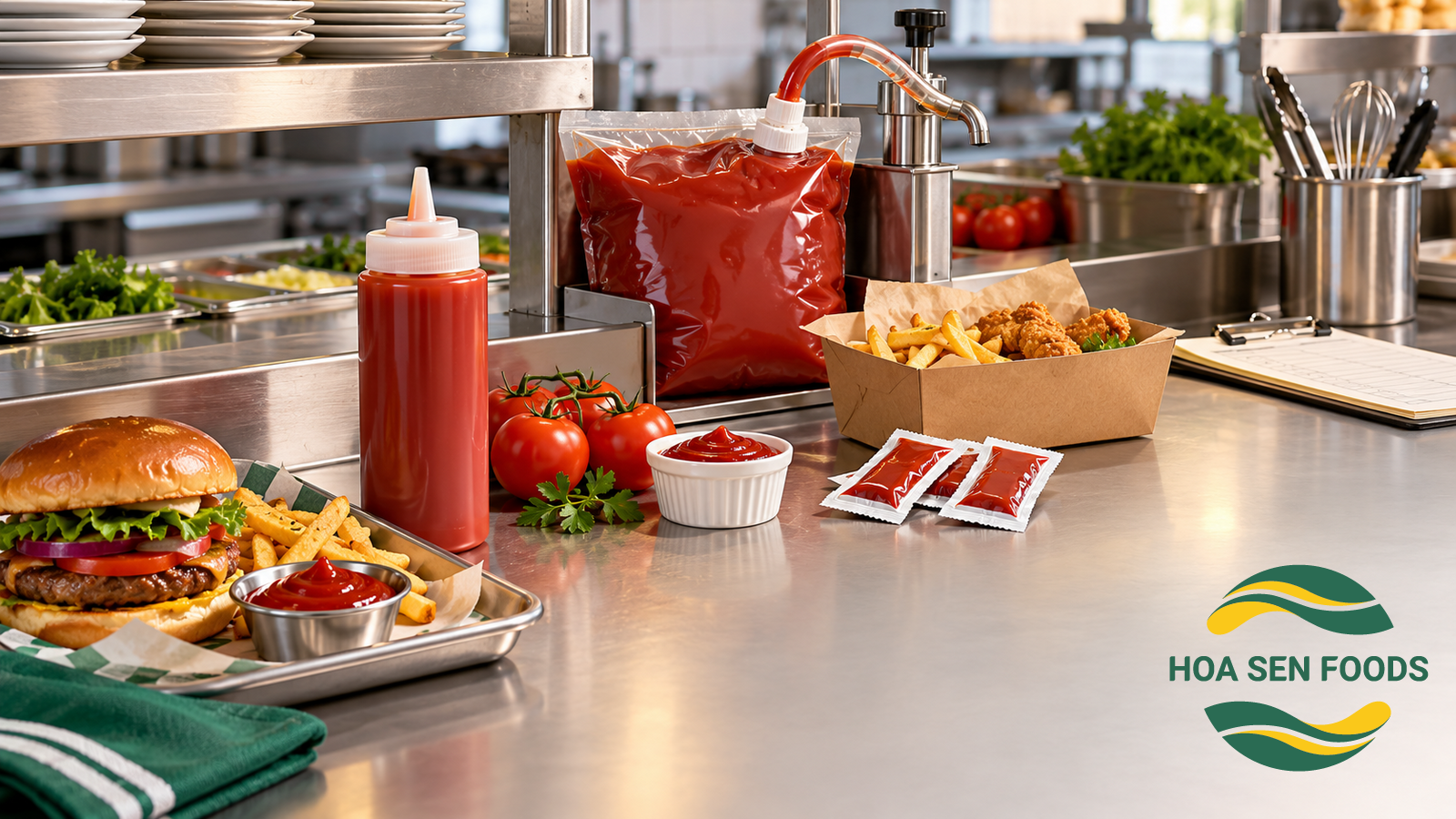
Quick answer: The easiest ketchup format to operate is the one that matches the point of use and operating rhythm. Squeeze bottles may suit tables or refill stations; pouches or larger containers need the right dispensing equipment and hygiene procedures; single-serve sachets are suitable for takeaway meals. Do not decide on pack size before measuring usage frequency, waste, post-opening conditions and replenishment capacity.
In foodservice, a “larger format” does not automatically mean “better operations”. Packaging with a lower cost per kilogram may require more decanting, be harder to clean, take up more space or leave more product after opening—raising the total cost of service. Conversely, single-serve sachets support portion control but increase the number of units to store and the amount of packaging to manage.
The right question is therefore not whether to choose a bottle, pouch or sachet based on intuition. Businesses need to design a packaging-format system around usage frequency, dispensing points, staff actions, hygiene, inventory and customer experience.
What makes a foodservice format easy to operate?
An easy-to-operate format helps staff dispense the right amount quickly, cleanly and consistently across shifts or locations. It must also fit storage space, receiving procedures, post-opening storage conditions and the business’s traceability system.
Before developing samples, agree on at least six indicators to track during a real-world trial:
- Handling time per serving or per dispenser refill.
- Average ketchup usage and the variation between staff members or shifts.
- Product left in the package and product discarded at the end of a shift or approved use period.
- Leaks, splashes, spills or service interruptions caused by an empty pack.
- Time required for cleaning, packaging replacement, labelling and post-opening storage.
- Ability to identify lots, count stock and replenish product at the point of use.
Do not set the same acceptance threshold for every operating model. Central kitchens, table-service restaurants, quick-service counters and delivery orders have different workflows.
Four packaging groups to include in the shortlist
| Format group | Situation to assess | Operational advantage | What must be verified |
|---|---|---|---|
| Squeeze bottle for tables or counters | Restaurants, self-service counters and dishes using ketchup repeatedly | Familiar handling and easy visual monitoring of the remaining level | Amount dispensed per squeeze, cap design, surface hygiene, bottle replacement and post-opening conditions |
| Large bottle or container for the kitchen | Preparation, sauce mixing and kitchens with relatively stable usage | Fewer package openings and a good fit for a concentrated point of use | Pouring method, handling weight, dispensing tools, remaining product and storage space |
| Closed pouch connected to a dispensing system | Chains that need repeated handling and portion control | May support fast replacement and reduce exposure when the system is designed correctly | Pouch–nozzle–pump compatibility, viscosity, installation and removal, equipment cleaning and machine performance |
| Single-serve sachet | Delivery, meal sets, events and orders requiring portioned servings | Portioning by unit and convenient distribution with the order | Easy opening, seal integrity, label area, inventory volume, secondary packaging and packaging obligations |
Hoa Sen Foods’ website currently lists examples of ketchup in bottles, larger formats and small sachets. These examples are a starting point for discussion, not a commitment that every material, size, nozzle, piece of equipment or minimum order quantity is available for every project. Feasibility must be confirmed for the specific formula, packaging, production line and market.
Seven questions for choosing a format based on operations
1. How much does each point of use consume per shift?
Do not rely only on total monthly volume. Break the data down by outlet, shift, weekday versus weekend and dispensing point. This helps identify which format can be used within the appropriate period, which format requires too many openings and which leaves a significant amount of product unused.
2. Where is the ketchup dispensed?
Tables, self-service counters, kitchen lines, packing areas and central kitchens have different requirements for speed, space, cleanliness and access. A bottle that works on a dining table may not work for repeated dispensing during a peak service period.
3. How much is needed per use?
The target portion must be evaluated together with viscosity and the dispensing mechanism. If portion control matters, test the target formula directly at the actual serving temperature. Do not infer the result from water or another sauce.
4. Who handles it, and how often?
Kitchen staff may be trained to use dispensing equipment; table customers need intuitive handling; packing staff need speed and quick visual checks. An easy-to-operate format should reduce dependence on individual skill and come with clear instructions.
5. How is the package handled after opening?
Confirm storage conditions, opening-time records, contact utensils, cleaning cycles and the approved use period after opening based on the product documentation. Do not assign one universal post-opening period to every formula or package.
6. How does the receiving and storage system work?
Calculate by carton, shelf and outlet: the weight staff can lift, units per carton, stacking capacity, lot codes, the location for opened product and replenishment during peak hours. GS1 notes that changes to net content or the number of units in a case may affect GTIN identification decisions in the supply chain.
7. What does the total cost of service include?
In addition to purchase price, include handling time, dispensing equipment, cleaning, secondary packaging, waste, damaged goods, storage space and the cost of interruptions. Comparing the cost per dish or serving is more useful than comparing packaging unit prices alone.
Suggested matrix by foodservice model
| Model | Format to test first | Operational reason | Risk to monitor |
|---|---|---|---|
| Table-service restaurant | Table squeeze bottle or an appropriately sized kitchen bottle | Customers dispense directly or staff dispense repeatedly | Surface hygiene, bottle replacement, inconsistent portions and post-opening waste |
| QSR or fast-food counter | Portion-controlled dispensing system or small sachets, depending on dine-in and takeaway channels | Requires speed and repeatability during peak hours | Blocked nozzles, incorrect portions, pouch replacement time and missing sachets in orders |
| Central kitchen or multi-outlet chain | Large format or a closed system after compatibility testing | Receiving is concentrated and procedures can be standardised | Lot traceability, decanting, internal transport and management of opened product |
| Food delivery or meal sets | Single-serve sachet or a sauce cup approved for the system | Easy portioning by order | Leaks, missing sachets, opening experience, allergen information and packaging waste |
This matrix is only a screening tool. Businesses still need to run a trial at the point of sale because usage frequency, dishes, temperature, viscosity, equipment and shift discipline directly affect the outcome.
Viscosity and dispensing method must be tested together
Foodservice ketchup cannot be assessed only by tasting a sample in a cup. Viscosity must match the dish and dispensing method: squeezing, pouring, pumping or tearing open a sachet. A sauce that is too difficult to dispense may slow operations and increase residual waste; a sauce that flows too quickly may cause portion errors and reduce presentation control.
When testing samples, lock the conditions: product temperature, equipment, nozzle type, number of dispensing actions, operator and time since the package was opened. These conditions make feedback more useful than comments such as “the sauce feels too thick” or “the nozzle is inconvenient”.
Hygiene and post-opening control are part of format design
Codex CXC 1-1969 addresses the prevention of contamination, cleaning, storage and operating controls within good hygiene practices. For foodservice, this means that packaging and dispensing equipment must be supported by a procedure: who replaces it, who cleans it, which cleaning agent is used, where it is stored and how cross-contamination is prevented.
The FDA Food Code 2022 is a model guide for retail and foodservice operations in the United States; it is not automatically a federal law applicable everywhere. Exporters and chain operators should check the version adopted by the competent authority in the relevant jurisdiction rather than treating this document as the only applicable requirement.
When selling in the European Union, allergen information for non-prepacked food is addressed by Article 44 of Regulation (EU) No 1169/2011 and national measures. Brand owners, importers and foodservice operators should define how information is transferred from the formula to staff and consumers.
Six-step pilot process before approval
- Establish a baseline: record the current format, usage, waste, handling time and incidents.
- Select two or three options: keep the formula stable to compare formats, or clearly record if the formula also changes.
- Provide short training: teach the same handling method, opening-date marking and cleaning procedure.
- Run the trial during normal and peak periods: observe the full operating context instead of testing only in a meeting room.
- Measure the same indicators: speed, usage, residual product, leaks, cleaning, stockouts and staff feedback.
- Define approval conditions: confirm the formula, packaging, equipment, case, instructions and operating procedure as one system.
Keep an approved reference sample and pilot record for comparison with commercial batches. All quantitative criteria, sample sizes and acceptance thresholds should be approved by the R&D, QA and operations teams according to the project’s risk profile.
A 10-point brief to send to Hoa Sen Foods
- Foodservice model and expected number of outlets.
- Dish, role of the ketchup and user group.
- Expected usage per shift or per order.
- Dispensing point: table, counter, kitchen, packing area or central kitchen.
- Preferred dispensing method: squeeze, pour, pump or sachet.
- Current storage conditions and post-opening procedure.
- Reference product, packaging or equipment samples, if available.
- Case format, storage limits and delivery method to each outlet.
- Market, labelling requirements, allergens and importer responsibilities.
- Expected volume, pilot plan and required delivery date.
If information is not yet available, mark it as “requires consultation”. Hoa Sen Foods can receive the brief and help review product-development and packaging directions. However, materials, sizes, equipment, minimum order quantities, timing, post-opening conditions and shelf life must be confirmed for each project; this article is not a capability statement or quotation.
Conclusion: start with the point of use, not the pack size
The easiest foodservice ketchup format to operate is the one that helps staff serve quickly, cleanly and consistently while maintaining control after opening. Squeeze bottles, large formats, closed pouches and single-serve sachets can all play a role, but they create value only when matched to the right point of use and tested with the actual formula, equipment, case and operating procedure.
Are you developing ketchup for a restaurant, QSR chain or meal-service business? Send Hoa Sen Foods information about your point of use, frequency and current procedure to build a packaging-format shortlist before sampling. See the contract-manufactured product range and Hoa Sen Foods services.
Frequently asked questions
Should foodservice use a large bottle or small sachets?
There is no universal answer. A bottle or large format may suit a concentrated point of use with a clear post-opening procedure; sachets may suit orders requiring individual portions. Compare the options using operating data, not purchase price alone.
Is a larger format always more cost-effective?
No. Include decanting time, equipment, cleaning, residual product, leaks, storage and interruptions. Total cost per dish or serving is a more useful basis for comparison.
Can the same formula be used in a squeeze bottle and a pump system?
Do not assume so. Viscosity, temperature, nozzle design and pump force affect dispensing performance. Test the target formula with the target equipment before approval.
How long can ketchup be used after opening?
Do not apply one universal number. The post-opening period and conditions must be based on the formula, procedure, packaging, shelf-life data and approved market requirements.
Can Hoa Sen Foods supply every foodservice format?
The website provides examples of bottles, larger formats and small sachets, but materials, sizes, equipment, minimum order quantities and lead times must be confirmed through a specific brief. The article should not be treated as a guarantee of availability.
References
- Hoa Sen Foods — Contract-manufactured products, checked on 24 September 2026.
- Hoa Sen Foods — 270 g ketchup manufacturing, checked on 24 September 2026.
- Hoa Sen Foods — 15 g ketchup sachet manufacturing, used only to confirm format examples; commercial claims on the page were not repeated, checked on 24 September 2026.
- Codex Alimentarius — General Principles of Food Hygiene, CXC 1-1969, revised through 2022, checked on 24 September 2026.
- U.S. FDA — Food Code 2022, version dated 18 January 2023; page checked on 24 September 2026.
- Regulation (EU) No 1169/2011, consolidated version dated 1 April 2025, checked on 24 September 2026.
- GS1 — GTIN Management Standard, checked on 24 September 2026.
DRAFT FOR REVIEW. This content provides editorial and operational guidance. It does not replace technical, food-safety or legal advice in the applicable market. Marketing/Brand Owner, R&D/Technical, QA/Legal, Production/Packaging and foodservice/B2B operations representatives should confirm the content before publication.