

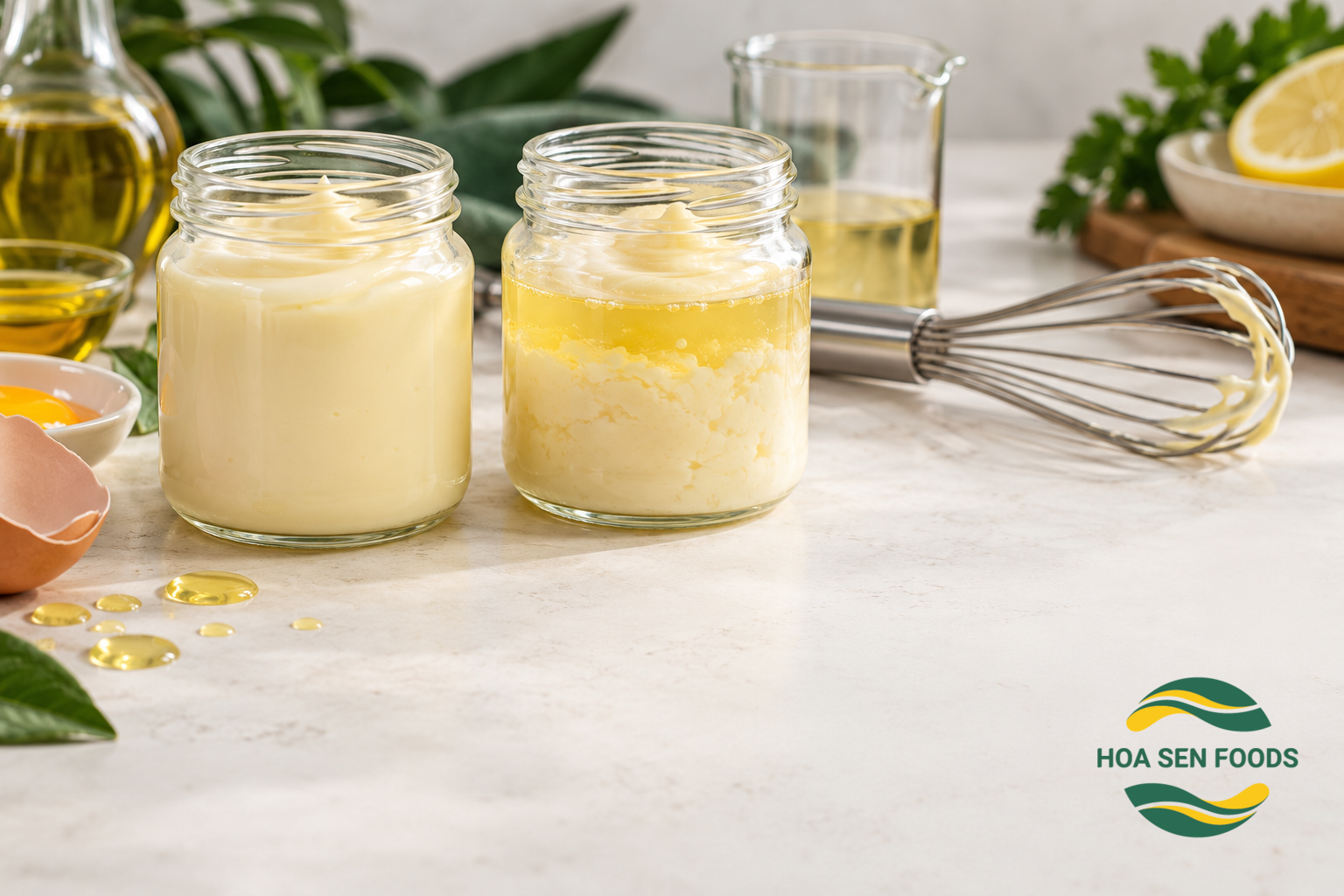
Quick answer: Mayonnaise is an oil-in-water emulsion: many small oil droplets are dispersed through a water phase and need to remain stable through a suitable formula and process. A sample that looks smooth immediately after mixing does not prove that it will retain its structure during storage, transport and use. R&D should therefore agree on criteria, test methods and monitoring conditions before locking the formula.
A mayonnaise sample may taste right today but change in viscosity, develop an oil layer or lose structure over time. The issue is not simply whether the product “looks good”. Instability can affect pouring, squeezing, spreading, kitchen portioning, lot-to-lot consistency and the data used to establish shelf life.
For a contract-manufacturing project, the useful question is not only “Has the sample separated?” It is: stable under which conditions, for how long, against which criteria and approved by whom?
What is a mayonnaise emulsion?
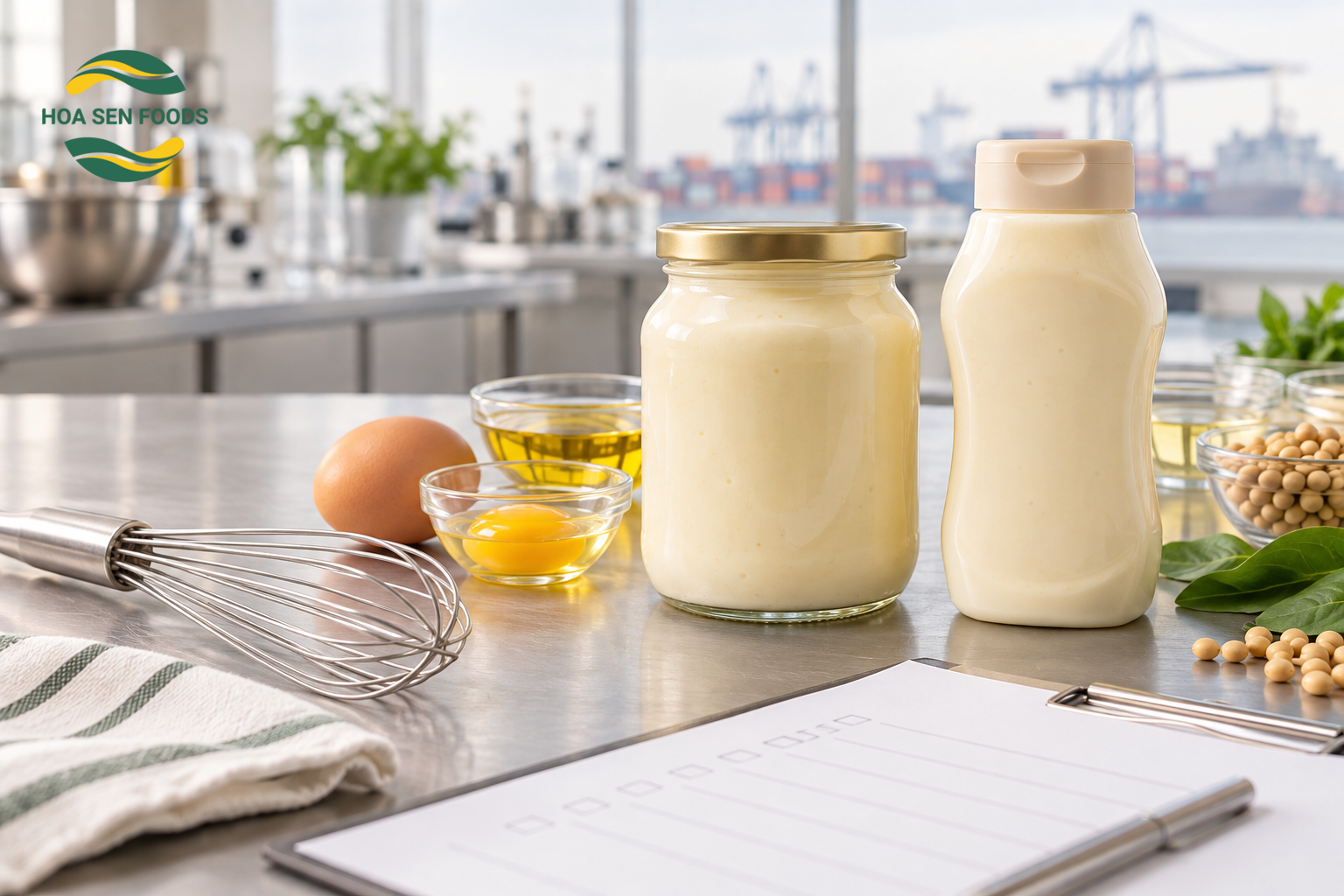
Mayonnaise is commonly described as an oil-in-water emulsion. In simple terms, the oil phase is divided into many small droplets and dispersed through the water phase; the emulsifier and the structure of the whole system help prevent the oil droplets from quickly joining into larger droplets and separating into a distinct layer.
“Stable” does not mean that the product will never change. In food R&D, stability should be defined against pre-agreed objectives: whether the product retains acceptable structural, sensory, chemical, microbiological and usability characteristics under the expected storage, transport and post-opening conditions.
Research on mayonnaise shows that emulsification intensity can change microstructure, instrument-measured properties and eating perception. Other formulation studies commonly monitor droplet size, viscosity, rheology and phase separation. Stability assessment should therefore use several layers of data, not a single visual observation.
Why can a smooth fresh sample still become unstable?
Ingredient ratios and properties can change
The oil phase, water phase, emulsifier, acid, salt, sugar, structuring ingredients and other components can affect one another. Changes in the source or lot of an ingredient may also make the system behave differently from the original sample. Do not use an ingredient ratio or pH value found online as a universal formula.
Mixing order and emulsification energy may not be suitable
The order in which ingredients are added, mixing speed and time, temperature, equipment and batch volume can all affect how oil droplets form and distribute. A condition that performs well at laboratory scale may not transfer exactly to pilot or production equipment.
Temperature and storage history affect the structure
The product may experience temperature fluctuations in storage, transport or use. Research on mayonnaise systems indicates that freeze–thaw exposure can promote partial aggregation and larger oil droplets, leading to oil separation. The test conditions should reflect realistic risks; do not apply an arbitrary temperature cycle and infer shelf life from it.
Packaging and use create additional variables
Jars, squeeze bottles, pouches and small sachets create different requirements for dispensing, squeezing, sealing, transport and post-opening handling. A product that is stable in a test cup cannot automatically be assumed to perform well in commercial packaging.
Physical stability does not equal safety or chemical stability
A sample that shows no visible separation may still change in odour, flavour or colour, or present a safety concern if the formula, ingredients, process and storage are not suitably controlled. Centrifugation or accelerated testing can help screen formulas, but they do not replace a shelf-life and safety-validation programme.
Separate five stability layers during assessment
| Assessment layer | Question to answer | Output to agree |
|---|---|---|
| Physical | Is there oil or water separation, structural change or a change in pumping or pouring behaviour? | Observation description, viscosity or rheology criteria, sample images and permitted variation |
| Sensory | Do colour, odour, flavour, mouthfeel and adhesion or spreadability remain suitable? | Sensory form, reference sample and approver |
| Chemical | Are there signs of oxidation or formula-related changes? | Parameters and methods established by R&D/QA |
| Microbiological and safety | Which hazards must be controlled for the product, process and market? | Testing plan, limits and responsible party |
| Packaging and use | Is the product compatible with the packaging and real use conditions? | Leak, squeeze or pour, post-opening, transport and storage checks |
Separating these five layers helps prevent an overly broad conclusion such as “the mayonnaise is stable” simply because no oil layer was visible at one point in time.
A seven-step R&D process for checking emulsion stability
Step 1: Define the use context and distribution conditions
Start with the intended user, whether the product will be spread, mixed, dipped or portion-pumped, the sales channel, packaging format, and expected storage and transport conditions. For an export project, specify the country or region instead of writing only “export”.
Step 2: Convert subjective expectations into testable criteria
Descriptions such as “smooth”, “holds its shape”, “easy to squeeze” or “not too rich” should be converted into criteria that R&D, the customer and QA interpret consistently. Each criterion should have an assessment method, measurement point and authorised approver.
Step 3: Establish baseline data immediately after sampling
Each initial sample should be coded by version, production date and adjustment objective. Depending on the plan, baseline data may include sample images, uniformity description, viscosity or flow characteristics, pouring, squeezing and spreading behaviour, relevant physicochemical parameters, and droplet size or microstructure when the project and equipment allow.
Step 4: Use screening tests to compare formulas
Layer-separation observation, centrifugation, temperature cycling or accelerated conditions may help identify sensitive formulas early. The main value of these tests is screening and hypothesis generation. Do not mechanically convert an accelerated result into a number of months of shelf life.
Step 5: Monitor samples over time under defined conditions
The retention plan should specify conditions, checkpoints, sample numbers, sampling method and assessment criteria. R&D/QA should review physical, sensory, chemical and microbiological data together as appropriate.
Step 6: Test in the intended packaging and use scenario
Test the product in the target packaging: filling, sealing, leakage, squeezing or pouring, portioning, product retention on the package wall, changes after opening and response to the expected transport journey.
Step 7: Confirm at pilot scale and control changes
After selecting a sample, assess whether it can transfer from trial scale to pilot or production. Significant changes to ingredients, suppliers, packaging or process should go through impact assessment and approval.
How should instability signs be interpreted?
| Sign | Hypothesis to investigate | Next step |
|---|---|---|
| Oil layer on the surface | Oil droplets may be aggregating or coalescing; the formula or emulsification energy may be unsuitable | Compare formulas, process conditions, droplet size and sample-storage history |
| Product becomes progressively thinner | The structure of the system may be changing | Measure again using the same method and temperature; compare with the reference sample |
| Water separation | Water-holding capacity or structural balance may be unsuitable | Review the formula, mixing order and temperature history |
| Difficult to squeeze or pour despite a smooth surface | Flow behaviour may not match the packaging and use method | Test with the actual packaging, tool and use temperature |
| Changed oil odour or aftertaste | Oxidation or an ingredient-related issue may be involved | R&D/QA should define the relevant chemical parameters and investigate the source of variation |
The table is only a framework for asking questions. Root causes must be investigated using data from the lot, ingredients, process and test conditions.
Considerations for products intended for export
Emulsion stability is a technical issue, while product names, ingredients and dossiers depend on the market. If a product is intended to use the name “mayonnaise” in the United States, 21 CFR 169.140 describes a standard of identity involving vegetable oil, acidifying ingredients, egg-yolk-containing ingredients and at least 65 percent vegetable oil by weight. That scope is not a default formula for Vietnam or every other market.
Codex CXC 1-1969 provides a general framework for good hygiene practices and HACCP, but it does not provide one universal mayonnaise formula or one stability test. Confirm the applicable requirements with the importer, testing or certification body and competent authority.
What should a business prepare before contacting Hoa Sen Foods?
- Intended mayonnaise type or sauce product.
- Market, sales channel and use case.
- Reference sample or sensory criteria.
- Ingredients to include, avoid or declare, including allergen information.
- Expected packaging and format.
- Expected storage, transport and post-opening use conditions.
- Expected volume by project stage.
- Approvers for formula, quality, label and commercial decisions.
- Requirements or documents received from the importer, if any.
Hoa Sen Foods positions itself as a trusted R&D and manufacturing partner for seasoning and food brands. A business can share the product type, market, packaging format, expected volume and formulation requirements so both parties can define the appropriate discussion, sampling and testing steps. Final methods, criteria and timelines must be confirmed for each project.
Explore the seasoning R&D process · Read the export mayonnaise manufacturing checklist · Discuss contract-manufacturing services
Frequently asked questions
Does mayonnaise that does not separate after sampling count as stable?
Not by itself. You need to know how long the sample was monitored, under which conditions, and whether it met the physical, sensory, chemical, microbiological and packaging-use criteria.
Can centrifugation replace shelf-life testing?
No. Centrifugation can support formula screening and comparison, but it does not by itself prove shelf life or safety under real distribution conditions.
Is a smaller oil-droplet size always better for mayonnaise?
It cannot be concluded from one parameter alone. The product must also meet sensory, usability, chemical and microbiological stability, packaging and cost objectives.
Why should packaging changes be tested again?
Packaging affects filling, sealing, oxygen exposure, transport and post-opening handling. A packaging change can alter the risk profile and validation plan.
Can one stability-criteria set be used for every mayonnaise product?
It should not be assumed. Criteria depend on the formula, market, use case, packaging, distribution conditions and project risk.
When should a project move from R&D samples to pilot scale?
When the target formula, reference sample, acceptance criteria and test plan are clear enough to assess repeatability at a larger scale. R&D/QA and the project approvers should confirm the decision.