

Quick answer: Egg-based and plant-based mayonnaise differ by more than one ingredient. The two directions affect user needs, emulsion structure, allergens, product naming, packaging, testing, storage and target markets. Before sampling, businesses should define the target market, permitted claims, sensory requirements, ingredient documentation and approval responsibilities.
When starting a project, the most useful question is not “Which type is better?” It is: Which formulation direction is more suitable for the intended users, sales channel and legal requirements?
Why should the formulation direction be decided at the beginning?
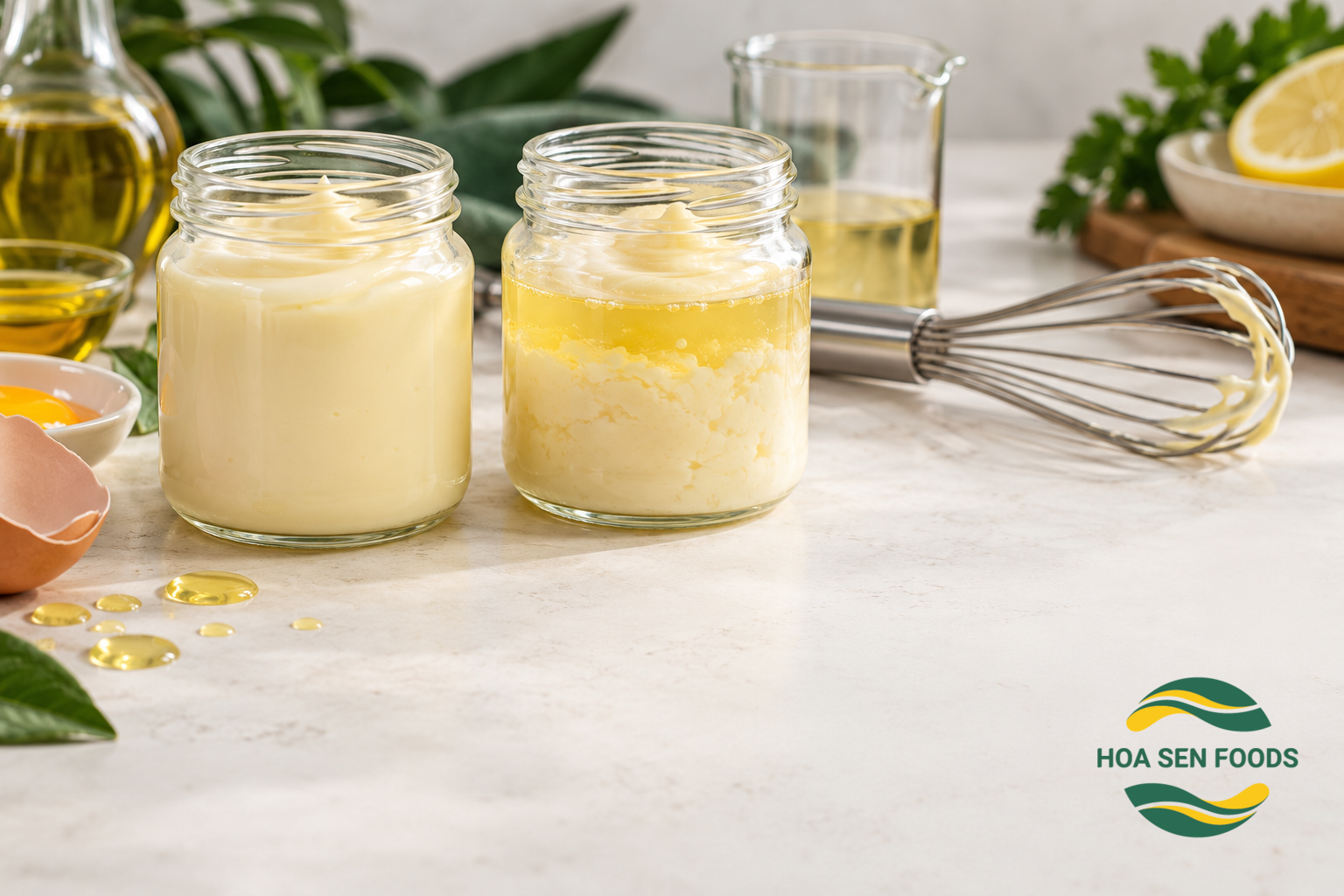
Mayonnaise is an emulsion system. Oil, the water phase, structuring ingredients, acids, flavour components and stabilisers must work together to deliver the intended experience. When eggs are replaced with plant-based ingredients, the R&D team is not simply changing one component; it must reassess perceived richness, viscosity, spreadability or pourability, aftertaste, stability and packaging compatibility.
If the business delays this decision until after samples have been developed or labels have been designed, adjustment costs may increase because the formula, artwork, ingredient documentation and testing plan may all need to change. The brief should therefore specify whether the product is egg-based mayonnaise, egg-free mayonnaise or a plant-based sauce that may require a different name in the target market.
1. Define the user and use context
Mayonnaise for households, restaurants, F&B chains, commercial kitchens, retail or foodservice will have different requirements. Describe the main dish or use action: spreading on bread, mixing into salad, using as a burger base, dipping, making a dressing or blending into a kitchen recipe.
- Do users need to avoid eggs because of allergies, dietary preferences or religious requirements?
- Will the product be consumed directly or used as an ingredient in another formulation?
- Does it need to be spreadable, quickly pourable, pumpable or easy to mix?
- Does the sales channel require a bottle, jar, pouch, can or single-use sachet?
- At what temperature will it be used, and who will control the product after opening?
2. Distinguish “plant-based”, “vegetarian”, “vegan” and “egg-free”
These terms should not be used interchangeably by default. The business should first identify the claim it wants to place on the label, then verify the formula, minor ingredients, processing aids, process controls and target-market requirements.
“Egg-free” describes a specific formulation attribute. “Plant-based” may require a clearer explanation because the product could still contain or come into contact with other allergens such as soy, mustard, sesame, peanuts or tree nuts, depending on the ingredients and facility. “Vegan” generally requires a broader scope of control and should not be used without an appropriate verification process.
The brief should separate three layers of information:
- Actual formula: which ingredients the product does or does not contain.
- Proposed claim: what the business wants to communicate on the label and in marketing.
- Required evidence: ingredient specifications, supplier declarations, allergen assessment, testing or certification where required by the market.
3. Define sensory criteria instead of simply saying “like regular mayonnaise”
A reference sample can start the discussion, but it is not enough to lock the formula. Describe the product using criteria that can be observed or assessed:
| Criterion | Question to resolve |
|---|---|
| Colour | Should it be cream, pale yellow or another colour? Does it change during storage? |
| Viscosity | Should it spread, pour, pass through a nozzle or mix easily? |
| Acidity | Should the sourness be mild, pronounced or have a short finish? |
| Richness | Should it feel rich and full, light, clean on the palate or more refreshing? |
| Aftertaste | Is a characteristic plant-based ingredient note acceptable? |
| Application | Will it be evaluated on bread, salad, burgers, fried food or another dish? |
For plant-based products, testing on real food is especially important. A sample that performs well in a tasting cup may not create the same experience when spread on bread, mixed into salad or combined with other seasonings.
4. Build an ingredient and allergen map
For egg-based mayonnaise, the egg component and its label declaration should be assessed for the target market. For the United States, businesses should review FDA allergen-labelling guidance. In the EU, eggs and egg products are among the allergens that must be declared under the Food Information to Consumers framework and Annex II of Regulation (EU) No 1169/2011.
Plant-based mayonnaise is not automatically allergen-free. Depending on the R&D choices, the formula may contain soy, mustard, sesame, peanuts, tree nuts or other ingredients. In addition to the ingredient list, the business should request:
- specifications for each ingredient;
- supplier allergen information and cross-contact risks;
- the permitted scope of each claim;
- the ingredient-change control process;
- the required ingredient names for the label in each market.
Do not wait until artwork design to ask for the allergen list again. It is input data for the formula and product dossier.
5. Check the product name requirements in the target market
The name “mayonnaise” may have a specific standard or interpretation in each market. If the product is intended for the United States and will use the name “mayonnaise”, the business should review 21 CFR 169.140. The standard of identity describes an emulsion containing vegetable oil, acidifying ingredients and egg-yolk-containing ingredients, and specifies not less than 65 percent vegetable oil by weight within that standard. This is a United States requirement and should not be treated as a default figure for every country.
For a plant-based product, clarify whether it will be called mayonnaise, vegan mayonnaise, egg-free mayonnaise or another sauce or dressing. The final name should be checked with the importer, a qualified legal adviser or the competent authority in the target market. Hoa Sen Foods may support the review of formulation and dossier information within the agreed scope, but it does not replace the importing authority or market-specific legal advice.
6. Define testing and data requirements for shelf-life decisions
Shelf life should not be entered into a brief as a desired number and then treated as an established result. The business should agree on an assessment plan based on the formula, packaging, storage conditions, manufacturing process and sales market.
Before approval, clarify:
- which parameters need to be tested for the product and market;
- whether the sample will be assessed in final or temporary packaging;
- the expected transport and storage conditions;
- the product state before and after opening;
- the sensory, stability and microbiological data required;
- who is responsible for approving the final conclusion.
Codex CXC 1-1969 can serve as a foundation for food-hygiene principles and hazard-control systems. Its practical application must still reflect the product, process, facility and applicable legal requirements.
7. Select packaging according to viscosity, sales channel and transport
Packaging is more than an external design element. For mayonnaise, viscosity and dispensing behaviour directly affect user experience, product retained in the pack, cleanability, seal integrity and transport losses.
The brief should state:
- bottle, jar, pouch, can or single-use sachet;
- pack size and expected volume for each SKU;
- nozzle or cap requirements if the product must pour or pump;
- food-contact material requirements and supplier documentation;
- case packing, transport and storage conditions;
- label, language, lot code and traceability information.
For plant-based products, do not assume that the packaging or format should be identical to the egg-based line. The two formulas may behave differently during pouring, spreading and storage; packaging should be tested with the final product.
8. Clarify responsibilities among the brand owner, manufacturer and importer
An export project usually involves several parties. Without clear roles from the beginning, questions about labels, dossiers, testing, claims and approvals may be passed from one party to another.
| Party | Items to agree |
|---|---|
| Brand owner | Users, claims, market, format, level of customisation, sample and artwork approval |
| Manufacturer/R&D | Formula feasibility, samples, specifications, production and packaging within the agreed scope |
| Importer | Market requirements, import dossier, label, registration and responsibilities in the destination country |
| QA/testing laboratory | Test plan, acceptance criteria and result documentation |
For imports into the United States, FSVP relates to the importer’s responsibility to verify foreign suppliers and imported food under the applicable rules. A Vietnamese manufacturer should not be described as “FDA-certified for FSVP” or as replacing the importer’s obligations.
What should you send to Hoa Sen Foods before sampling?
- Product direction: egg-based, egg-free, plant-based or a sauce/dressing whose name must be verified.
- Intended market and sales channel.
- Main dish or use context.
- Reference sample and desired sensory profile.
- Proposed claims for the label.
- Allergen, religious or dietary requirements, if any.
- Packaging format and expected volume by stage.
- Testing, documentation and approval requirements.
Hoa Sen Foods presents its service scope as including consulting, seasoning R&D, processing and production, and packaging. A business can begin by sharing product information, market, format and formulation requirements so both parties can identify the appropriate R&D step.
Start with a clear brief
If you are preparing a private-label mayonnaise project, start by sharing four groups of information: formulation direction, target market, packaging format and expected volume. This gives Hoa Sen Foods a clearer basis for discussing feasibility, samples and information that must be verified before production.
Explore seasoning and food contract manufacturing services · Explore contract-manufactured products
FAQ
Is plant-based mayonnaise always egg-free mayonnaise?
Do not assume so. Check the actual formula, minor ingredients and cross-contact risks. If you want to use “egg-free”, “plant-based” or “vegan”, define the claim scope and the verification requirements for the target market.
Is egg-based mayonnaise suitable for export?
It may be suitable, but it must be assessed against the market, formula, label, allergens, packaging, storage and import dossier. There is no single set of requirements for every country.
Can the same packaging be used for egg-based and plant-based mayonnaise?
It may or may not be suitable, depending on viscosity, dispensing method, materials, claims, format and test results. Packaging should be assessed with the final product rather than selected from appearance alone.
Will the shelf life of the two product lines be the same?
Do not assume it. Shelf life depends on the formula, process, packaging, storage conditions and test data. Each SKU should be assessed using its own product dossier.
Is the manufacturer responsible for the entire import dossier?
Responsibilities must be defined in the contract and under the destination market’s rules. Importers usually have their own obligations in the destination country; confirm them with the importer and the relevant market adviser.
Read more from Hoa Sen Foods
- Export mayonnaise manufacturing: 10 points to clarify
- Plant-based sauces: an F&B opportunity that requires substance
- Seasoning R&D process: from idea to sauce bottle