

Quick answer: Export mayonnaise manufacturing is not simply about choosing a good-tasting formula. Businesses need to clarify the product name and scope, emulsion system, ingredients and allergens, destination-market labelling requirements, food-contact packaging, storage conditions, shelf life, traceability records and the importer’s responsibilities.
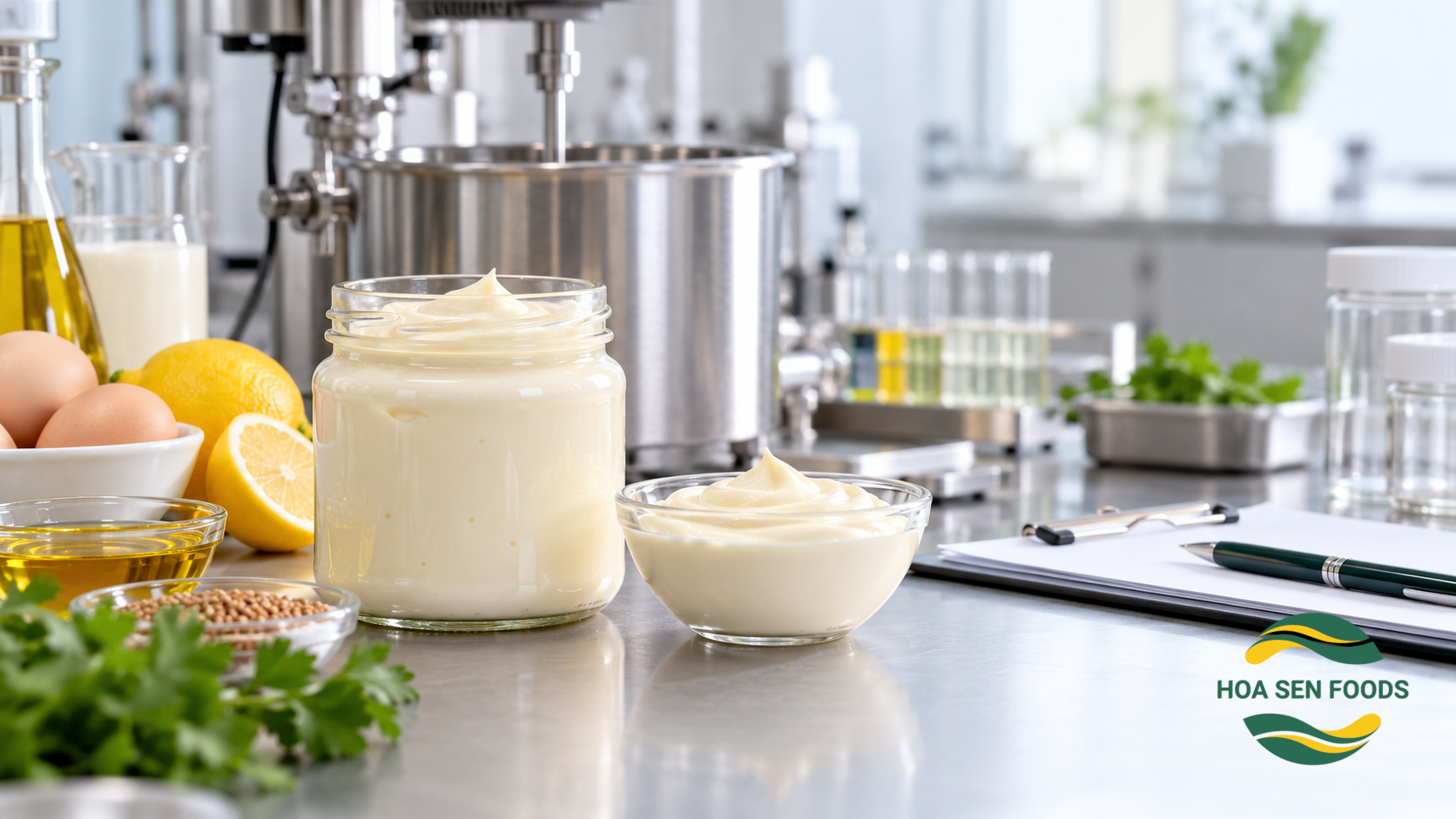
Mayonnaise is an emulsion product. Even a small change in ingredients, mixing conditions, packaging or transportation can affect sensory quality and stability. Therefore, an export seasoning manufacturing brief should be more specific than “make mayonnaise like this sample.”
Hoa Sen Foods positions itself as a reliable manufacturing and R&D partner, supporting customers with ingredient consultation, formula development, sampling, processing, production and packaging within the confirmed scope of each project. Businesses can review the seasoning food manufacturing services and contract-manufactured product categories before preparing a brief.
10 Points to Clarify Before Contract Mayonnaise Manufacturing for Export
1. Define the destination market and product name
First identify whether the product will be sold in Vietnam, the United States, the European Union, the GCC or another market. Each market may have different requirements for the food name, ingredients, labelling, allergens, additives, packaging and import documentation.
If the product is intended to be called “mayonnaise” in the United States, review 21 CFR 169.140. Within that U.S. standard, mayonnaise is described as an emulsified food containing vegetable oil, acidifying ingredients and an egg-yolk-containing ingredient, with not less than 65% vegetable oil by weight. This is a U.S. requirement and should not be treated as a default rule for every market.
2. Describe the target formula using measurable criteria
Turn descriptions such as “rich, smooth and not too heavy” into criteria that the R&D team and product approver can interpret consistently: richness, acidity, saltiness, colour, viscosity, spreadability or pumpability, adhesion to food and ingredients that must not be used. You can also review the seasoning R&D process from idea to sauce bottle to understand the development and sample-approval stages.
3. Clarify egg sources, alternatives and allergens
The FDA lists egg as one of the major food allergens in the United States. In the EU, Regulation (EU) No 1169/2011 sets requirements for food information and allergen communication.
- Will the formula use egg yolk, whole egg or a processed egg ingredient?
- Does it contain milk, soy, mustard or other potential allergens?
- Can suppliers provide suitable specifications, COAs and allergen information?
- Is an egg-free or plant-based formula required?
Do not claim that a product is “allergen-free” or “suitable for everyone” without the relevant assessment and confirmation.
4. Define acidification and related safety controls
Acid affects flavour, formulation and product controls. Do not take a pH value found online and treat it as a universal target. pH, water activity, processing, ingredients, packaging and shelf life should be assessed together by the R&D and QA teams.
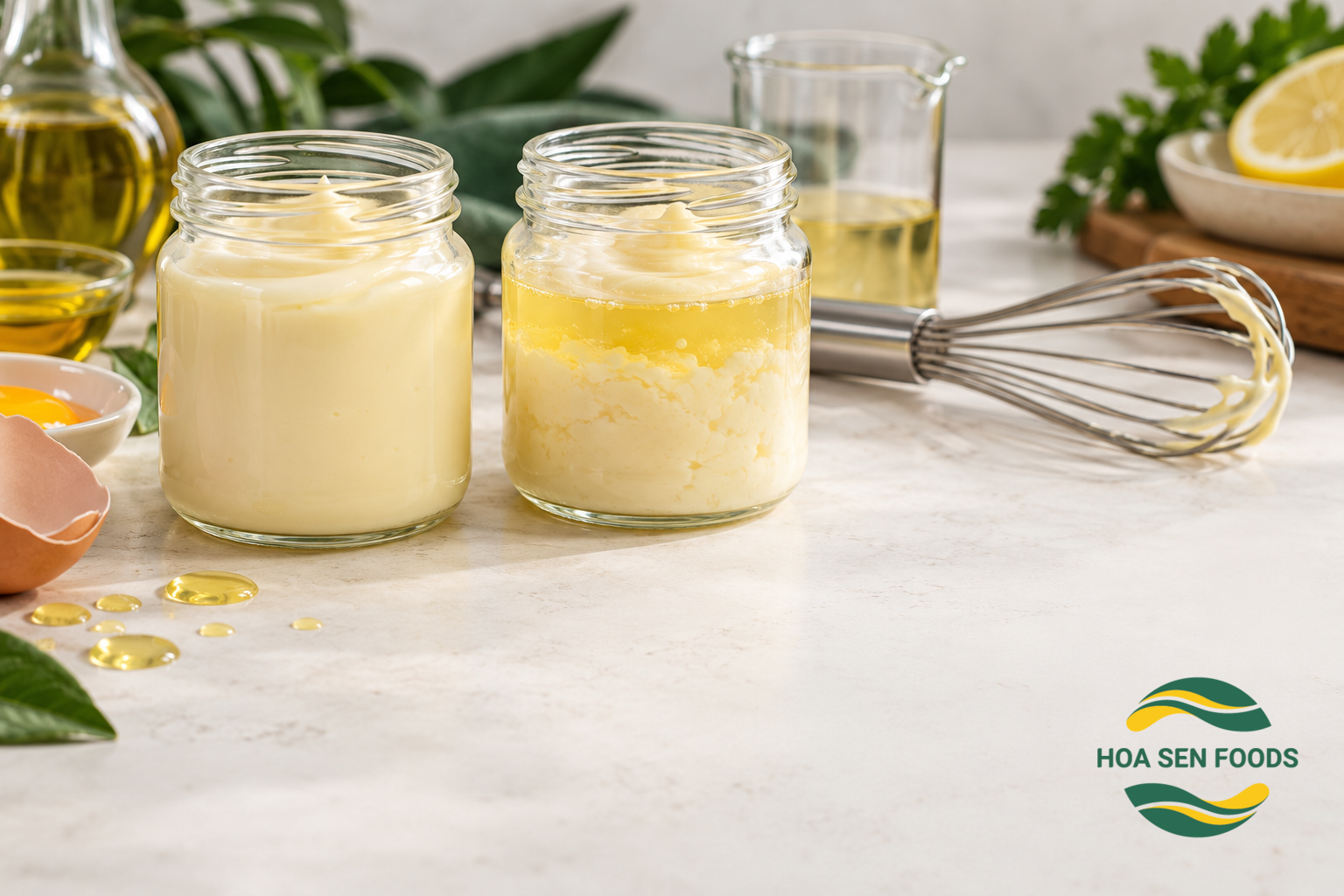
5. Control emulsion stability
Agree on how to assess oil separation, water separation, changes in viscosity, colour, aroma, flavour, pouring or pumping performance and acceptable batch-to-batch variation. The technical or QA team should establish the testing points and acceptance criteria.
6. Review additives, flavourings and labelling requirements
Prepare a preliminary ingredient list for review, including ingredient names, functions, additives, flavourings, colours, label wording, language requirements, nutrition information, net quantity, lot identification and expiry information.
7. Choose packaging for the usage model and transport journey
Squeeze bottles, jars, pouches and single-serve sachets have different requirements for user experience, portioning, closure, transportation and handling after opening. The brief should specify food-contact materials, seals, leak resistance, pallet configuration, artwork, barcodes, lot coding and expiry information. For a packaging comparison, see export sauce packaging: bottle, pouch or sachet.
For the EU market, food-contact materials should be reviewed under the applicable framework, including Regulation (EC) No 1935/2004. Do not describe packaging as “export compliant” until the destination market and material documentation have been confirmed.
8. Do not set shelf life before supporting data is available
Shelf life depends on the formula, process, packaging, filling conditions, temperature, transportation and how consumers open and use the product. If approved data is not yet available, do not put a fixed shelf-life claim into the brief or promotional content.
9. Prepare traceability records and the importer’s document set
Depending on the market and commercial agreement, buyers may request specifications, COAs, allergen information, label artwork, packaging records, lot codes and traceability documents. Codex CXC 1-1969 provides a reference for good hygiene practices, hazard prevention, records and suitable storage and transportation.
10. Check FSVP and the U.S. importer’s responsibilities
If the product will enter the United States, clarify the importer’s role under the Foreign Supplier Verification Program. The FDA explains that importers must conduct risk-based verification of foreign suppliers, including hazard evaluation, supplier assessment, food-safety records, verification activities and corrective action where necessary.
Do not state that a Vietnamese manufacturer is “FDA FSVP certified” or claim that it can replace the importer’s obligations. A manufacturer may support the importer by providing agreed documentation, while the importer and relevant legal or compliance advisers must confirm the applicable requirements.
Mayonnaise Manufacturing Brief Checklist
- Destination market and sales channel.
- Product name intended for the label.
- Reference sample or sensory description.
- Ingredients to use and ingredients to avoid.
- Egg, allergen and plant-based requirements.
- Packaging format, fill size and intended use.
- Expected volume by project stage.
- Sample deadline and planned launch date.
- Importer documents or market requirements already received.
- Final approver for product, quality, labelling and commercial matters.
When Should You Contact Hoa Sen Foods?
Businesses can begin discussions when they have a reference sample, a reasonably clear product description or requirements from an importer. Not having a finished formula does not prevent the project from starting. However, the clearer the brief is about the market, users, packaging and success criteria, the stronger the basis for consultation.
Share the mayonnaise type, target market, packaging format, expected volume and formula requirements with Hoa Sen Foods to discuss the next step within the confirmed scope of consultation, R&D, manufacturing and packaging for the project.
Frequently Asked Questions
Can mayonnaise be contract manufactured without a finished formula?
Yes. A project can start with a reference sample or target description, but the market, usage, allergens, packaging and approval criteria should be defined so that R&D can assess the development direction.
Must export mayonnaise contain eggs?
That depends on the product name, formula and destination market. Egg-free or plant-based formulas require a separate review of the product name, label and applicable legal requirements.
Can one formula be used in every country?
This should not be assumed. The formula may need to be adjusted for taste preferences, ingredients, additives, labelling, allergens, packaging and import requirements in each market.
Is mayonnaise shelf life decided when the sample is made?
No. Shelf life should be based on appropriate data for the formula, process, packaging and storage conditions.
Is the manufacturer fully responsible for the export label?
Responsibilities should be defined in writing between the brand owner, manufacturer, importer and any consulting or certification parties.
Export notice: Businesses should confirm the applicable requirements with the importer, certification bodies and competent authorities before implementation. This article is intended to guide content planning and brief preparation; it is not legal advice and does not guarantee customs clearance.