

Sitting in a vibrant, heavily scented souk in Muscat last year, you could easily feel the historical pulse of the regional economy through its aromas. The global spice trade is the ancient, undeniable heartbeat of the entire Middle East. Because it has fueled entire economies for millennia, today it is undergoing a massive, highly profitable, high-tech commercial revival.
For many aspiring food entrepreneurs worldwide, the ultimate commercial dream is incredibly clear. See your very own logo on a premium glass jar of traditional Kabsa spice or a modern Sriracha-style chili sauce sitting elegantly in a Dubai supermarket.
But here’s the thing. While the massive consumer appetite for bold, authentic flavor in the Gulf Cooperation Council (GCC) is nearly bottomless, the actual barrier to entry is high. It isn’t just about having a really good kitchen recipe your family loves. It is heavily about navigating a highly complex web of subtle cultural nuances, strict religious certifications, and high-stakes international logistics safely.
From what we’ve seen, most new food brands fail rapidly not because their product tastes bad, but because they completely lacked a solid, thorough business roadmap. They vastly underestimated the heavy export paperwork, or they blindly chose the absolute wrong production partner. To be fair, this isn’t always the case with every single startup, but a lack of preparation destroys more food brands than bad flavors ever will.
If you are genuinely ready to start spice brand Middle East operations today, this incredibly thorough pillar guide is your complete A–Z map. We will take you carefully from a late-night kitchen-table idea to a highly profitable, shelf-ready product in the UAE, Saudi Arabia, Qatar, and beyond.
When it comes to the highly saturated GCC food market, completely “general” or generic brands are dying a slow, painful death. To succeed in this competitive landscape, you absolutely must find a highly specific, defensible corner of the retail market to own entirely.
Research your exact target demographic aggressively. The Middle East isn’t a single, uniform consumer monolith. Because the palate of a local, traditional Emirati family differs significantly from the preferences of the massive expatriate populations from India, the Philippines, or Europe, your product must target a specific tongue. Anyone looking to start spice brand Middle East businesses must choose their audience first.
Identifying Your Primary Sales Channel
Before you physically mix a single gram of raw powder, decide exactly where your brand will live commercially.
- Retail Supermarkets: Consider this the most brutally competitive and expensive channel to conquer. Think of massive, dominant chains like Carrefour UAE, Lulu Hypermarket, or Panda Retail in Saudi Arabia. You absolutely need high-end, eye-catching packaging and significant marketing budgets to pay for strict shelf-space listing fees.
- HoReCa (Hotels, Restaurants, Cafes): Treat this as a high-volume, highly profitable B2B play. Sell bulk-labeled, highly consistent seasoning blends directly to growing burger chains, massive dark kitchens, or luxury hotel catering teams. When you launch seasoning brand GCC campaigns here, consistency is your ultimate selling point.
- E-commerce & Direct-to-Consumer (DTC): Take the absolute fastest, lowest-risk route to market. Use massive digital platforms like Amazon.ae, Noon, or your own dedicated Shopify store to test the market with significantly lower overhead costs.
Analyzing Modern Flavor Trends in the Gulf
To launch seasoning brand GCC products successfully in 2026, you must align your R&D tightly with one of these three dominant consumer movements.
- Clean-Label & Organic Formulations: Modern Gulf consumers are obsessively checking back labels for added MSG, artificial chemical dyes (like Sunset Yellow), and synthetic anti-caking agents. If your label honestly says “100% Natural” and “No Artificial Preservatives,” you have already won half the retail battle. Health is a major driver when you start spice brand Middle East product lines.
- Exciting Fusion Flavors: Think completely outside the traditional box with concepts like “Black Truffle Shawarma Rub” or “Spicy Chili-Lime Za’atar.” Modern, young consumers absolutely love traditional cultural foundations updated with a sharp, global twist.
- Ultimate Convenience Kits: Build smart, easy-to-use meal-base mixes that actively help busy, working families cook authentic Mandi or complex Biryani perfectly in under 30 minutes.
Use free digital tools like Google Trends (filtering specifically by Saudi Arabia or the UAE) to guide your R&D choices. Analyze the “Best Sellers” list in the Grocery category on Amazon.ae carefully to see exactly what specific products are actually moving in real-time.
After years of helping ambitious founders, I’ve realized that the single biggest financial mistake is trying to build a physical factory on day one.
Unless you have millions of dollars in venture capital sitting idle in the bank, do not buy heavy industrial machinery. Instead, use a professional, highly experienced OEM manufacturing partner to bring your vision to life. This is the absolute smartest way to start spice brand Middle East companies safely.
DIY Kitchen R&D vs. Professional OEM Partner
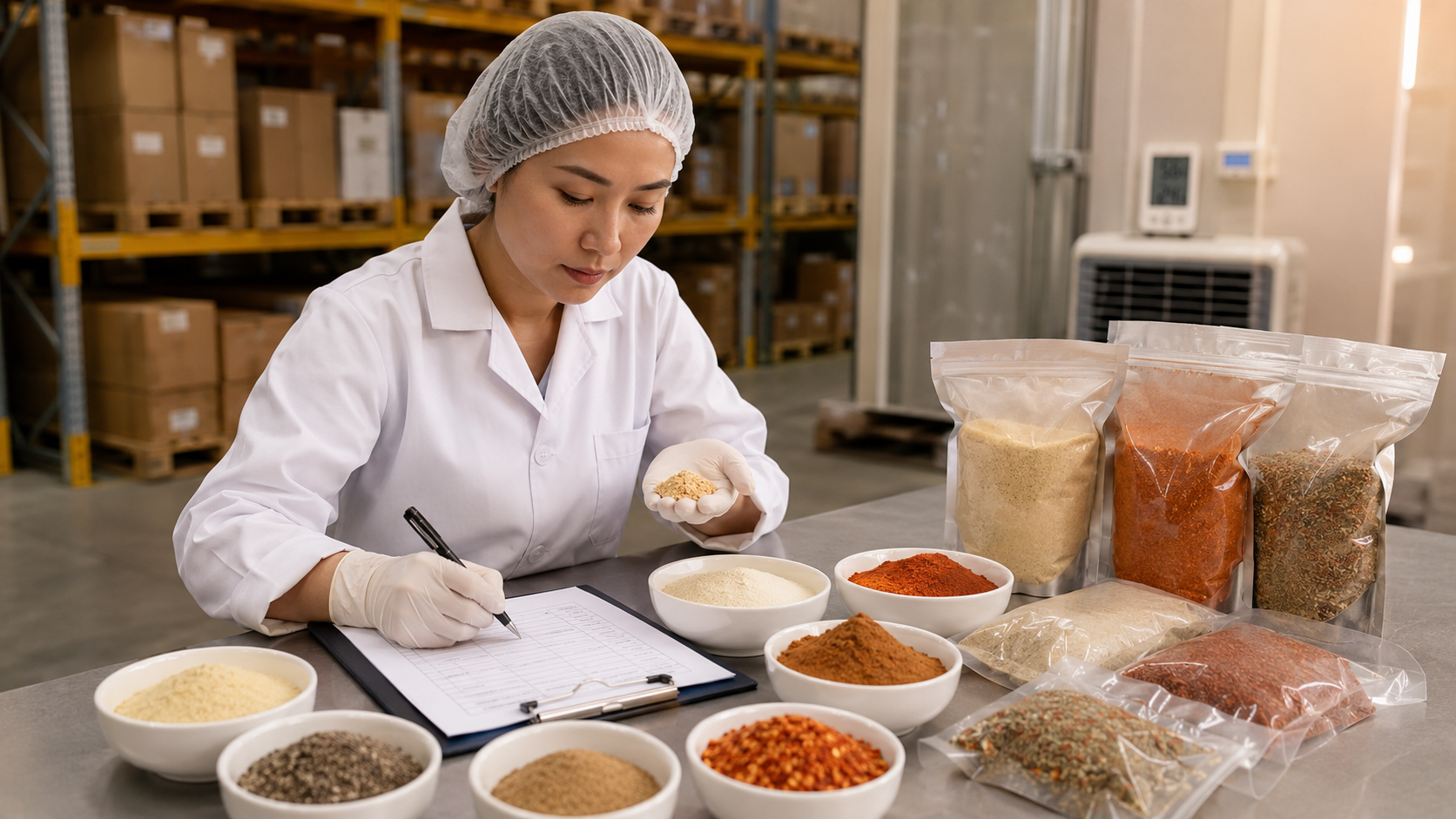
In our experience, the absolute best way to develop a new food product is a smart hybrid approach. Start the creative process in your own home kitchen. Perfect the creative “soul” and delicate balance of the flavor yourself. Once you finally have a prototype profile that your friends and family rave about, take that specific prototype to a specialized OEM manufacturer.
A professional manufacturing partner helps you scale that fragile recipe safely. They ensure the garlic powder doesn’t clump into a solid rock in the humid Dubai summer air. They guarantee that the specific chili heat remains perfectly consistent across 10,000 separate jars.
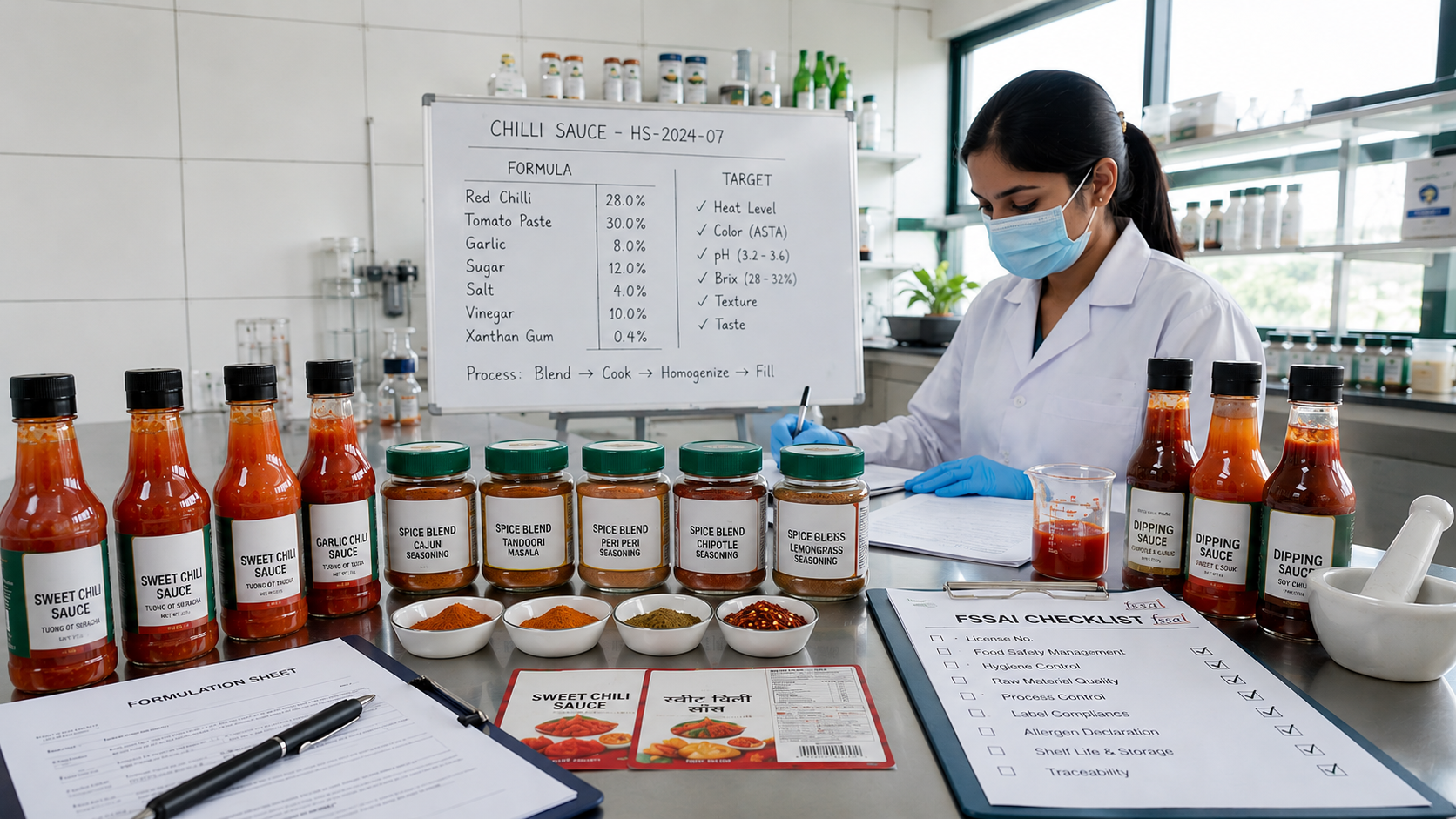
Scaling a tiny 10-gram kitchen recipe to a massive 2-ton industrial mixer requires deep, precise food science. Put in place a collaborative “Taste Loop” with your factory’s R&D lab. They will send you physical prototypes, you will taste them rigorously, and they will adjust the exact micron sizes and spice ratios until it is flawless. Every single brand aiming to launch seasoning brand GCC products must pass through this critical testing phase.
Creating Your Unique Selling Proposition (USP)
Stand out aggressively from the incredibly crowded supermarket shelf. Sometimes your unique USP isn’t just about a “secret” spice ingredient; it is entirely about your origin sourcing story.
- “Sourced directly from the rich, volcanic Central Highlands of Vietnam.”
- “Processed using advanced cold-milling technology to retain 100% of the natural essential oils.”
- “A traditional Arab family recipe modernized thoroughly with zero chemical additives.”
Use physical samples and regional focus groups aggressively. Don’t just blindly trust your own personal taste buds. Send unbranded samples to potential retail buyers or professional chefs living in the region and ask them for brutal, unfiltered honesty. To start spice brand Middle East ventures, you must listen to the local tongue.
Understand the strict legal landscape thoroughly before you ever ship a single shipping container. If you fail to prepare for this specific step, your expensive goods will be destroyed permanently at the destination port.
When you launch seasoning brand GCC businesses, you are willingly entering one of the most strictly regulated food safety environments in the entire world.
The Absolute Halal Requirement
Halal certification is never optional in the Gulf; it is the absolute legal and cultural baseline. You absolutely need a thorough Halal certificate issued by a religious body officially recognized by the GAC (Gulf Accreditation Center) or the SFDA (Saudi Food and Drug Authority).
Many cheap factories claim to be “Halal,” but their local certification isn’t recognized legally in the GCC. Verify this crucial detail immediately. If your factory uses an unapproved auditor, Saudi customs will reject your container immediately upon arrival. Planning to start spice brand Middle East operations requires treating Halal as a core business strategy, not just a religious afterthought.
Product Registration Systems (ZAD, FIRS, and SFDA)
Register your physical products digitally before they ever leave the factory floor in Asia. In the UAE, every single food product must be officially registered in the national ZAD portal (federal level) or the FIRS system (Dubai Municipality level).
In Saudi Arabia, you must deal directly with the SFDA’s highly strict electronic registration system. Doing this requires a valid regional Trade License, a registered local distributor, or your own registered branch office operating legally in the region. You cannot simply mail a box of spices to Riyadh and hope it clears customs magically.
The Mountain of Export Documentation
Prepare your export paperwork meticulously. Exporting food requires a massive, flawless stack of documents for every single shipment. Anyone looking to launch seasoning brand GCC campaigns must master these documents.
- Certificate of Origin (CO): Proves exactly where the spices were grown and physically processed.
- Health Certificate: Issued officially by the exporting government, proving the food is fit for human consumption.
- Certificate of Analysis (COA): A detailed laboratory report proving the batch is totally free from heavy metals, salmonella, and illegal pesticides.
If you are serious about your goal to start spice brand Middle East businesses, you must ensure your chosen OEM partner handles these complex export documents entirely in-house.
Design purely for the supermarket shelf, but respect the local culture deeply.
Your physical packaging is the very first “taste” a consumer gets of your brand. In the highly competitive Middle East, visual cues and material quality are absolutely everything. It will dictate whether your effort to launch seasoning brand GCC fails or succeeds.
The Strict Rules of GCC Packaging Design
When designing your physical labels, follow these non-negotiable rules closely to avoid severe government fines:
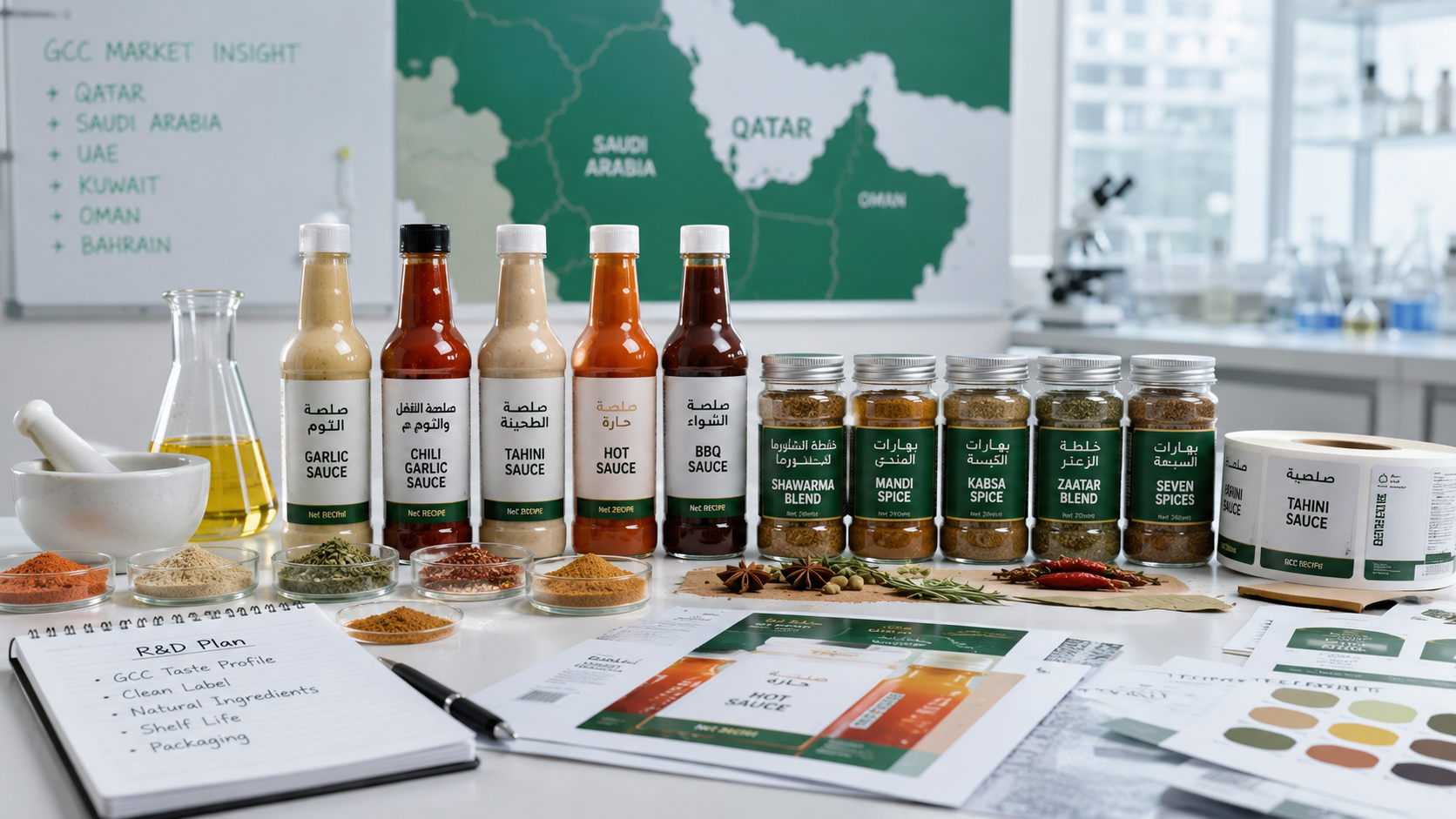
- Strict Bilingual Labels: Arabic and English text are legally mandatory on all packaging. The Arabic translation must be perfectly accurate and culturally appropriate. Using a cheap Google Translate output will get your product mocked by consumers and quickly rejected by health inspectors.
- Strategic Color Psychology: Understand regional color meanings deeply. Green very often represents Halal compliance, purity, and nature. Rich gold and deep matte blacks strongly suggest premium, expensive luxury. Avoid using colors or symbols that might have negative or offensive cultural connotations in Islamic traditions.
- Mandatory Symbols: Place your recognized Halal logo very prominently on the front label. If your product features a “Vietnam Origin,” use that specific fact to suggest exotic, high-quality agricultural sourcing to the buyer.
Choosing the Right Physical Materials
Think critically about the harsh physical environment. The Middle East gets incredibly hot during the long summer months.
If you use cheap, thin plastic jars, the intense ambient heat during logistics transfers will degrade the sensitive spices before they ever reach the consumer’s air-conditioned kitchen. Use high-barrier, multi-layered foil pouches or heavy UV-protected glass to ensure total long-term freshness.
Protect the volatile essential oils from oxygen and harsh sunlight at all costs. Proper packaging is the most critical physical investment when you start spice brand Middle East product lines.
Choose your manufacturing partner exactly as carefully as if you were choosing a spouse.
If your factory partner fails to maintain strict quality standards, your entire brand dies overnight. You cannot launch seasoning brand GCC products effectively if your backend supply chain is weak or unreliable.
The “Test Batch” Market Strategy
Don’t launch your brand blindly with 50,000 units. Start the process with a highly manageable Minimum Order Quantity (MOQ).
Put in place a smart “Soft Launch” strategy. Sell your first 1,000 to 3,000 units strictly via online marketplaces (like Amazon.ae) or through a few select boutique grocery shops in Dubai. Gather real, actionable data from actual paying customers. Is the chili spice level right for the local palate? Is the overall salt content too high? Do they love the glass jar, or do they find it too heavy to pour easily?
Use this highly valuable feedback to tweak your master formula with your OEM partner before you spend serious money on a massive production run. Anyone attempting to start spice brand Middle East businesses must embrace this crucial testing phase.
Scaling Your Production Safely
Once you finally have solid “Proof of Concept” and your sales are growing organically, scale up your operations aggressively.
This is exactly where your OEM partner’s true factory capacity becomes critical to your survival. You absolutely need a partner who can go seamlessly from producing 1,000 units a month to 100,000 units a month without a single drop in flavor consistency or food safety.
Build a strong, transparent relationship with a factory that operates as your silent, reliable backend. At Hoa Sen Foods, we consciously act as the bệ phóng (launchpad) for your growing brand. We handle the intense, highly technical work daily, ensuring your product is perfect so you can focus entirely on building your retail empire and executing your plan to launch seasoning brand GCC products.
Launching Marketing and B2B Outreach
Support your physical launch with smart, culturally relevant digital marketing.
Run highly targeted Instagram and TikTok ads focused heavily on young foodies in Riyadh and Dubai. Partner actively with local Arab food influencers. Send them free samples and ask them to show their followers how to cook traditional dishes using your modern, clean-label spice blends.
If you are targeting the massive HoReCa sector, hire a strong B2B sales representative immediately. Give them premium sample kits to hand out to executive chefs at luxury hotels. Chefs care intensely about flavor consistency and saving labor costs. Prove to them that your custom blend saves their kitchen staff time while delivering incredible, unforgettable flavor.
To completely dominate the market when you start spice brand Middle East ventures, your marketing must be as potent as your spices.
To start spice brand Middle East operations is to join a proud, historical lineage of global merchants and spice traders that spans thousands of years. It is an exciting, deeply rewarding journey of heavy responsibility, absolute kindness to the consumer, and incredible financial potential.
To be fair, the road ahead is undeniably long and filled with hurdles. You will inevitably face frustrating customs delays, annoying labeling revisions, and intense shelf competition from massive global food giants. But when you finally see that first beautiful bottle sitting proudly on a kitchen counter in Riyadh, knowing deeply that it is pure, completely safe, and incredibly delicious, the massive effort becomes entirely worth it.
Deciding to launch seasoning brand GCC product lines requires immense bravery, but you do not have to do it alone.
Hoa Sen Foods exists specifically to protect your hoài bão (ambitions). We actively provide the “Tin cậy” (unshakable reliability) and “Cương trực” (absolute straightforwardness) you desperately need on the factory floor. We don’t just blend dry spices; we nurture your long-term business vision from the ground up.
Stop dreaming idly about owning a food brand and start taking the precise, calculated steps to build one today. Use the thorough roadmap we have provided to avoid the costly mistakes that destroy amateur startups. If you want to successfully start spice brand Middle East companies, you must plan meticulously and execute flawlessly.
Ready to sketch out your brand’s highly profitable future in the Middle East?
Frequently Asked Questions (FAQ)
1. How much starting capital do I typically need to launch a seasoning brand in the UAE?
While exact costs vary wildly based on your marketing strategy, using an OEM partner allows you to start for a tiny fraction of the massive cost of building a physical factory. Budget carefully for mandatory product registration fees, your initial MOQs, attractive packaging design, and your first digital marketing push. Having a solid financial plan is the first step to start spice brand Middle East successfully.
2. Can I safely use my own proprietary recipe with an OEM manufacturer?
Absolutely. Protect your valuable recipes fiercely with strict NDAs. A professional, highly ethical partner like Hoa Sen Foods will help you scale your fragile kitchen formula for massive industrial production while keeping the specific flavor profile completely identical and keeping your trade secrets totally safe.
3. What is currently the most popular spice blend trending in the Middle East right now?
While traditional, ancient heritage mixes like Za’atar, Kabsa, and Baharat remain absolute daily staples, we currently see a massive, highly profitable surge in demand for “Clean-label” Fried Chicken Seasonings, Sriracha-style sauces, and gourmet, fusion-flavored Chili Pastes. Understanding these trends helps you launch seasoning brand GCC products that actually sell.
4. Do I need to physically live in the GCC to start a spice brand there?
No, you do not need to live there permanently, but you will absolutely need a registered local distributor or a trusted legal agent on the ground to handle the strict legal registration of your products in government systems like ZAD (UAE) or the SFDA (Saudi Arabia).
5. How long does it realistically take to go from an idea to a finished product ready for export?
If you work closely with a highly agile OEM partner, the R&D and sampling phase usually takes 2 to 4 weeks. Once you approve the final sample and finalize your packaging design, initial production and export document preparation typically take another 4 to 6 weeks. It takes patience to properly start spice brand Middle East operations.