

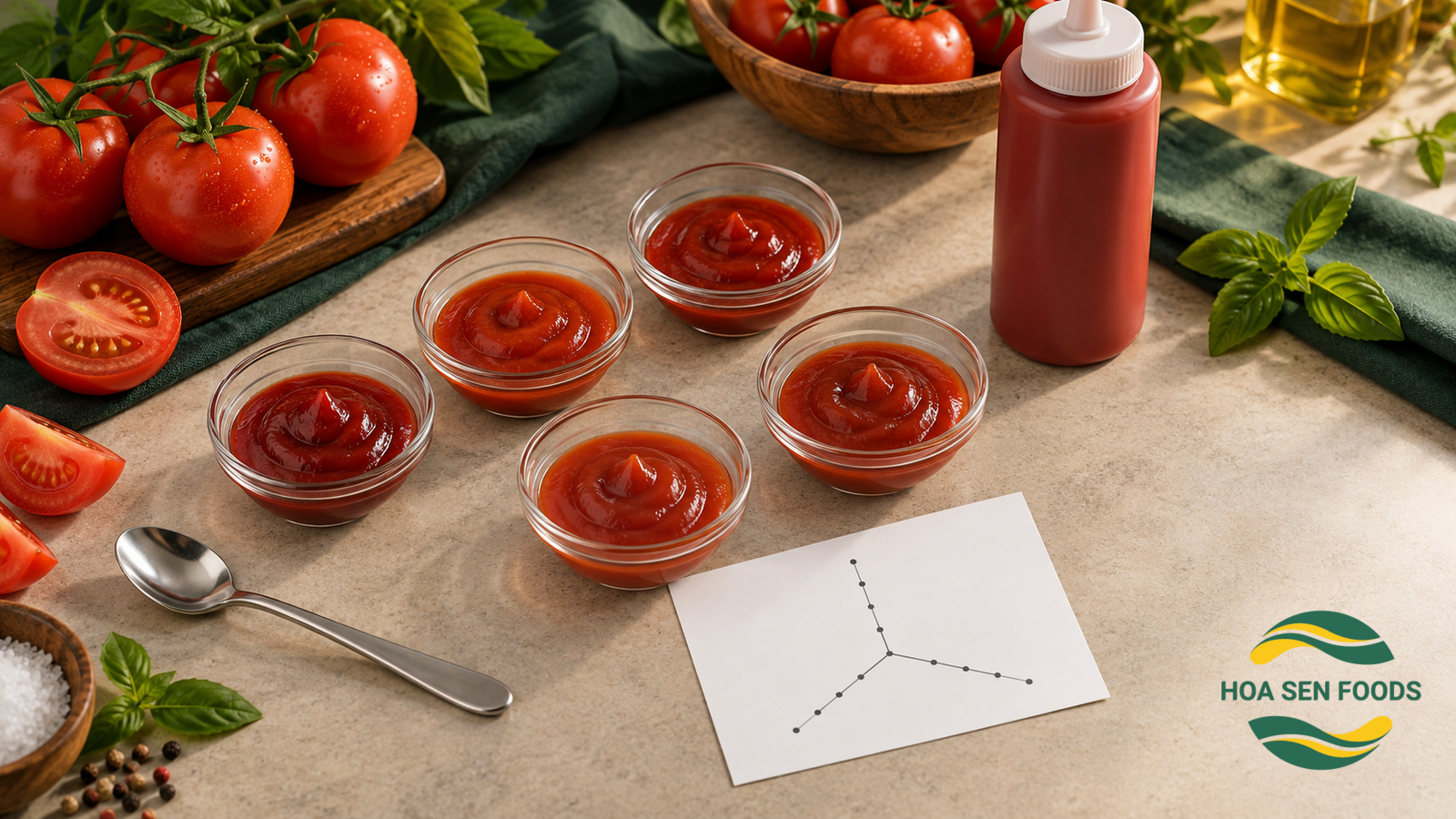
Quick answer: In contract ketchup manufacturing, sourness, sweetness and viscosity should be approved as one system, based on the food application, users, serving quantity, serving temperature, sales channel and packaging. The brief should describe the desired eating experience, reference samples and usage conditions instead of simply asking for a sauce that is “moderately sweet and sour with a good texture”. Technical specifications must be established separately by the R&D and QA teams for each project.
“Make a well-balanced sweet-and-sour ketchup” may sound like a clear request. For an R&D team, however, it still leaves important questions unanswered: Should the sourness appear quickly or feel rounded? Should the sweetness lift the tomato aroma or remain in the aftertaste? Should the product flow quickly through a sauce pump or cling to French fries?
The challenge of contract ketchup manufacturing is not solved by increasing or reducing one ingredient in isolation. The three sensory dimensions influence one another, while the final experience also changes with the food application, temperature, serving quantity and the way the sauce is dispensed from its package. A strong brief therefore turns subjective descriptions into criteria that can be tested, compared and approved.
Why should sourness, sweetness and viscosity be evaluated together?
A sample with pronounced sourness can feel fresh and cut through rich foods, but it may also taste sharp if its sweetness, tomato aroma or aftertaste is not balanced. Conversely, increasing perceived sweetness may soften the sensory impression of sourness, but it does not replace the evaluation of food safety, formulation or QA control parameters.
Viscosity is not an isolated criterion either. Ketchup that is too thick may cling well but be difficult to pump or dispense from a bottle; ketchup that is too thin may flow quickly but slide off the food. The project team should therefore approve flavour, mouthfeel and practical usability at the same time.
| Dimension to define | What the brief should describe | Useful test method | Common feedback problem |
|---|---|---|---|
| Sourness | Perceived intensity, onset, sharp or rounded sensation, and cleanliness of the aftertaste | Taste alone and with the target food under the expected serving conditions | Saying only “less sour” without identifying the front taste or aftertaste |
| Sweetness | Sweetness level, onset, persistence, and whether it lifts tomato aroma or balances sourness | Compare samples in pairs while keeping the serving quantity consistent | Assuming “sweeter” automatically means “more enjoyable” for every user group |
| Viscosity | Pouring, squeezing, pumping, cling, surface coverage and mouthfeel | Test with the intended package, dispensing tip, temperature and food application | Using “thick” or “thin” as the only measure of quality |
Start with the use case, not with a number
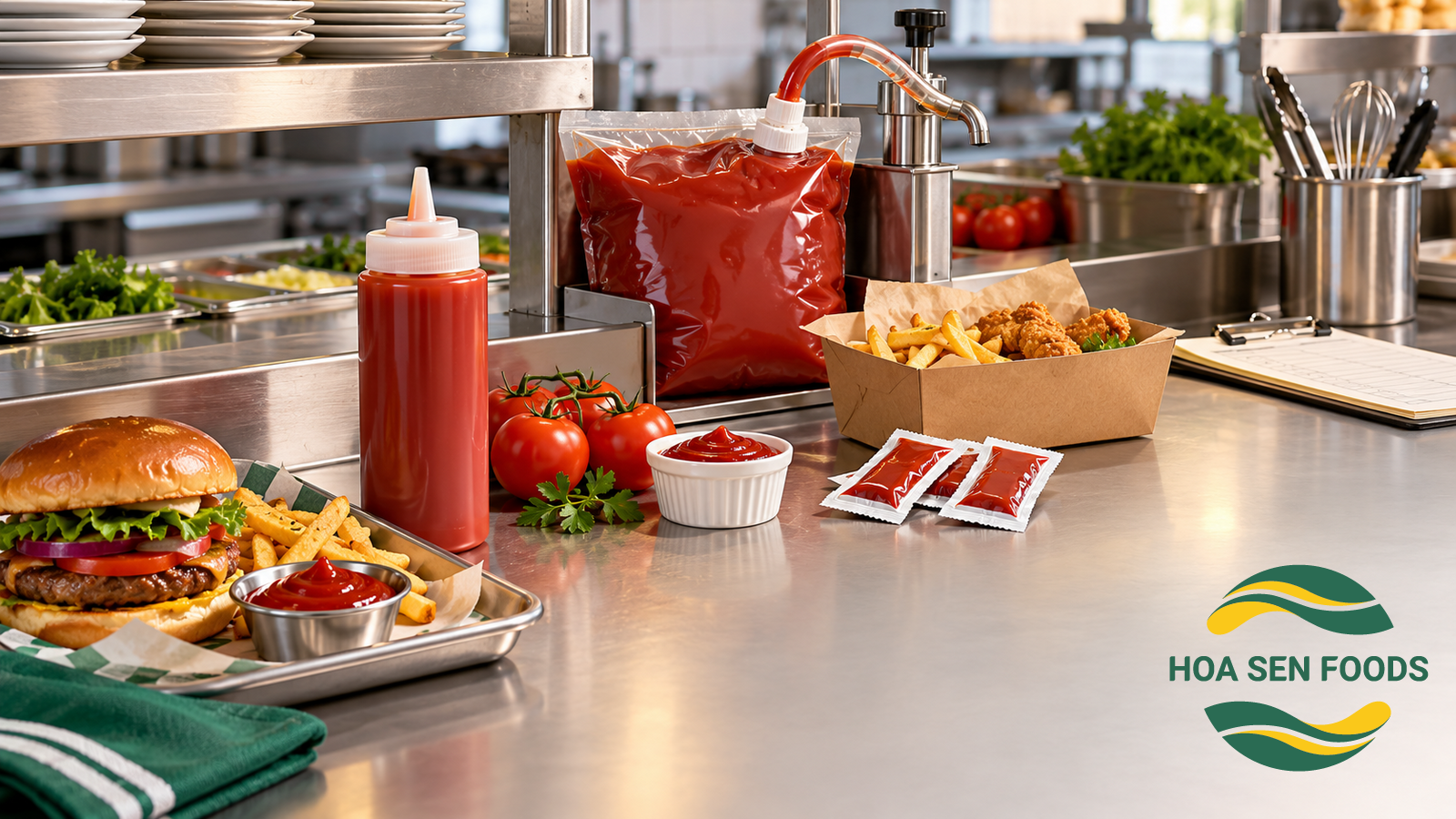
The same ketchup may need different behaviour when it is used on a hamburger, as a dipping sauce for fries, as a sauce base or through a pump dispenser in a foodservice kitchen. Before developing samples, the brand should answer five questions:
- Who will use the product and what flavour profile are they familiar with?
- What food will the ketchup be served with, in what quantity and at what temperature?
- Will it be sold through retail, foodservice or both?
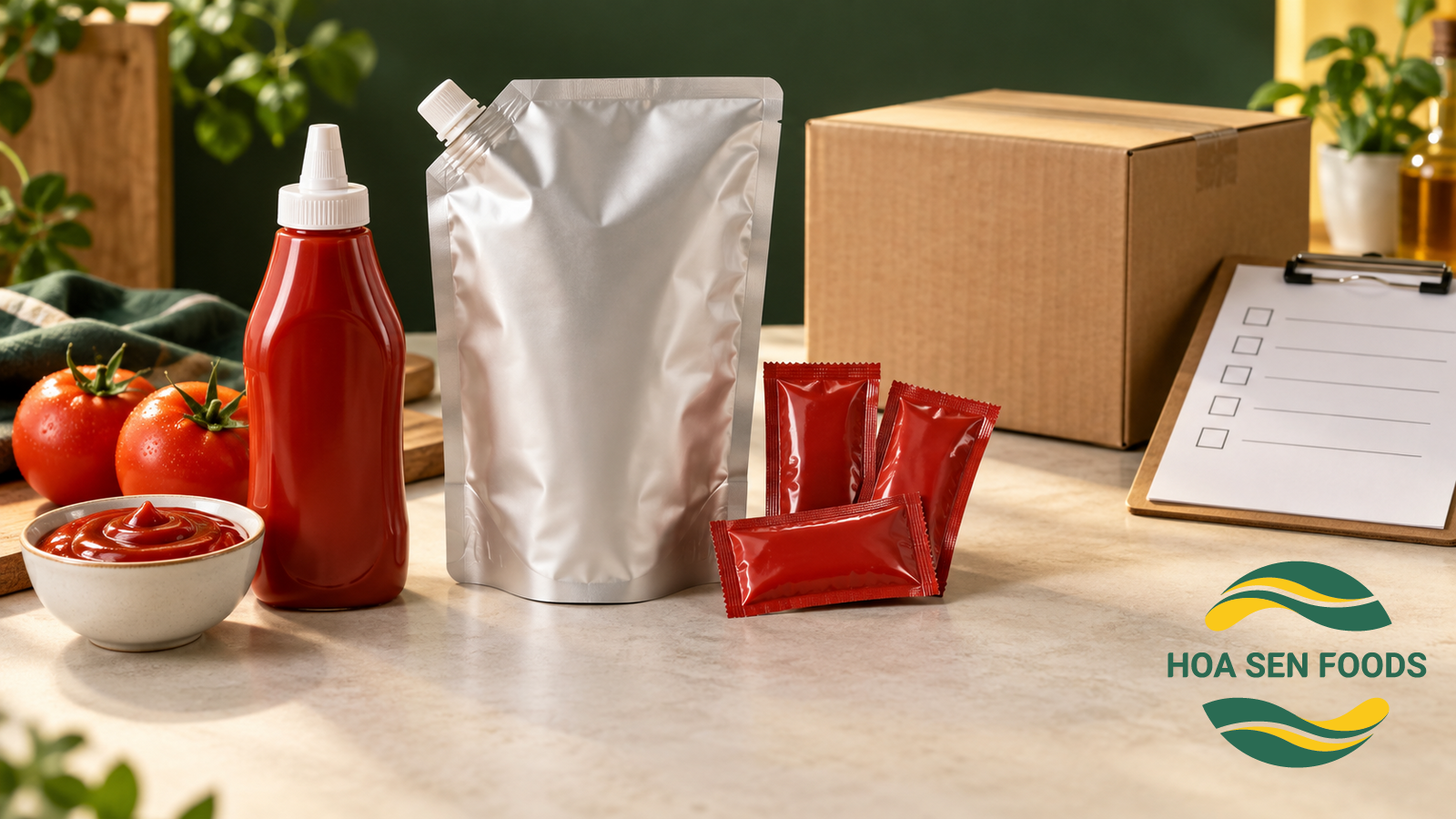
- Will the intended package be a squeeze bottle, pour bottle, bulk pouch, pump container or single-serve sachet?
- What does the target market require for the product name, ingredients, additives, allergens and label information?
These answers help R&D determine how to build and evaluate the samples. If packaging or the target market has not been finalised, record it as an assumption for the testing round rather than treating it as a final decision. See the seasoning R&D process from idea to finished product for an overview of formulation development and sampling.
How should the three sensory dimensions be described in the brief?
1. Sourness: describe intensity and timing
Instead of writing “slightly sour”, describe the sourness relative to a reference sample, when it appears and what remains after swallowing. If the product will be served with oily or rich food, test it in that exact context because the food base can change the perceived sourness.
Do not use perceived sourness to infer pH or product safety. These are separate evaluation layers: sensory perception serves the user experience, while formulation and safety parameters must be established, tested and approved by R&D and QA.
2. Sweetness: define its role, not only its level
Sweetness can round out the overall profile, lift the tomato aroma or balance perceived sourness. However, “moderately sweet” may mean different things for children, families, quick-service restaurants and consumers in different markets.
The brief should state the reference sample, target users and characteristics to avoid: sweetness that appears too early, a lingering sweet aftertaste, sweetness that masks tomato aroma or a profile that makes the food feel heavy. These descriptions are more useful than a generic adjective.
3. Viscosity: describe how the product behaves
Viscosity should be described through observable behaviour: Does the product leave the bottle easily? Does it form a clean stream? Does it cling to the food surface? Does it spread evenly as a sauce base? Does it leave a heavy mouthfeel?
In the United States, 21 CFR 155.194 includes quality criteria for the flow of products called catsup or ketchup within its regulatory scope. This illustrates why thickness may be linked to a defined test method and test conditions. A value from one market should not automatically become the target for every formula or country.
Use a context matrix to avoid approving a sample that only works in ideal conditions
| Use case | What to observe | Risk of tasting only with a spoon |
|---|---|---|
| Dipping fried food | Cling, ability to balance richness, and aftertaste after repeated dipping | The sample may taste good alone but disappear when served with the food |
| Burger or sandwich | Spreadability, flavour alongside bread and fillings, and leakage | Coverage and interaction with other ingredients remain untested |
| Foodservice pump container | Pumping, portion control, clean operation and consistency during service | Operational problems are not detected in a simple tasting |
| Retail bottle | Squeeze or pour force, portion control and cleanliness around the opening | Flavour is approved before the packaging experience is evaluated |
Eight details to include in a contract ketchup manufacturing brief
- Users and target market: who will use the product, where it will be sold and through which channel.
- Food application and usage: dipping, drizzling, pumping, mixing or use as a sauce base.
- Reference sample: what should be learned from it and what should not be repeated.
- Sourness profile: desired intensity, onset and aftertaste.
- Sweetness profile: perceived level, role and characteristics to avoid.
- Viscosity behaviour: pouring, squeezing or pumping, cling and mouthfeel.
- Packaging and use conditions: intended package, temperature, frequency of use and post-opening period to be studied. You can review glass-bottle ketchup manufacturing and 15 g ketchup sachet manufacturing when considering the initial packaging direction.
- Project constraints: ingredient, label, market, target price, expected volume and documentation requirements to be verified.
These details do not lock the formula from the beginning. They create a clear enough boundary for Hoa Sen Foods and the brand to discuss samples with purpose, reducing feedback such as “make it a little better” without identifying which attribute should change.
A six-step process for testing and approving ketchup samples
- Define the decision for the round: Does this round need to decide sourness, sweetness, viscosity or packaging usability?
- Select reference samples: specify the attribute to reference rather than asking to copy another product in full.
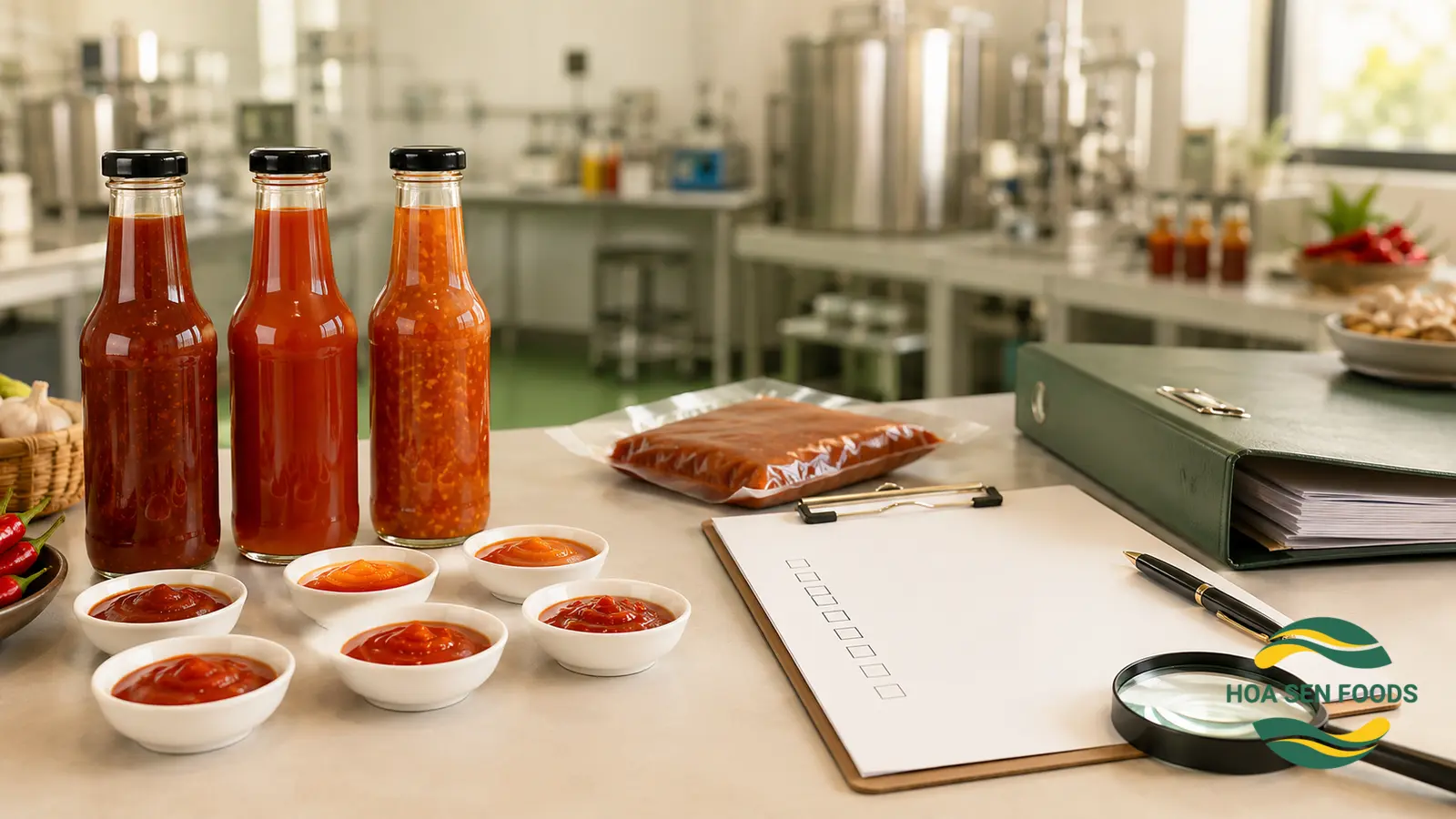
- Build a purposeful sample set: make controlled changes so the reviewers can recognise the impact of each dimension.
- Standardise tasting conditions: use the same food, serving quantity, temperature, order and feedback form.
- Give attribute-based feedback: record what to keep, what to change, the priority and the observable evidence.
- Lock the reference sample and acceptance criteria: do this only after the relevant parties agree on the formula, packaging and market scope.
ISO 13299:2016 provides general guidance for establishing a sensory profile, while ISO 4120:2021 describes the triangular test for determining whether two products have a perceptible difference. The method, panel size and acceptance criteria should be designed by the R&D and QA teams for the project objective. This article does not replace a formal sensory testing procedure.
Considerations when developing ketchup for export markets
The terms “tomato sauce”, “ketchup” and “catsup” should not be treated as interchangeable translations. In the United States, 21 CFR 155.194 covers the identity, ingredients, labelling, quality and fill of catsup or ketchup within the relevant regulatory scope. In the European Union, Regulation (EU) No 1169/2011 provides the framework for food information to consumers, including the principle that food information must not be misleading and the mandatory information required in applicable cases.
Codex CXS 57-1981 applies to processed tomato concentrates and states that it does not cover ketchup or other heavily seasoned sauces. Input-material standards and finished-product requirements must therefore be distinguished. The brand should confirm the requirements with the importer, relevant advisers or competent authorities before implementation.
Where can Hoa Sen Foods support the sample development process?
According to its public service information, Hoa Sen Foods provides consulting, research and development, processing, manufacturing and packaging activities for seasoning products, including ketchup. For a specific project, the scope of formulation, ingredients, packaging, testing, production volume, timeline and required documentation must be confirmed through a formal brief and technical discussion.
Before making contact, the brand should prepare the product type, market, user group, food application, reference sample, packaging format, expected volume and three separate descriptions for sourness, sweetness and viscosity. This gives both parties a practical basis for discussing the right questions from the first sample round.
Are you developing ketchup for retail, foodservice or private label? Send a brief covering the target market, usage, reference sample, packaging and expected volume so that Hoa Sen Foods can discuss contract ketchup manufacturing services. You can also review the contract-manufactured product range and 270 g ketchup manufacturing.
Frequently asked questions
Does thicker ketchup always mean better quality?
No. Suitable viscosity depends on the food application, dispensing method, packaging and desired experience. A product that is too thick may cling well but be difficult to pour or pump. Quality should be evaluated against the project’s full set of criteria.
Does increasing sweetness make ketchup safer by increasing its pH?
This should not be assumed. Sweetness may change the sensory perception of sourness, but pH, formulation, processing and food safety are technical matters that must be assessed separately by R&D and QA.
Can one formula be used for both retail and foodservice?
It may be possible for some projects, but the formula should be tested with the packaging, dispensing mechanism, temperature and operating rhythm of each channel. A shared formula should be approved only after the real usage experience and label or documentation requirements have been reviewed.
How should feedback on ketchup samples be written?
Separate the feedback by attribute: sourness onset, sweetness level, aftertaste, tomato aroma, pouring or pumping behaviour, cling and mouthfeel. State what should be kept, what should be changed and which sample is the reference.
How many sample rounds are enough?
There is no fixed number for every project. The number depends on brief clarity, customisation, decision speed, packaging changes and technical or market requirements. Set a decision objective for each round instead of testing without a defined endpoint.
Does the United States flow standard apply to every ketchup product?
No. 21 CFR 155.194 applies within its relevant definitions and market scope. The brand should confirm the legal product name, formula, sales channel and importing-country requirements before selecting a test method or acceptance threshold.
References
- Hoa Sen Foods – Services.
- Hoa Sen Foods – Ketchup manufacturing.
- ISO 13299:2016 – Sensory analysis: Methodology – General guidance for establishing a sensory profile; confirmed by ISO on 8 September 2026.
- ISO 4120:2021 – Sensory analysis: Methodology – Triangle test; confirmed by ISO on 9 June 2026.
- eCFR 21 CFR 155.194 – Catsup; checked on 18 September 2026.
- Regulation (EU) No 1169/2011; consolidated version dated 1 April 2025, checked on 18 September 2026.
- Codex CXS 57-1981 – Processed Tomato Concentrates; revisions up to 2023.
This article is provided for information and remains a draft pending approval. Formula, sensory specifications, technical parameters, packaging, labelling and export requirements must be confirmed for each product and market before production or publication.