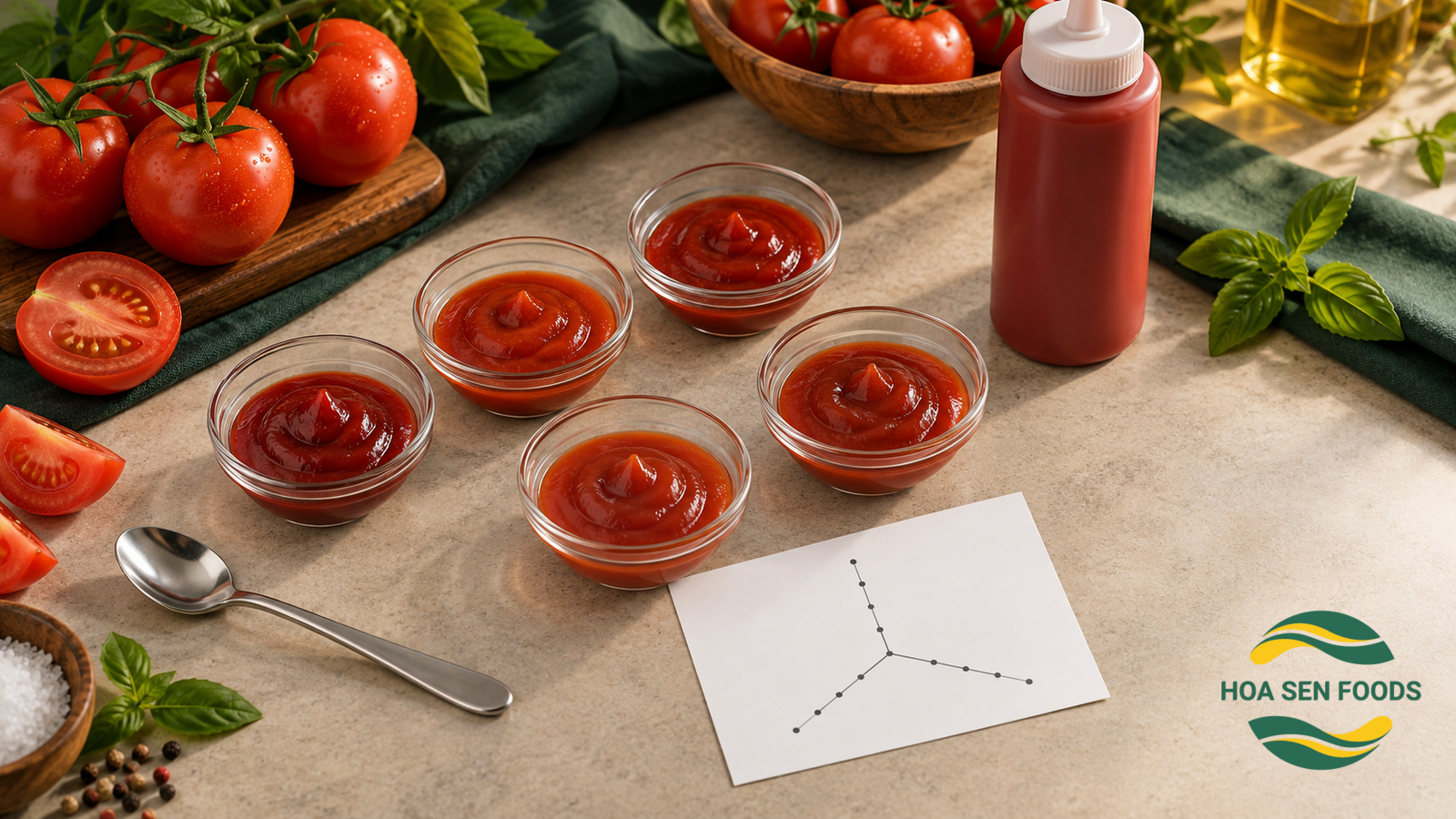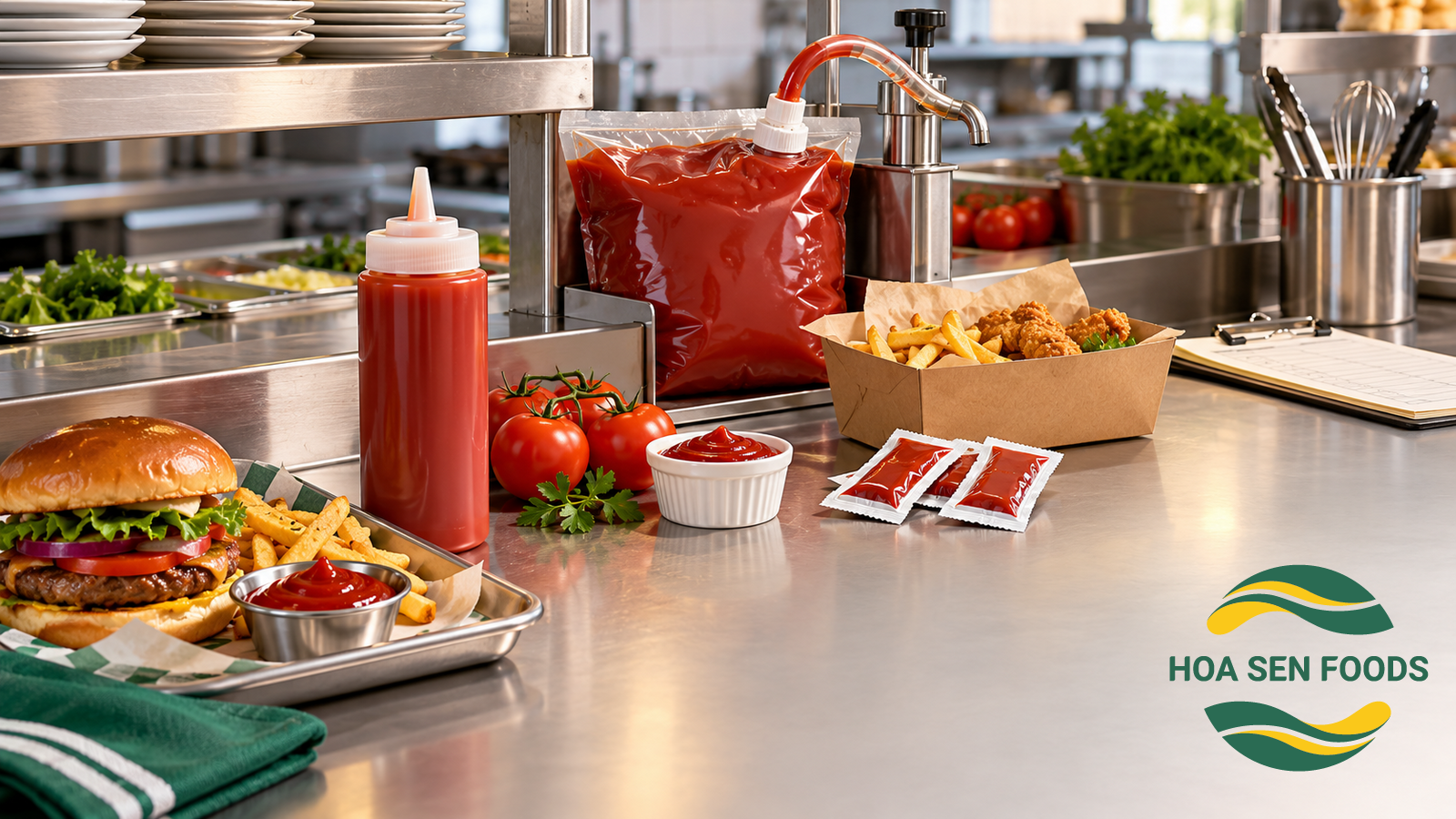


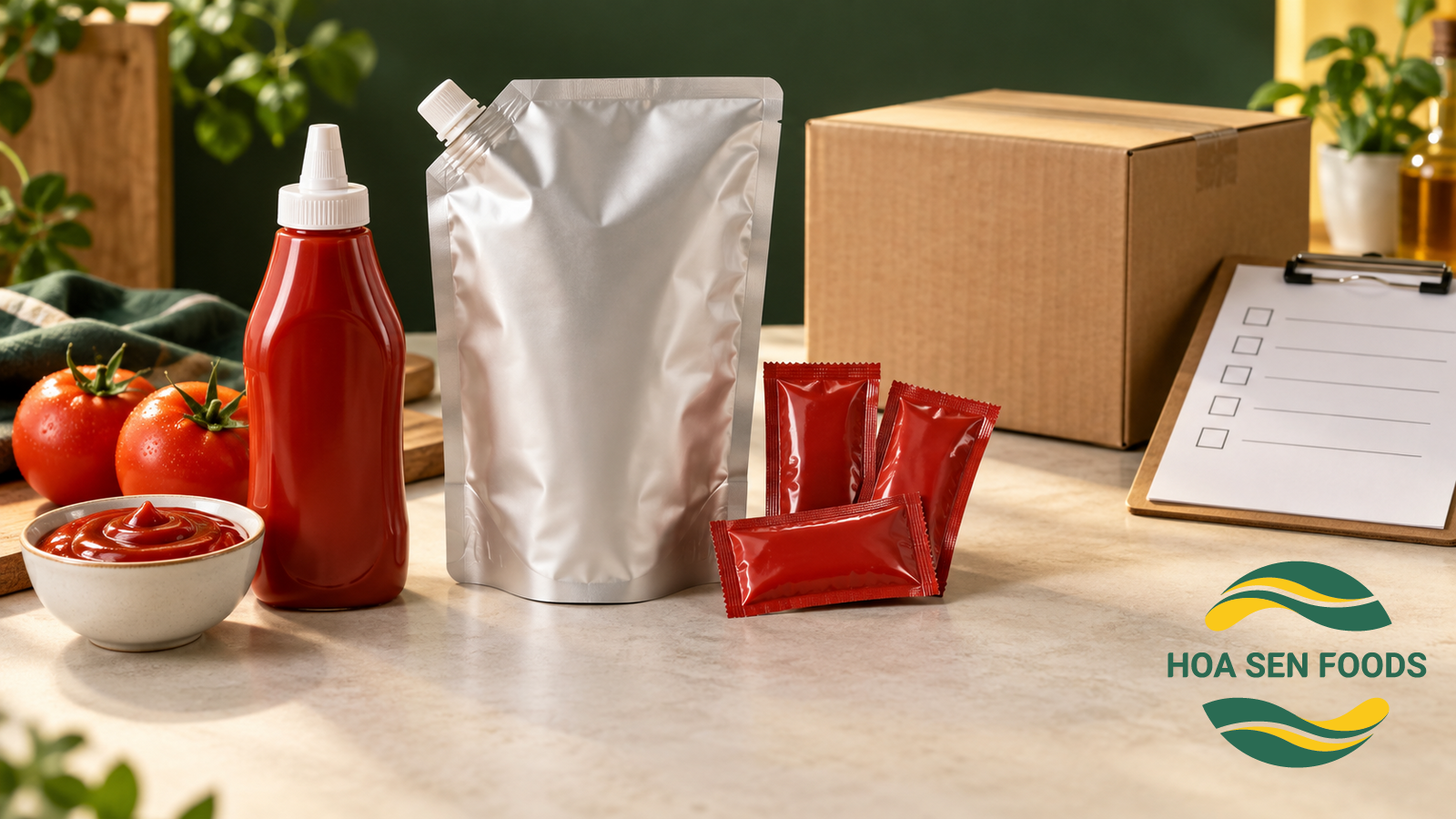
Quick answer: There is no single best packaging format for every export ketchup project. Bottles are often suitable for retail and repeated use; flexible pouches may help optimize storage or foodservice operations; and single-use sachets support portion control and takeaway service. The final decision should be based on the sales channel, conditions of use, product–material compatibility, filling line, labeling requirements and regulations in the target market.
For export ketchup, packaging is more than an outer shell. It affects the sauce dispensing experience, product protection, available space for mandatory information, case configuration, customer operations and total cost to the point of sale. Therefore, choosing a bottle, pouch or single-use sachet should begin with an evidence-based brief rather than simply copying the most common market format.
Why should ketchup packaging be decided early?
Formula, viscosity, dispensing method and packaging structure are interconnected. A product that flows well from a squeeze bottle may not deliver the same experience through a pouch nozzle. A visually attractive label may not leave enough room for all mandatory information. A convenient single-use sachet may not fit a project’s material-reduction goals or packaging obligations in the importing market.
The Hoa Sen Foods contract manufacturing product page currently presents several ketchup formats, including bottles, larger pack sizes and small sachets. For chili sauce, the chili sauce manufacturing category can provide additional examples of product formats. These are starting references, not a commitment that every material, size or structure is available for every project. Compatibility with the formula, equipment, order volume and target market still needs to be confirmed through a specific brief and testing.
Quick comparison: bottles, flexible pouches and single-use sachets
| Criterion | Bottle | Flexible pouch | Single-use sachet |
|---|---|---|---|
| Channels to consider | Retail, households, table service and repeated-use kitchens | Foodservice, refill or larger formats depending on the system | Quick-service restaurants, delivery, meal portions and events |
| User experience | Easy to hold and recognize; cap, squeeze force and dispensing volume need control | Compact when empty; nozzle, holder or dispensing equipment may need evaluation | Portioned by serving; requires clean tearing and dispensing |
| Communication surface | Generally convenient, depending on the shape and label | Can provide a large area, but folds and sealing zones must be considered | Limited space; mandatory information and readability must come first |
| Transport | Leakage, deformation, cap performance and case efficiency must be checked | May reduce unused space, but puncture resistance, seals and case stacking need testing | Easy to portion, but high unit counts require control of seals and secondary packaging |
| Points to verify | Material, cap, seal, squeeze performance and sauce compatibility | Film structure, nozzle, seal strength and machine compatibility | Film structure, tear opening, fill-weight variation, seal integrity and packing speed |
The table above is a screening framework, not a technical conclusion. Material, film structure, fill volume, storage conditions and testing criteria must be approved against the actual formula and legal requirements of the importing country.
When should you prioritize a bottle?
A bottle deserves consideration when the retail product needs strong brand visibility, consumers use the sauce repeatedly and the distribution channel is familiar with bottled formats. However, the decision should not be based on appearance alone. The project team should clarify:
- Whether users squeeze, pour or pump the product, and the desired amount per use.
- Viscosity at the actual serving temperature and the ability to empty the package.
- Cap structure, seal, leakage prevention and tamper evidence if required by the market.
- Space for the label, lot code, expiry date, languages and importer information.
- Case and pallet efficiency, load limits and the risk of deformation during transport.
Glass and plastic bottles should not be treated as interchangeable default choices. Each material has different requirements relating to impact, transport weight, inertness, use conditions and post-consumer recovery.
When should you assess a flexible pouch?
A flexible pouch may suit a project that needs a larger volume, compact storage or a sauce-dispensing system for foodservice. Its practical value depends on the complete system: pouch, nozzle, holder or pump, outer case and the process used after opening.
Before making a decision, check whether the pouch stands independently or sits inside a case, whether users need dedicated equipment, how leftover sauce is stored and whether staff can replace the pouch without increasing contamination or product-loss risks. Machine compatibility and the suitability of the film structure must be confirmed by the manufacturer; they should not be inferred from a visual sample alone.
When does a single-use sachet create value?
Single-use sachets are often considered for meals, delivery and models that require consistent portions. The example of 15 g ketchup sachet manufacturing can help identify questions for a project brief; it is a reference example and does not replace technical confirmation for a new project. This format may help operators forecast consumption by serving, but the small label area and higher number of packages per order must also be managed.
During development, evaluate tearing, clean dispensing, seal integrity, leakage inside the case and the ability to present mandatory information. If the product is exported to the European Union, the project should also review packaging obligations and extended producer responsibility requirements under Regulation (EU) 2025/40 and relevant national rules. The Regulation applies from 12 August 2026, but requirements, transition periods and exemptions vary; market-specific professional advice is needed based on the destination and market-entry date.
Nine questions for choosing packaging for an export project
- Where will the product be sold? Identify the country, sales channel, importer and distribution model.
- Who will use it? Households, restaurants, central kitchens and takeaway customers have different handling needs.
- How much is used per occasion? Serving volume influences whether the product should be poured, squeezed, pumped or portioned.
- How will the product be stored? Clarify conditions before and after opening, temperature, use period and real operating conditions.
- Does the viscosity match the dispensing method? Test the target formula rather than relying only on water or a different sample.
- Does the package provide enough space for legal information? Check the required information, languages, type size and coding.
- Can the filling line run this structure? Confirm tolerances, cap, nozzle, film, seal area and expected speed.
- How will cases and pallets be designed? Account for leakage, stacking, vibration, temperature and transit time.
- Who is responsible for compliance and post-consumer obligations? Assign responsibilities among the brand owner, contract manufacturer, packaging supplier and importer.
Legal requirements go beyond label design
For the European Union, food-contact materials must follow the principles of Regulation (EC) No 1935/2004. Under normal or reasonably foreseeable conditions of use, the material must not transfer constituents into food at levels that could endanger health, cause an unacceptable change in composition or deteriorate the food’s organoleptic characteristics. Regulation (EU) No 1169/2011 requires mandatory information for prepacked food to appear directly on the package or on an attached label, in a clear and legible form.
For the United States, materials and components that come into contact with food need an appropriate legal basis for their intended use and conditions of use. The FDA notes that packaging, adhesives, colorants and other components may fall within the scope of food-contact substances. Therefore, a packaging file should contain more than a quotation and drawing; it should include supplier documentation suitable for the target market.
Codex CXC 1-1969 also places packaging within the broader food hygiene system, covering production, packing, storage and transport. In other words, attractive packaging that does not protect the product under its intended conditions of use is not a complete solution.
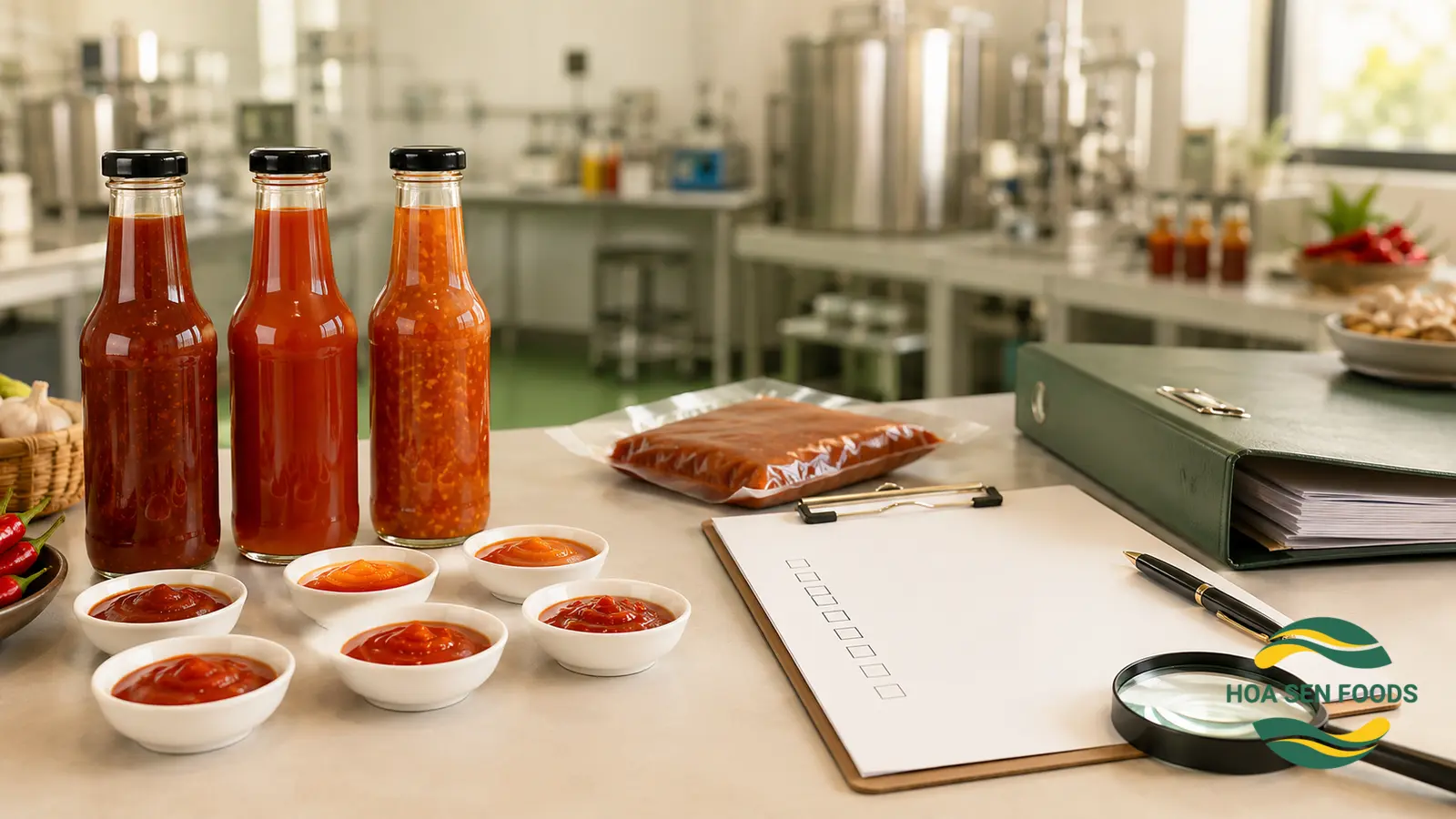
Testing plan to agree before approving the package
One fixed test list should not be applied to every project. R&D, QA, production, packaging and market teams should build a plan based on risk. At a minimum, the brief may include these testing groups:
- Product–material compatibility under the intended use and storage conditions.
- Cap, seal or seam integrity; leakage after case stacking and simulated transport.
- Dispensing performance at the actual temperature and the amount of product left in the package.
- Print durability, label readability, lot coding and mandatory information.
- Machine performance, fill-weight variation and defect rate in the trial batch.
- Shelf-life evaluation using the selected formula–process–packaging combination.
Acceptance limits, sample sizes, duration and methods must be approved for each project. This article does not replace technical or legal advice in the importing market.
What should a packaging brief to Hoa Sen Foods include?
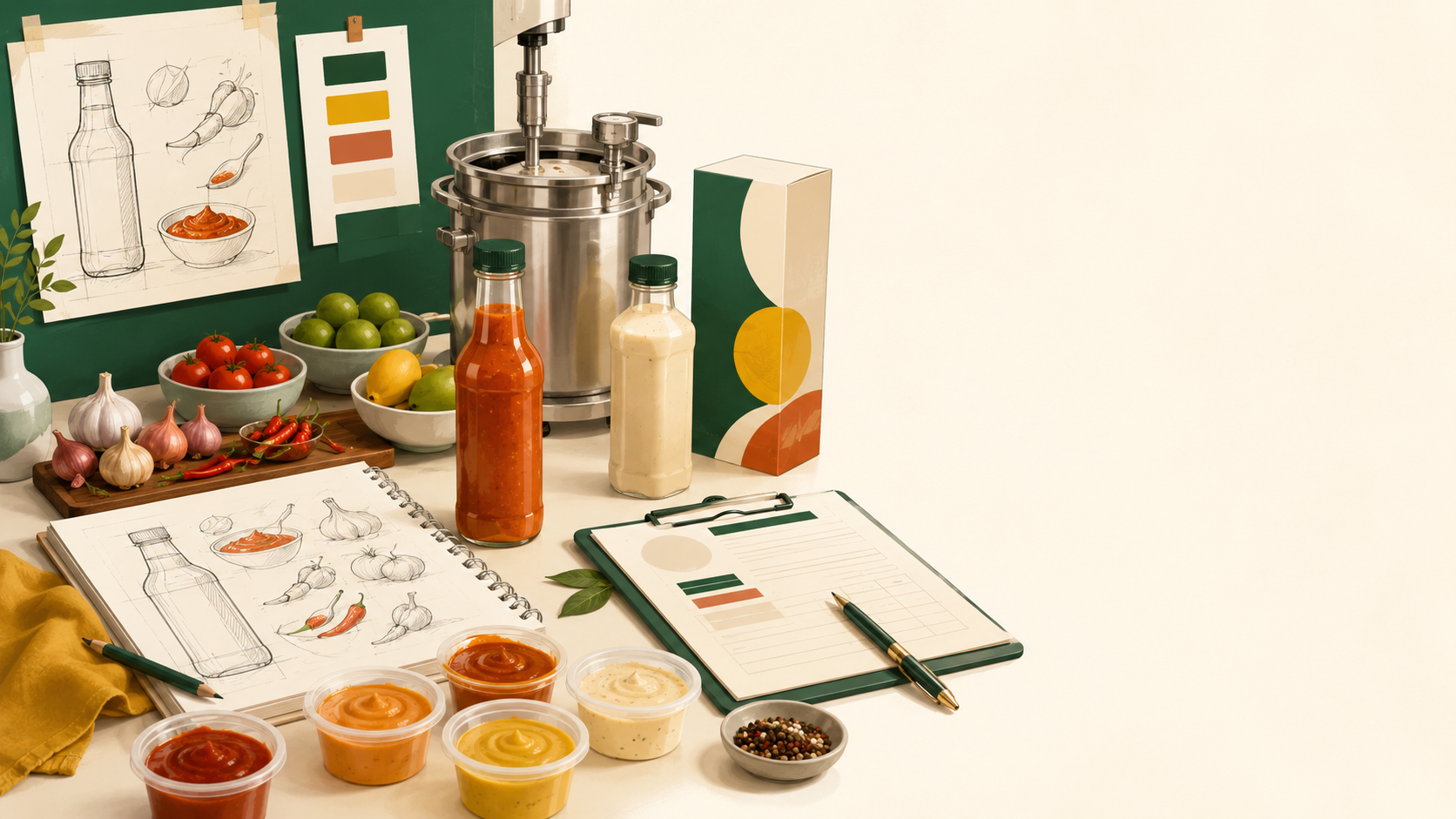
To make the discussion practical, the brand owner should prepare the target market, sales channel, desired fill volume, serving size, storage conditions, dispensing method, preferred material or reference sample, label requirements, case configuration, expected volume and launch date. If a detail is not yet known, mark it as “needs advice” instead of inserting an unverified number. For the formula and development process, read Seasoning R&D from idea to sauce bottle.
Hoa Sen Foods can receive a brief and help review the formula, manufacturing and packaging direction. The feasibility of each bottle, pouch or sachet format, as well as material, size, minimum order quantity and lead time, can only be confirmed after the relevant teams assess the specific project.
Conclusion: choose a packaging system, not just a container
Bottles, pouches and single-use sachets solve different problems. The right choice fits the user, product, equipment, logistics, labeling and market obligations at the same time. Start with the nine questions above, then test the actual formula–packaging combination before locking the design and placing a commercial order.
Are you preparing a private-label or export ketchup project? Send Hoa Sen Foods a brief covering the target market, sales channel and desired format so the team can review the points that need verification before sample development. You can also explore the OEM, ODM and private-label framework for sauces, the contract manufacturing product range and Hoa Sen Foods services.
Frequently asked questions
Which packaging is best for export ketchup?
There is no universal answer. Bottles, flexible pouches and single-use sachets should be compared according to the sales channel, serving size, storage conditions, transport, filling line and regulations in the importing country.
Can the same formula be used for a bottle and a small sachet?
It should not be assumed. Different filling, dispensing and surface-contact conditions may create separate testing requirements. The target formula and process need to be evaluated for each format.
Are single-use sachets always more cost-effective than bottles?
No. Total cost should include material, printing, secondary packaging, operations, defect rates, logistics and packaging obligations. The price of one package does not represent the full cost of service.
Can mandatory information be removed from a small label?
Some regulations may provide specific treatment for small packages, but this should not be assumed. Build an information matrix for the importing country and have it confirmed by a legal specialist or importer before printing.
Can Hoa Sen Foods manufacture every type of bottle, pouch and sachet?
This should not be concluded before assessment. The Hoa Sen Foods website presents examples of different formats, but actual capability for materials, dimensions, equipment, volume and lead time must be confirmed against each brief.
References
- Hoa Sen Foods — Contract manufacturing products, checked 23 September 2026.
- Hoa Sen Foods — Ketchup manufacturing, checked 23 September 2026.
- Hoa Sen Foods — 15 g ketchup sachet manufacturing, checked 23 September 2026.
- Regulation (EU) 2025/40 on packaging and packaging waste, checked 23 September 2026.
- Regulation (EC) No 1935/2004 on food contact materials, checked 23 September 2026.
- Regulation (EU) No 1169/2011 on food information to consumers, consolidated version dated 1 April 2025, checked 23 September 2026.
- U.S. FDA — Packaging and Food Contact Substances, checked 23 September 2026.
- Codex CXC 1-1969 — General Principles of Food Hygiene, checked 23 September 2026.
Draft pending approval: Marketing/Brand Owner, R&D/Technical, QA/Legal, Production/Packaging and Export/Importer representatives should review and approve this content before publication. Review no later than 23 March 2027, or earlier if the target market, packaging structure or applicable regulations change.