

Iraq is a Middle Eastern market worth considering for Vietnamese seasoning businesses, but it should not be approached through assumptions. To bring sauces, dipping sauces, marinades, spice blends, or private-label products into Iraq, businesses need to prepare the formula, Halal evidence, Arabic labeling, heat-resistant packaging, logistics, pricing, and importer plan before producing the first shipment.
Halal Seasonings for Iraq: What Should Vietnamese Businesses Prepare Before Exporting?
Iraq is an important Middle Eastern market for Vietnamese food businesses to study. It may not be the first market mentioned compared with the UAE, Saudi Arabia, Qatar, or Kuwait, but from the perspective of everyday food, seasonings, sauces, dipping sauces, and packaged products, Iraq has many factors worth serious attention.
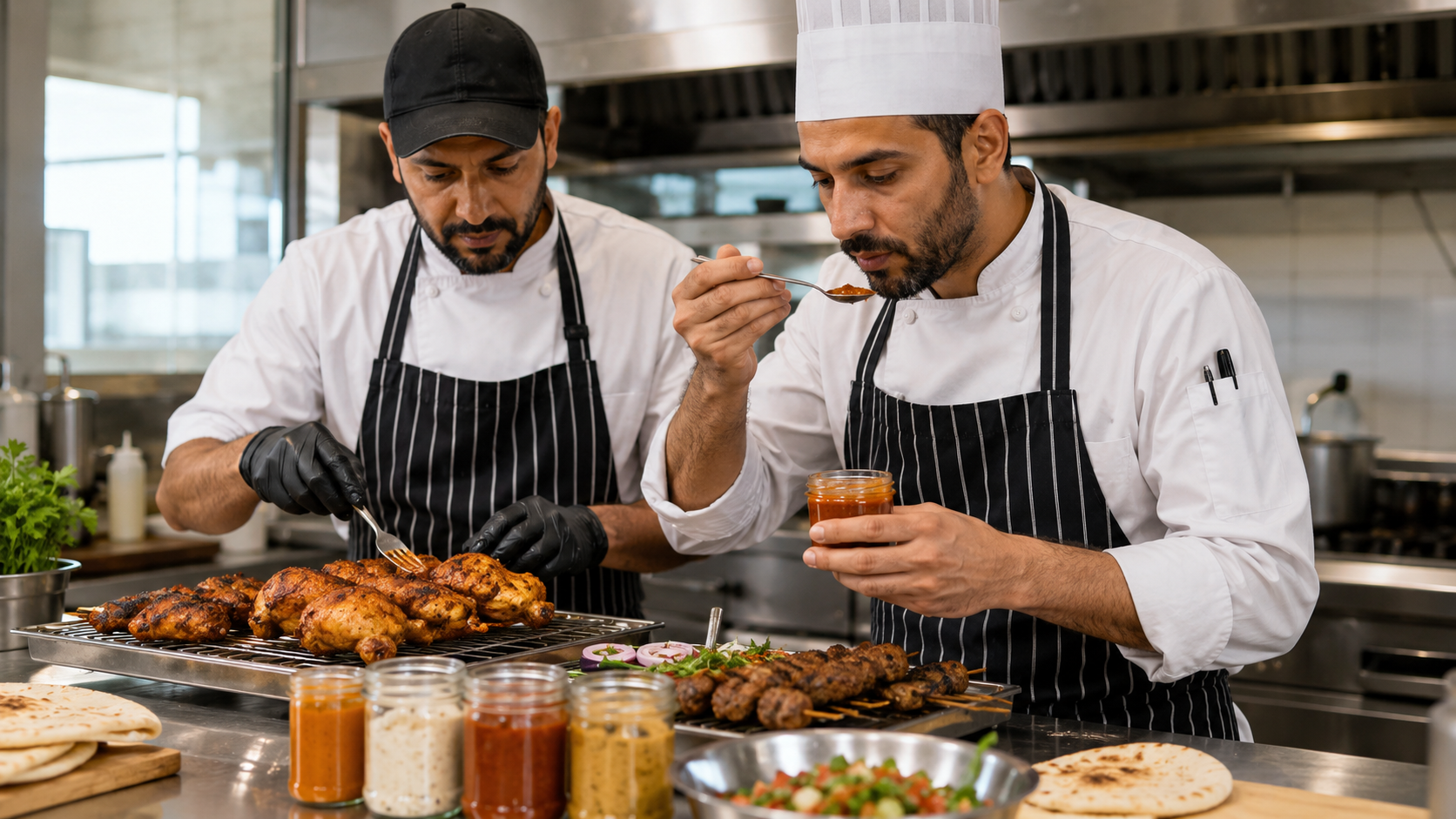
Iraqi consumers are familiar with rice, bread, meat, chicken, fish, beans, vegetables, grilled dishes, stews, pickles, side sauces, and aromatic spices. Dishes such as Iraqi-style biryani, dolma, kebab, grilled chicken, masgouf, tashreeb, kubba, falafel, shawarma, tomato-based stews, and bread-based meals create a natural foundation for dipping sauces, marinades, spice blends, plant-based dipping sauces, food-service products, and private-label products.
However, Iraq is not a market to enter by oversimplifying. A product may taste good in Vietnam but may not fit Iraq if the flavor is too unfamiliar, the Arabic label is not suitable, the ingredient dossier is unclear, the Halal certificate is not accepted by the importer, the price is unrealistic, the packaging is unstable, or the shelf life is not sufficient for shipping, warehousing, and distribution.
For Hoa Sen Foods, the first question is not simply: “Is Iraq a Muslim market?” The more practical question is: has this product become clear enough in formula, ingredients, Halal evidence, Arabic labeling, shelf life, packaging, logistics, and distribution channel to enter Iraq?
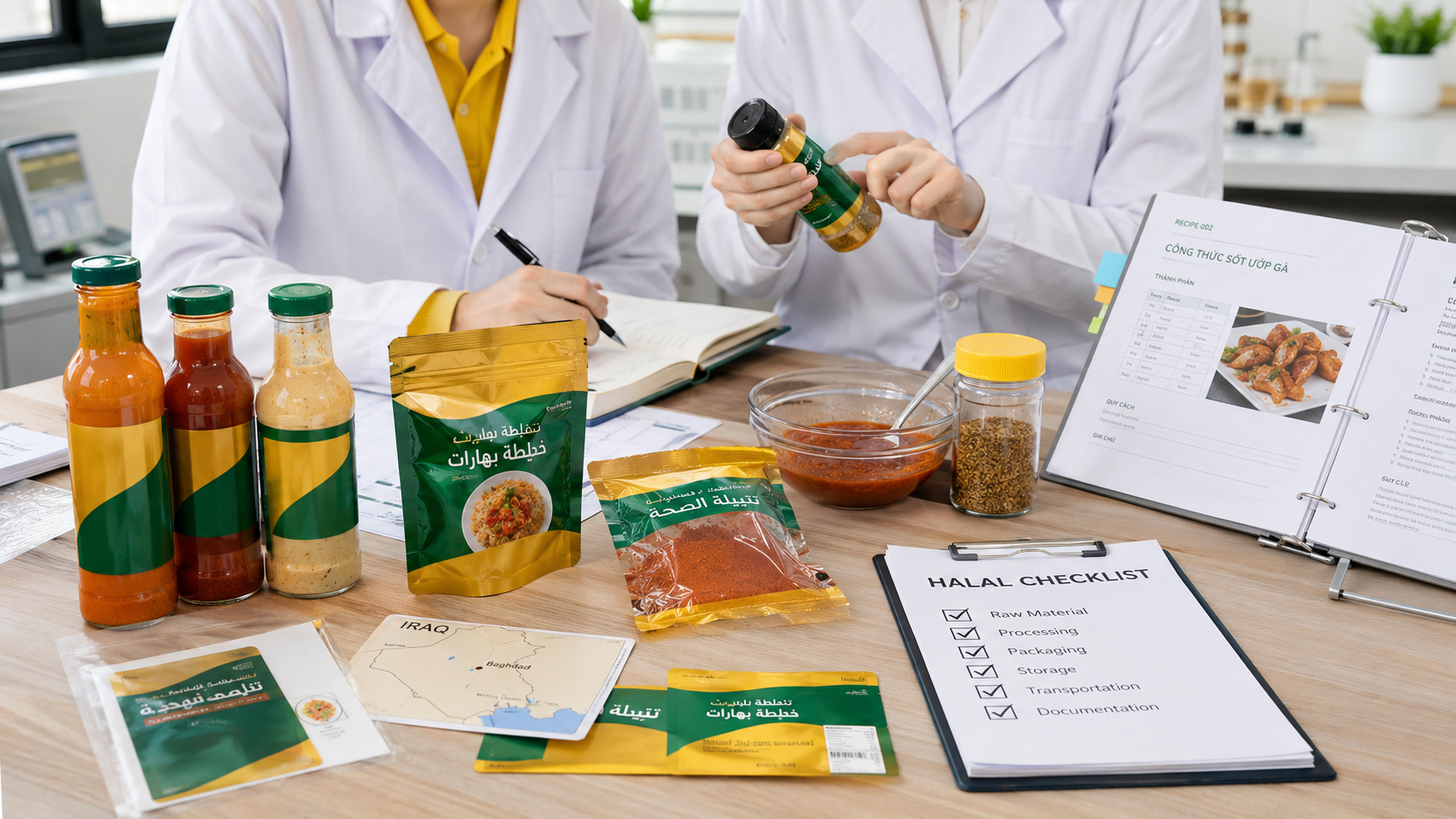
Why is Iraq worth attention for the seasoning industry?
Iraq has strong everyday food demand and a bold flavor culture. For seasoning products, the opportunity is not only about creating a new flavor. It is about developing products that can be used in real meals, supported by clear documentation, and distributed through suitable channels.
There are five reasons why Iraq deserves serious research from Vietnamese seasoning companies:
- Iraq has a food culture that uses many spices, meats, rice dishes, bread, grilled foods, stews, pickles, and side sauces.
- Halal plays an important role in consumer trust, especially for imported products and formulas that contain additives, flavorings, fermented ingredients, or complex components.
- Iraq has multiple market entry points, including Baghdad, Basra, Erbil/Kurdistan, Najaf, Karbala, Mosul, and other trade centers. Each region may have its own consumption and distribution characteristics.
- Food service, restaurants, central kitchens, grill shops, fast-food chains, and ingredient distributors may offer a more practical entry route than mass retail at the beginning.
- Imported products with suitable packaging, relevant taste, clear documentation, trusted certification, and strong importers may still find opportunities in supermarkets, imported-food stores, wholesale markets, and B2B channels.
For the seasoning industry, product groups worth considering include chili sauce, garlic sauce, sweet and sour sauce, tamarind sauce, grilled-meat marinades, seafood seasonings, spice blends, soy sauce, plant-based dipping sauces, vegan sauces, products for bread, shawarma, kebab, and falafel, and private-label products for Iraqi importers.
How should Halal be understood in the Iraqi context?
Iraq is a Muslim market, so Halal is a foundation of consumer trust. However, for the seasoning industry, Halal should not be treated as a simple logo or label. It should be understood as a control system with four layers.
| Control layer | Question to answer | Where Hoa Sen Foods can support |
|---|---|---|
| Product formula | Does the product contain alcohol, pork derivatives, gelatin, enzymes, emulsifiers, fats, flavorings, or additives from animal sources? | Review the formula at a foundation level and suggest lower-risk R&D directions. |
| Ingredient chain | Does each ingredient have specifications, COA, Halal certificates when needed, origin details, and supplier change commitments? | Standardize the ingredient list, work with suppliers, and prepare technical documentation. |
| Production process | Is there any cross-contamination risk? Are sanitation, retained samples, batch coding, and traceability clear? | Control production, packaging, batch codes, retained samples, and batch records. |
| Certification, label, and import | Will the Halal certificate be accepted by the Iraqi importer? Is the Arabic label suitable? | Provide technical information so clients can work with importers, testing bodies, and certification organizations. |
Halal risk in seasoning products usually does not come from salt, sugar, pepper, chili, garlic, or onion. The risk often comes from small but important components that affect taste and stability: flavorings, carriers, solvents, flavor enhancers, enzymes, fermented ingredients, food colors, preservatives, stabilizers, emulsifiers, processing aids, and direct food-contact packaging.
Do not ask “Is this product Halal?” based on intuition. The better question is: does this product have enough evidence to prove Halal suitability when an importer, inspection body, or customer asks?
How is Iraq different from Jordan, the UAE, and Saudi Arabia?
If a business has already studied Jordan, the UAE, or Saudi Arabia, it should not copy the same strategy directly into Iraq. Iraq has its own logic in terms of sales regions, logistics, importers, Arabic labeling, pricing, and distribution channels.
| Comparison | Key difference to understand | Implication for product preparation |
|---|---|---|
| Compared with Jordan | Iraq has a larger consumption scale and more distribution centers, but logistics and risk control may be more complex. | Do not look at only one entry point. Identify Baghdad, Basra, Erbil/Kurdistan, or another priority region. |
| Compared with the UAE | Iraq is not an international re-export hub like Dubai. Local importers, Arabic labels, realistic pricing, and stable supply matter more. | Focus on domestic consumption and real distribution channels instead of expecting a re-export model. |
| Compared with Saudi Arabia | Both markets have Islamic foundations and Arab flavor culture, but retail structure, income levels, logistics, and importer requirements differ. | Do not use a Saudi formula, label, or strategy for Iraq without checking market fit. |
For Iraq, businesses should pay special attention to Arab-Mesopotamian flavor preferences, Arabic labeling, Halal evidence, importer capability, regional differences, realistic pricing, heat-resistant packaging, sufficient shelf life, and food-service opportunities.
Why should the seasoning industry be especially careful when entering Iraq?
Seasoning products may look simple from the outside, but they are often complex in formula. A bottle of sauce, a jar of paste, a seasoning pouch, or a spice blend can contain many small ingredients.
To make a product stable in taste, color, aroma, texture, shelf life, and cost, formulas often use additives, flavorings, food acids, stabilizers, flavor enhancers, preservatives, colors, enzymes, or fermented ingredients.
| Risk group | Why it matters | Recommended approach |
|---|---|---|
| Flavorings and aromas | The origin, carrier, solvent, and production process of flavorings may affect Halal suitability. | Request specifications, COA, and Halal certificates when needed. Avoid using a generic “flavour” description if the dossier is unclear. |
| Flavor enhancers and umami bases | MSG, nucleotides, yeast extract, hydrolyzed protein, soy sauce, or fermented paste can affect the Halal dossier. | Check material origin, enzymes, fermentation process, and any alcohol-related risk. |
| Fermented ingredients | Soy sauce, vinegar, paste, and yeast extract can create strong flavor but require clear records. | Do not assume suitability or unsuitability. Use data and supplier confirmation. |
| Animal-derived ingredients | Gelatin, collagen, animal fat, animal enzymes, meat extract, or meat flavor increases risk. | Prioritize plant-based formulas or use these ingredients only when documentation is very clear. |
| Alcohol and solvents | Some flavorings, extracts, or fermented materials may involve alcohol or solvents. | Verify from the beginning instead of waiting until dossier submission. |
| Allergens | Soy, gluten, sesame, mustard, peanuts, milk, or seafood may require warnings. | Create an allergen list and cross-contamination risk map. |
| Direct food-contact packaging | Bottles, caps, seals, pouches, jars, adhesives, inks, and coatings can affect safety and perceived quality. | Check compatibility with the product, leakage, odor, color change, shelf life, and shipping conditions. |
| Heat and warehousing conditions | Sauces may separate or swell at the cap; dry seasonings may clump or lose aroma. | Test product stability under long-distance shipping and hot-climate conditions. |
| Shared production processes | Cross-contamination may occur through production lines, tools, storage, and packaging. | Control sanitation, batch coding, retained samples, traceability, and deviation handling. |
Which products should a business start with in Iraq?
Businesses should not bring the entire catalog into Iraq at the beginning. With a market that has many variables, it is better to start with one to three lead products that are easier to control for Halal, easier to explain to the importer, easier to test for taste, and more likely to generate repeat orders.
- Chili sauce, garlic sauce, sweet and sour sauce, or tamarind sauce that can be used with shawarma, kebab, grilled chicken, grilled fish, snacks, sandwiches, or fried foods.
- Marinades and seasoning sauces for grilled dishes, adjusted around garlic, onion, cumin, paprika, pepper, lemon, chili, and herbs.
- Spice blends or seasoning mixes with a Southeast Asian difference that can fit seafood, dipping, or grilled dishes.
- Soy sauce, dipping sauce, and plant-based sauces to reduce Halal risk, while still controlling fermented ingredients, additives, and saltiness.
- Sauces or pastes for food service, central kitchens, restaurants, or local food manufacturers.
- Private-label products for Iraqi importers, supported by R&D, recipe confidentiality, production control, and technical documentation.
Choose the Iraq entry channel before certification
Before certification, testing, or packaging printing, businesses need to identify which channel the product will enter. Each channel leads to different requirements for formula, labeling, pack size, pricing, and documentation.
| Market entry channel | What to prepare | Suitable product direction |
|---|---|---|
| Modern retail | Clear label, attractive packaging, suitable pack size, barcode, shelf life, and nutrition information when needed. | Dipping sauces, chili sauce, small-pack seasonings, and plant-based dipping sauces. |
| Wholesale and traditional distribution | Pricing, cartons, packaging durability, stock rotation, and delivery capability are important. | Economic pack sizes, dry seasonings, mainstream sauces, and easy-to-resell products. |
| Food service | Larger pack sizes, consistent quality, volume-based pricing, and regular supply. | Sauces, pastes, marinades, dipping sauces, and seasonings for restaurants and central kitchens. |
| Grill, kebab, and shawarma channels | Products need to be tested in real dishes, easy to use, easy to mix, and stable in frequent use. | Spicy sauces, garlic sauces, marinades, spice rubs, and dipping sauces. |
| Kurdistan / Erbil | This can be a separate entry point with distribution systems and practical requirements different from Baghdad or Basra. | Imported products, food service, urban retail, and private label. |
| Private label | Clarify formula ownership, packaging design, certification responsibility, testing, MOQ, and confidentiality. | Products developed according to the importer’s taste, price point, and private label. |
10-step roadmap for preparing seasoning products for Iraq
- Define the region and sales channel: Determine whether the product targets Baghdad, Basra, Erbil/Kurdistan, Najaf, Karbala, Mosul, urban retail, wholesale markets, food service, grill channels, private label, or domestic distributors.
- Work early with the Iraqi importer: The importer helps confirm practical requirements for Halal certification, Arabic labeling, import dossiers, pack size, shelf life, pricing, payment, shipping, and distribution.
- Select lead products: Prioritize products that are easier to control for Halal, fit the target price, work with Middle Eastern meals, and have repeat-order potential.
- Create a detailed formula table: Each ingredient should include commercial name, technical name, material code, supplier, origin, usage rate, function, Halal status, specification, COA, and risk notes.
- Classify ingredient risk: Group ingredients into low, medium, and high risk so they can be handled before dossier submission or formula finalization.
- Check labels, additives, claims, and import documents: Work with the importer to confirm what the Arabic label should include, whether additives and flavorings are suitable, how allergens should be declared, and whether claims are supported by evidence.
- Rework the formula if needed: If an ingredient is not Halal-suitable or lacks a clear dossier, reformulate with more transparent materials instead of forcing the old formula.
- Control production, cross-contamination, and allergens: Check material separation, tools, lines, sanitation, retained samples, batch codes, packaging, labels, and deviation handling.
- Select a suitable Halal certification body: Confirm whether the certification body is accepted by the Iraqi importer and whether its scope fits the product category.
- Run trial production and control the first shipment: A trial batch helps check formula, sensory profile, stability, packaging, label, batch dossier, delivery time, and real cost.
Document checklist for seasoning businesses
| Dossier group | Documents to prepare |
|---|---|
| Product dossier | Product name in Vietnamese, English, and Arabic if available; product description; detailed formula; production process; quality criteria; microbiological or heavy-metal criteria if available; expected shelf life; storage conditions; product images; packaging specifications; intended use; and expected sales channel. |
| Ingredient dossier | Ingredient list; specifications; COA; Halal certificates if available; plant, animal, microbial, or synthetic origin; additive and processing-aid information; allergen information; supplier commitments; and replacement plan for important ingredients. |
| Factory and process dossier | Factory layout; production flow chart; sanitation procedures; cross-contamination control; allergen control; batch control; retained samples; deviation, complaint, and recall handling; personnel training; water control; pest control; hygiene; and maintenance. |
| Packaging and label dossier | Label artwork; Arabic and English label versions according to importer requirements; ingredient and additive list; nutrition information if applicable; allergen declaration; Halal claim if applicable; claim evidence; food-contact packaging specifications; barcode; carton images; batch code; expiry date; and pallet information. |
| Commercial dossier | Iraqi importer or partner; sales channel; priority regions such as Baghdad, Basra, Erbil/Kurdistan, Najaf, Karbala, or Mosul; target price; MOQ; delivery terms; volume plan; reorder plan; market-test strategy; and possible expansion into Jordan, Kuwait, Saudi Arabia, the UAE, or Iraqi communities abroad. |
Common mistakes Vietnamese seasoning businesses make when entering Iraq
| Common mistake | Why it is risky | How to avoid it |
|---|---|---|
| Thinking Iraq only needs Halal | Halal is important but not enough. The product still needs suitable taste, price, label, channel, shelf life, and importer support. | Treat Halal as one part of the formula, dossier, label, and commercial system. |
| Not segmenting the market by region | Baghdad, Basra, Erbil/Kurdistan, and other cities can be very different. | Choose the priority region before finalizing product and label decisions. |
| Preparing Arabic labels too late | This can lead to packaging revision, reprinting, or export delays. | Develop the label with the importer from the preparation stage. |
| Using a Halal certificate that is not accepted | The business may have to redo certification, losing time and cost. | Confirm the certification body with the importer before implementation. |
| Keeping the formula unclear | Generic terms such as flavoring, additives, or flavor enhancers make Halal and label assessment difficult. | Standardize specification, COA, origin, and certification for each ingredient. |
| Ignoring Iraqi taste preferences | A product that tastes good in Vietnam may not suit Iraq. | Test the flavor with importers, chefs, target users, or food-service channels. |
| Using packaging that cannot handle heat | Products may leak, swell, separate, clump, lose aroma, or lose quality. | Test packaging stability under realistic shipping and warehousing conditions. |
| Setting the first MOQ too high | Importers may hesitate to test a new product. | Design a reasonable first shipment to learn from the market. |
| Ignoring food service | Retail may require time to build awareness. | Use food service, grill shops, kebab, and shawarma channels as real-use testing channels. |
The role of a contract manufacturing partner in the Iraq Halal journey
If a business already has a factory, R&D team, quality management system, export compliance staff, and Halal experience, it can handle many parts internally. But for startups, brand owners, F&B businesses, or distributors that want to develop their own products, a suitable contract manufacturing partner can significantly reduce risk.
- Listen to market goals, priority region, and sales channel.
- Advise which products should be prioritized instead of bringing the entire catalog into Iraq.
- Review the formula for Halal, allergen, and additive risks.
- Develop samples in a direction that is easier to support with documentation.
- Adjust taste to fit Iraqi and Middle Eastern dishes.
- Work with transparent ingredient suppliers.
- Check product stability under heat and long-distance shipping.
- Control production, packaging, retained samples, and batch codes.
- Support technical information for labels, packaging, and product dossiers.
- Protect recipes, production volume, and commercial information.
- Clearly explain what can be done, what cannot yet be done, and which parts need confirmation from certification bodies, testing laboratories, or importers.
A good partner is not someone who promises that everything can be done. A good partner helps the business see a realistic path, including the points that must be prepared carefully before moving forward.
Where can Hoa Sen Foods support businesses?
As a production and R&D back-end partner for seasoning and food brands, Hoa Sen Foods can support clients at the foundation stages:
- Consulting on product ideas for the Iraqi market.
- Developing formulas for seasonings, dipping sauces, sauces, pastes, dipping salts, or packaged products.
- Testing samples and adjusting based on feedback.
- Optimizing taste, pack size, packaging, and production cost.
- Reviewing ingredient risk at a foundation level.
- Checking product stability under long-distance shipping and hot-climate conditions.
- Controlling production and packaging.
- Preparing technical information so clients can work with importers, testing bodies, Halal certification organizations, or suitable market consultants.
- Protecting client formulas and business information.
Hoa Sen Foods should not be understood as a Halal certification body or legal import consulting firm. For official certification requirements for Iraq, businesses need to work with a competent certification organization, the importer, and suitable consulting partners.
Quick map: 5 control layers before entering Iraq
| Control layer | Quick check question |
|---|---|
| 1. Formula | What is inside the product? Are there any Halal-risk ingredients? Do additives and flavorings have clear documentation? Can any ingredient be replaced with a clearer option? |
| 2. Ingredient dossier | Does each ingredient have specifications, COA, Halal certificates when needed, allergen information, supplier details, and origin information? |
| 3. Production | Does the process control cross-contamination, sanitation, allergens, batch codes, retained samples, packaging, and traceability? |
| 4. Label, packaging, and Halal | Does the product have Arabic/English labels, ingredient list, nutrition information, shelf life, batch number, storage instructions, allergen warnings, claims, and Halal certification if applicable? |
| 5. Commercial readiness | Does the product have a clear customer segment, sales region, channel, price point, pack size, importer, and market-test plan? |
Conclusion: enter Iraq through preparation, not broad expectations
Iraq is a Middle Eastern market worth considering for Vietnamese seasoning businesses. It has a clear Islamic food culture, bold taste preferences, strong everyday food demand, and opportunities for sauces, dipping sauces, marinades, spice blends, food-service products, and private-label products if businesses enter in the right way.
However, Iraq is not an easy market if a business only looks at Halal and ignores taste, Arabic labeling, pricing, shelf life, logistics, packaging, food service, regional differences, and importer capability.
A seasoning product that wants to enter Iraq needs five clear foundations: clear formula, clear Halal and food-safety dossier, clear labeling, clear quality, and clear commercial planning.
For Hoa Sen Foods, every seasoning idea is not only a formula. It can be the ambition of a brand owner who wants to bring a unique flavor to a new market, a distributor who wants to develop a private label, or an F&B business that wants to standardize a packaged product.
Download the in-depth Halal guide for the Iraq market
FAQ
Do seasoning products exported to Iraq need Halal certification?
Iraq is a Muslim market, so Halal is very important, especially for imported products and formulas with complex ingredients. However, the specific requirement should be confirmed with the importer, sales channel, and accepted certification body.
Which language should product labels for Iraq use?
Arabic labeling is the foundation. English can support B2B transactions, but consumer products often need a clear Arabic label or Arabic supplementary label according to the importer’s confirmation.
Which products should businesses start with in Iraq?
Businesses should start with one to three lead products that have lower Halal risk, clear ingredient dossiers, flavors that can work with Iraqi or Middle Eastern dishes, and packaging that can withstand long-distance shipping and hot climates.
Can food service be a good entry channel for Iraq?
Yes. Restaurants, grill shops, shawarma and kebab outlets, central kitchens, and ingredient distributors can be worth testing, especially when retail products do not yet have strong brand awareness.
Why is packaging important when exporting to Iraq?
Iraq has hot climates in many areas, and warehousing and distribution conditions may vary. Weak packaging can cause leakage, swelling caps, separation, clumping, aroma loss, or quality reduction.
Does Hoa Sen Foods provide Halal certification?
No. Hoa Sen Foods supports R&D and production, including formula development, sample testing, packaging optimization, production control, and technical information preparation. Official certification must be handled by a competent certification body and confirmed by the importer.
Should a business use the same formula for Iraq and GCC countries?
No business should assume this automatically. Iraq has its own taste preferences, distribution channels, logistics, and importer requirements. Formula, label, pack size, and documentation should be checked for each market.