

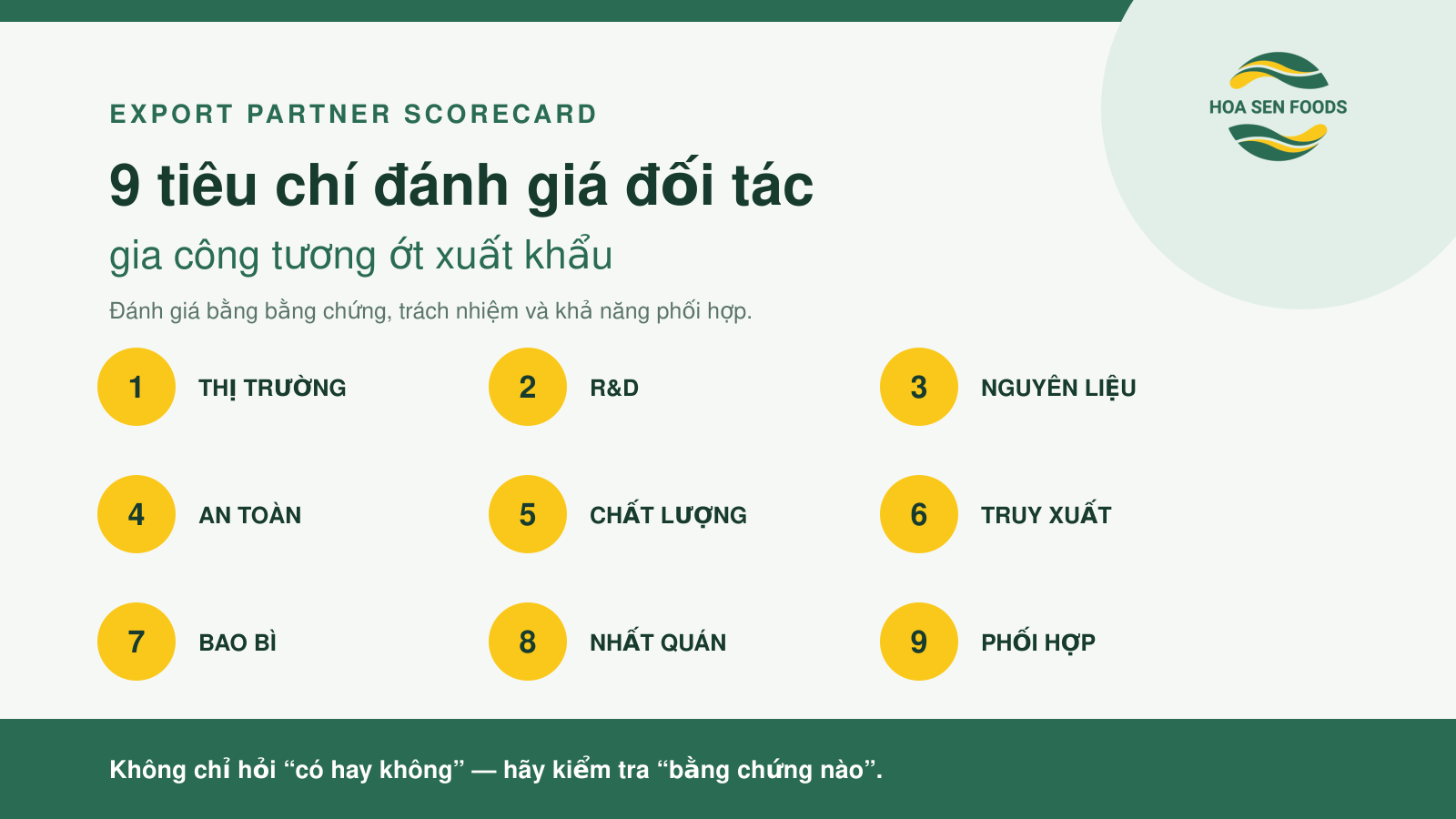
Quick answer: An export chili sauce manufacturing partner should not be evaluated only by price or by the first product sample. Businesses should assess nine areas together: target-market understanding, R&D capability, ingredient control, food safety and quality, traceability, packaging, batch consistency, importer coordination, and change control. Each criterion should be supported by evidence that can be reviewed.
Fit matters more than size or the lowest price
A large manufacturer is not automatically the right partner for every product, sales channel, or stage of brand development. Likewise, a supplier that can produce a good-tasting sample may still be weak in documentation, packaging control, traceability, or export coordination.
A scorecard does not replace an audit, legal review, importer assessment, or regulatory verification. Its role is to help purchasing, R&D, quality, and commercial teams use the same decision-making framework.
How to use the 9-criteria scorecard
- Insufficient evidence: the supplier has only provided verbal explanations or documents that do not clearly apply to the project.
- Conditionally acceptable: initial evidence is available, but scope, validity, or applicability still needs confirmation.
- Acceptable: evidence has been reviewed and is relevant to the product, target market, and responsibilities of each party.
Do not turn the scorecard into a mechanical points exercise. A gap in food safety, regulatory compliance, or traceability can outweigh advantages in price or speed.
1. Understanding the target market and assigning responsibilities
A suitable partner should ask where the chili sauce will be sold, through which channels, who the importer is, and which party is responsible for labeling, documentation, testing, registration, or other market-entry requirements. In the United States, importers subject to the Foreign Supplier Verification Programs (FSVP) rule are responsible for conducting risk-based foreign supplier verification activities where applicable.
Evidence to review: target-market brief, responsibility matrix, and a list of requirements that must be confirmed with the importer or local specialist.
2. R&D capability that matches the chili sauce brief
R&D should translate business and consumer requirements into measurable sample criteria. Depending on the project, this may include intended use, target consumer, heat level, sweet-sour-salty balance, color, viscosity, texture, and packaging format.
Evidence to review: product brief, sample evaluation form, reference sample, formula approval process, and version-control records.
3. Ingredient control and supplier-change management
Changes in raw material source, origin, specification, or supplier can affect sensory quality, process performance, compliance documentation, or final-product consistency. A suitable contract manufacturer should have a defined process for approving ingredients and communicating significant changes.
Evidence to review: ingredient specifications, supplier documentation, substitution approval process, and change-notification procedure.
4. Food safety system and process controls
Codex CXC 1-1969 identifies Good Hygiene Practices as a foundation for food hygiene and HACCP as a risk-based approach to controlling significant hazards. However, the name of a system or certification alone does not prove that every product is suitable for every export market.
Evidence to review: certification scope where applicable, validity status, monitoring records, corrective-action records, and clearly assigned responsibilities.
5. Product specifications and testing plan
There is no single pH, water activity, Brix, viscosity, or shelf-life target that should be applied to every chili sauce formula. Product specifications must be developed according to the formula, process, packaging, storage conditions, intended use, and destination market.
Evidence to review: proposed product specification, sampling and testing plan, test methods, acceptance criteria, and deviation-handling procedure.
6. Traceability, lot coding, and recall readiness
Traceability should connect incoming ingredients, production lots, packaging materials, inspection results, and outbound shipments. For the European Union, traceability principles are established under Regulation (EC) No 178/2002, although the exact application should be reviewed for the specific product and supply chain.
Evidence to review: lot-code examples, incoming-production-outgoing records, recall procedure, and mock-recall results where available.
7. Packaging suited to the formula and logistics journey
Packaging is not only a branding decision. Sauce viscosity, filling method, closure integrity, packaging material, labeling requirements, shipping cartons, storage conditions, and logistics conditions all need to be considered together.
Evidence to review: packaging samples, material documentation where required, seal or closure checks, compatibility testing, and destination-market labeling requirements.
8. Batch consistency and change control
The approved sample should become a reference point for later production. The manufacturer should have a process for controlling formula versions, approved samples, ingredient changes, packaging changes, and relevant process parameters.
Evidence to review: version codes, sample approval forms, retained or reference samples where applicable, and a formal change-control process.
9. Transparent coordination from sampling to delivery
An export project may involve the brand owner, contract manufacturer, packaging supplier, laboratory, logistics provider, and importer. Each party should understand its responsibilities, dependencies, deadlines, and unresolved items.
Evidence to review: named project contacts, milestone schedule, document checklist, approval records, and a clear process for managing changes.
9-criteria scorecard summary
| Criterion | Key evidence | Warning sign |
|---|---|---|
| Market and responsibilities | Market brief, responsibility matrix | Claims to “handle everything” without defining responsibilities |
| R&D | Sample form, criteria, version history | Samples are sent without recording the product objective |
| Ingredients | Specifications, change approvals | Ingredients are changed without notification |
| Food safety | System scope, control records | Only certification names are presented without scope |
| Quality | Specifications, testing plan | Parameters or shelf life are fixed without sufficient data |
| Traceability | Lot coding, records, procedures | Ingredients cannot be linked to the shipped lot |
| Packaging | Samples, labeling requirements, compatibility checks | Packaging is printed before key requirements are finalized |
| Consistency | Approved sample, version control, change control | Changes are made without documented approval |
| Coordination | Project owner, milestones, document list | No clear person is responsible for key actions |
What should you prepare before contacting Hoa Sen Foods?
Prepare as much information as possible about the chili sauce type, target consumers, intended use, destination market, reference sample, packaging format, expected volume, launch target, and known documentation requirements. If some items are still unclear, mark them as “confirmed,” “under review,” or “advice needed.”
Hoa Sen Foods provides food consulting, seasoning R&D, manufacturing, and packaging services. For a specific export chili sauce project, the exact scope of capabilities, certifications, MOQ, lead time, testing, and required documentation should be confirmed according to the product and destination market.
Explore Hoa Sen Foods contract manufacturing products.
Frequently asked questions
Should I choose an export chili sauce manufacturer based only on certifications?
No. Certifications should be reviewed for scope, validity, and relevance to the product and destination market. Businesses should also evaluate R&D, ingredient control, testing, traceability, packaging, consistency, and coordination.
Who is primarily responsible for FSVP when selling food into the United States?
The FDA places FSVP obligations on importers that fall within the scope of the rule. Responsibilities among the importer, brand owner, and manufacturer should be defined according to the transaction, product, and applicable regulations.
Can the same export documentation be used for every market?
Not by default. Labeling, ingredients, allergens, additives, certifications, registrations, and import procedures may vary by market, product, and importer.
Does a low quotation mean the manufacturer is unsuitable?
Not necessarily. Quotations should be compared on the same scope, including formula, ingredients, packaging, MOQ, testing, documentation, logistics assumptions, change management, and each party’s responsibilities.
When should a contract manufacturer be audited?
An audit may be appropriate when required by product risk, importer or customer requirements, or the supplier-approval process. The audit scope should be determined by qualified QA personnel or other competent specialists.