

The UAE is an attractive market for Vietnamese seasoning businesses because of strong purchasing power, modern retail, developed food service, and its role as a re-export gateway. Yet a product cannot rely only on good taste or a Halal logo. Businesses need clear formulas, ingredient records, production control, bilingual labeling, heat-resistant packaging, realistic pricing, and a suitable importer.
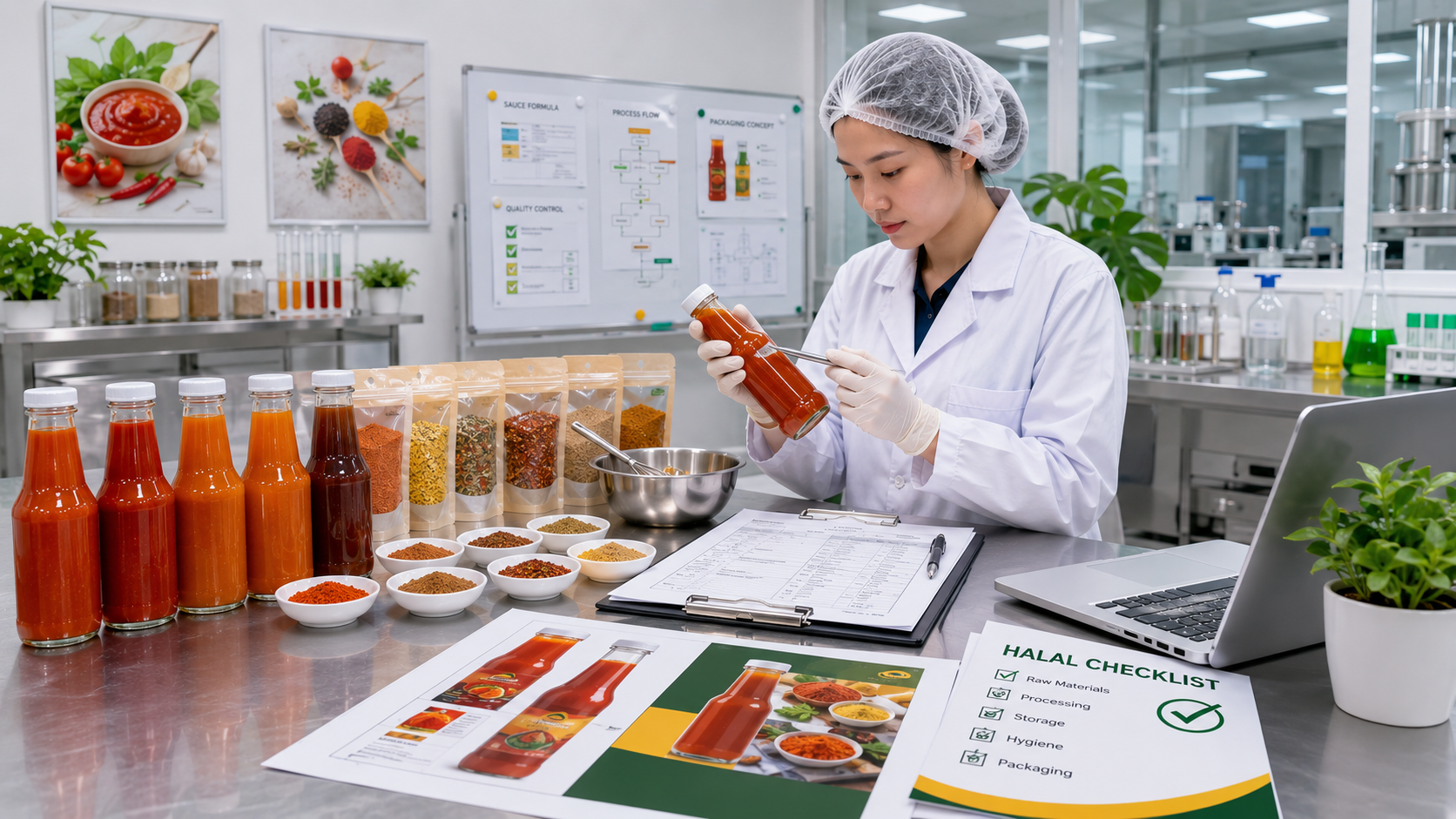
Why is the UAE worth serious attention for the seasoning industry?
The UAE matters because it combines high purchasing power, modern trade, a diverse consumer base, developed food service, and re-export access to nearby regions. For seasoning companies, the opportunity is real, but only if the product can be imported, registered, labeled, displayed, traced, and kept stable in market conditions.
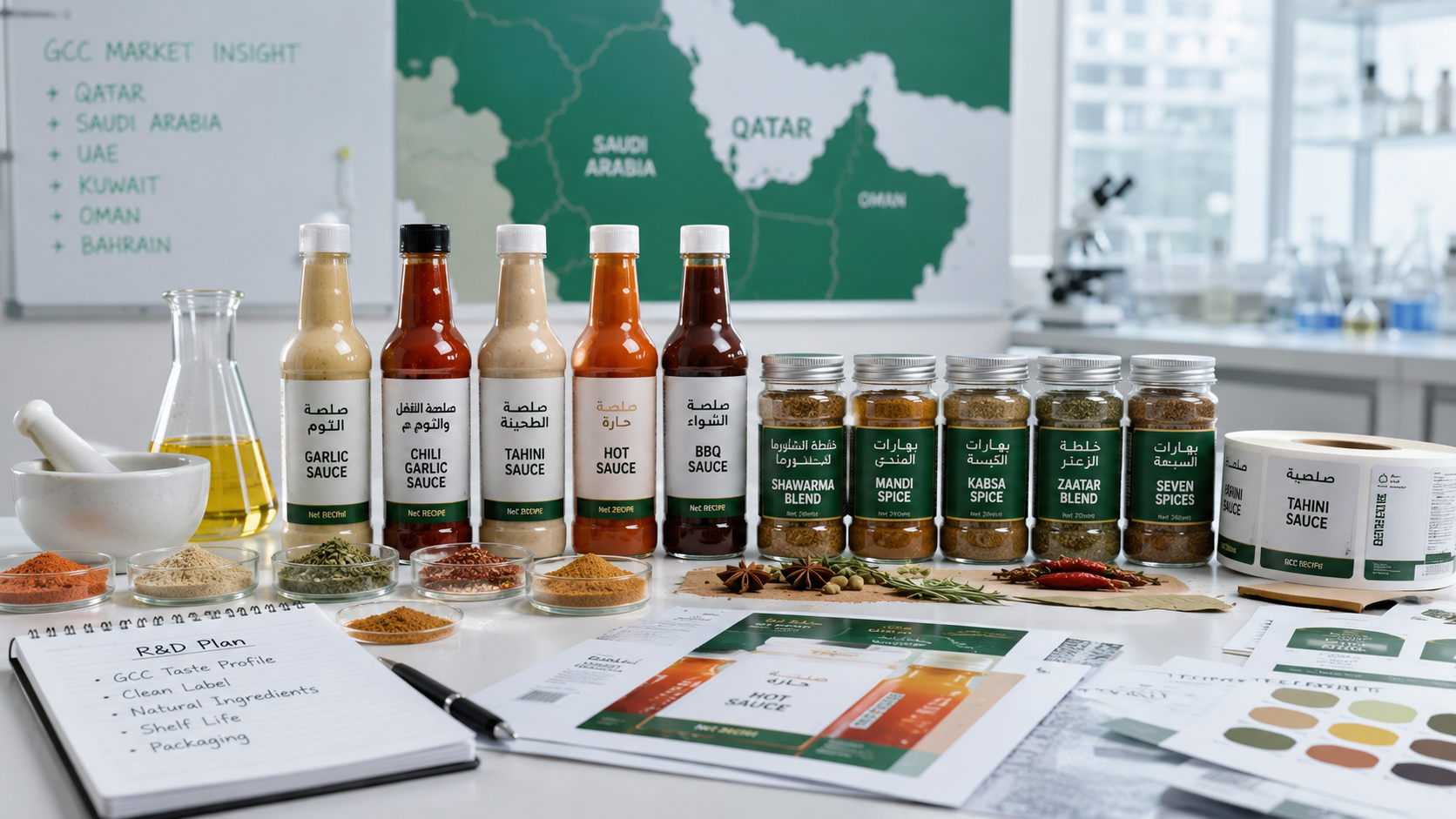
The UAE is often viewed as an attractive market: strong purchasing power, modern retail systems, international consumer communities, and a strategic gateway into the Middle East and North Africa. For seasonings, dipping sauces, sauces, pastes, dipping salts, seasoning powders, marinades, and private-label products, this is a market worth studying carefully.
But the UAE should not be entered in a hurry. A product that tastes good in Vietnam, looks attractive, and sells well domestically may still face difficulties if its Halal dossier is unclear, its label is not suitable, its certification is not accepted, its packaging cannot handle heat, or its price after logistics is no longer competitive.
For Hoa Sen Foods, the first question when developing a UAE-oriented product is not: “How long does Halal certification take?” The more important foundation question is: is this product clear enough in formula, ingredients, production process, packaging, label, and documentation to be reviewed against UAE market expectations?
This guide is for food brand owners, F&B businesses, distributors, seasoning startups, and companies that want to develop contract-manufactured or private-label products for the UAE in a practical, safe, and commercially realistic way.
What makes the UAE attractive for Vietnamese seasoning businesses?
The UAE is small by land area but large in trade influence. Dubai, Abu Dhabi, and the country’s logistics hubs do not only serve domestic consumption. They also connect goods to the GCC, the Middle East, North Africa, South Asia, and many neighboring markets.
Vietnamese seasoning businesses should pay attention to the UAE for five practical reasons:
- The UAE depends heavily on imported food, giving international suppliers an opportunity when products are stable, documentation is clear, and supply is consistent.
- The consumer base is diverse, including Emirati consumers, Arab communities, South Asian, Southeast Asian, European, international professionals, tourists, and migrant workers.
- Retail and food service channels are developed, including supermarkets, hypermarkets, specialty grocery stores, restaurants, hotels, cloud kitchens, central kitchens, e-commerce, and distributors.
- The UAE hosts many food industry exhibitions, making it useful for finding importers, distributors, and private-label partners.
- The re-export role makes the UAE an important market-learning point, although businesses should not assume that a UAE dossier will automatically fit every other country.
For seasonings, opportunities may exist in chili sauce, garlic sauce, sweet-and-sour sauce, tamarind sauce, grilling marinades, seafood seasonings, soy sauce, plant-based dipping sauce, dipping salts, spice blends, food-service formats, and private-label products for UAE distributors.
How should Halal be understood in the UAE context?
Halal in the UAE should not be reduced to “no pork” or “no alcohol.” Those are only baseline conditions. For seasoning products, Halal should be managed as a control system covering the formula, ingredient chain, production process, certification, labeling, and import readiness.
| Control layer | Questions to answer | Meaning for the business |
|---|---|---|
| Product formula | Does the product contain prohibited ingredients? Does it include alcohol, pork derivatives, gelatin, enzymes, emulsifiers, fats, flavorings, or animal-origin additives? If yes, is the source Halal-suitable? | The business needs evidence, not only a general claim that the product is Halal. |
| Ingredient chain | Does each ingredient have a specification, COA, origin record, Halal certificate if needed, supplier information, country of origin, and change-control commitment? | The dossier must be clear enough when an importer or reviewing party asks for support. |
| Production process | Is there any cross-contamination risk with non-Halal-suitable materials? Are sanitation, retained samples, batch coding, traceability, and change control clear? | Production needs to be controlled and repeatable, not handled only by verbal assurance. |
| Certification, label, and import | Is the Halal certificate accepted by the importer and the UAE market? Is the label suitable? Does the product require registration or label assessment before selling? | Certification and labeling should be confirmed before mass packaging or first shipment. |
In the seasoning industry, Halal risk usually does not sit in simple ingredients such as salt, sugar, pepper, chili, or garlic. Risk often appears in small but important components: flavorings, flavor enhancers, carriers, solvents, enzymes, fermented ingredients, stabilizers, emulsifiers, food colors, preservatives, processing aids, and food-contact materials.
Why must seasoning products be handled carefully before entering the UAE?
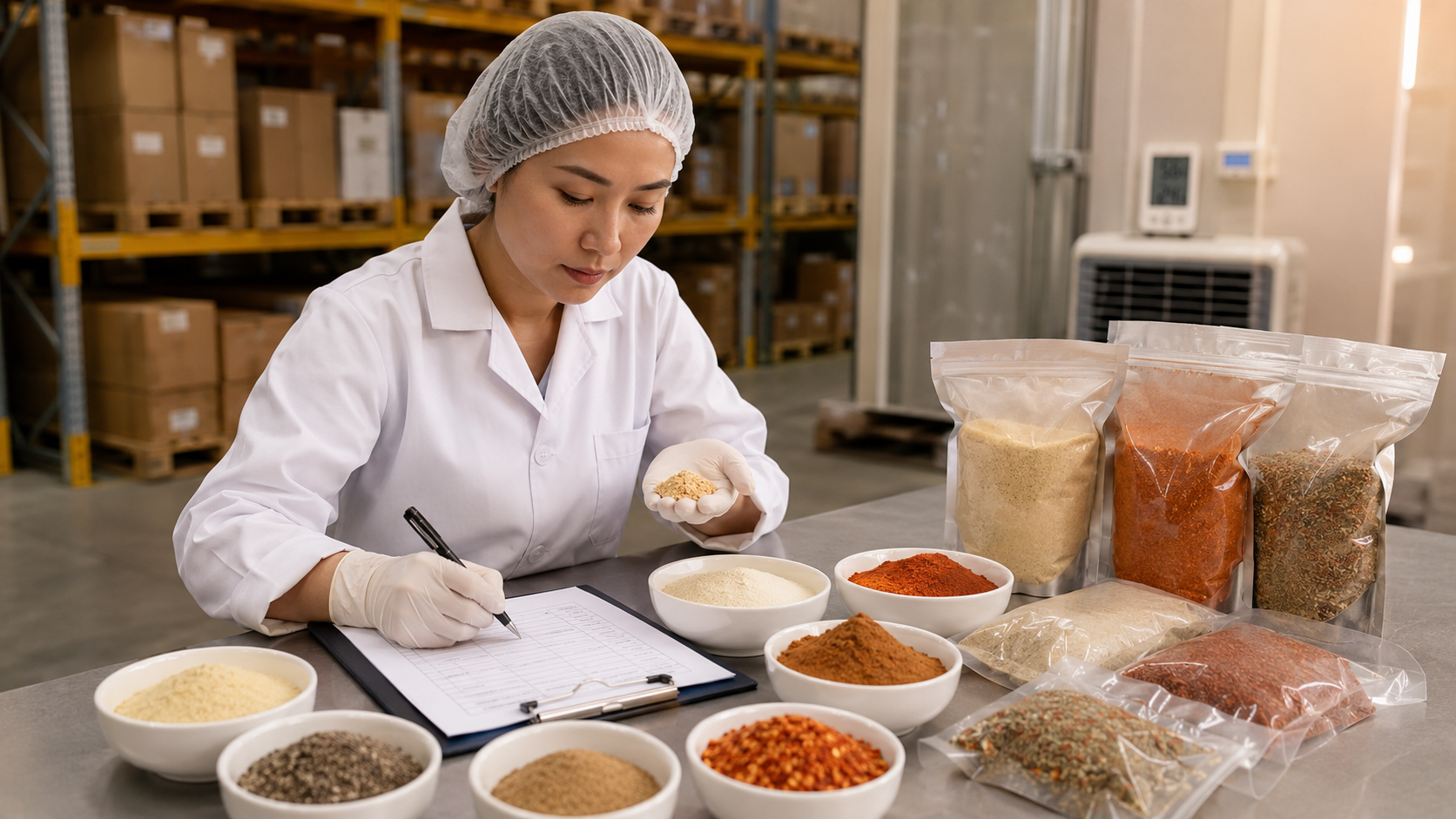
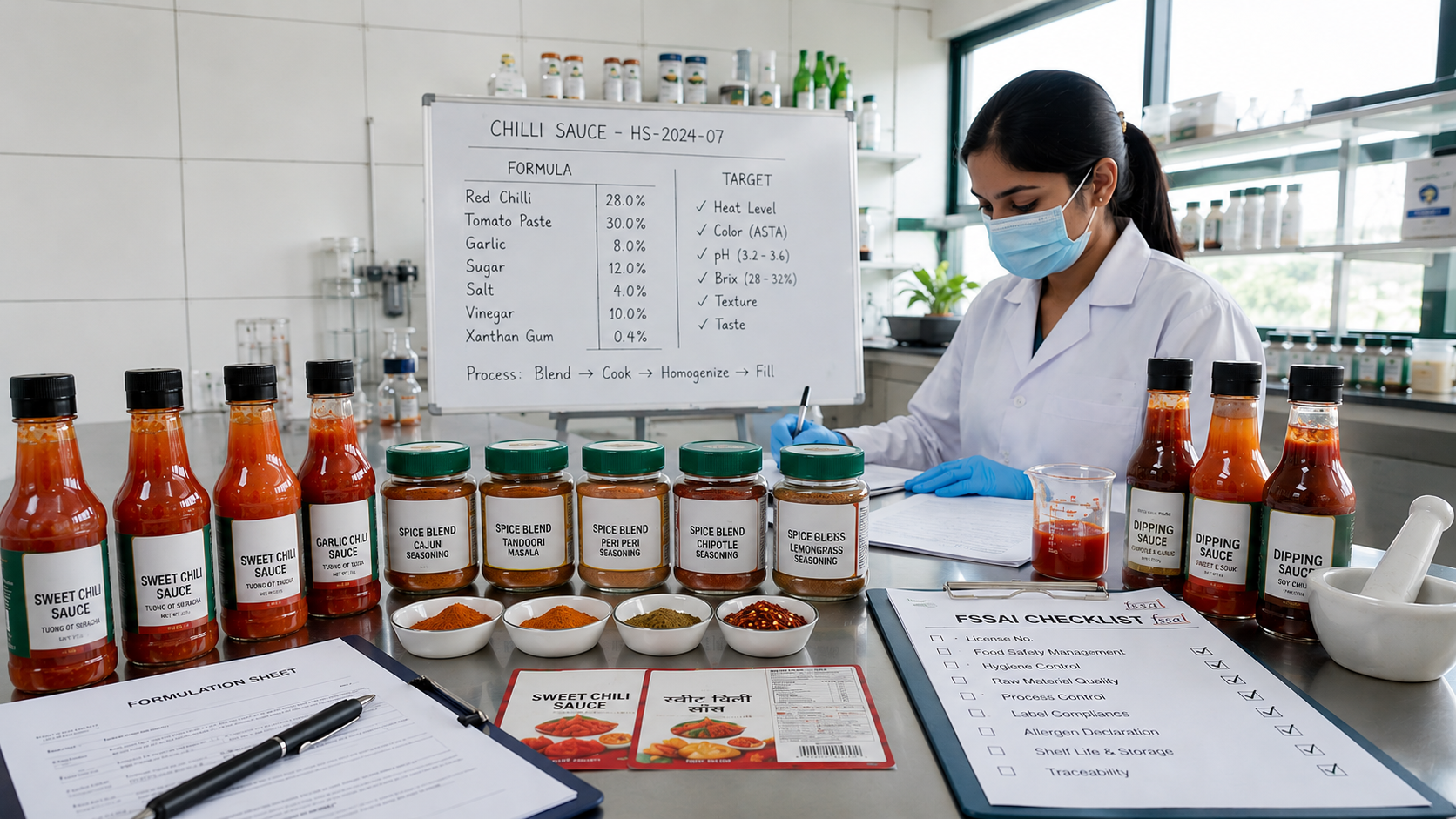
Seasonings can look simple from the outside, but industrial formulas are often complex. A bottle of sauce, jar of paste, marinade pack, or spice blend may contain many minor ingredients that affect Halal suitability, label accuracy, product stability, shelf life, sensory quality, and cost.
To keep taste, color, aroma, viscosity, shelf life, and cost stable, a formula may require additives, flavorings, food acids, stabilizers, flavor enhancers, preservatives, colors, enzymes, or fermented materials. For UAE-bound products, businesses should pay close attention to six groups of risk.
Which flavoring risks should businesses review?
Flavorings may be natural, synthetic, or mixed. The issue is not only the flavor name, but also the origin, carrier, solvent, production method, and certification of the flavoring itself. Meat, chicken, beef, smoke, seafood, fermented, or complex-base flavors need closer review.
Businesses should request specifications and Halal certificates when available, instead of listing only “flavour” in the internal file. This helps reduce problems during Halal review, label review, or importer due diligence.
Why do umami bases and flavor enhancers matter?
MSG, nucleotides, yeast extract, hydrolyzed protein, amino acids, soy sauce, fermented pastes, and savory bases may affect the Halal dossier. The key is to check ingredient origin, fermentation process, enzyme use, processing aids, and any potential alcohol-related concerns if they exist.
These ingredients can be useful in seasoning formulation, but they should not be treated casually. A good R&D process keeps the flavor benefit while building evidence around the ingredient record.
How should fermented ingredients be treated?
Soy sauce, vinegar, pastes, fermented sauces, yeast extract, and some fermented ingredients can create strong flavor. They should not be assumed unsuitable, and they should not be assumed automatically suitable. The business needs data, supplier confirmation, and supporting documents.
For export planning, fermented ingredients should be reviewed early because replacing them late may change flavor, cost, color, viscosity, and shelf life.
Which animal-origin ingredients increase Halal risk?
If the formula includes gelatin, collagen, animal fat, animal oil, meat powder, meat extract, animal enzymes, or animal-origin flavorings, Halal risk rises sharply. For companies entering the UAE for the first time, a plant-based formula or limited use of animal-origin materials is usually a safer starting point unless documentation is very clear.
This does not mean every product must be vegan. It means that new exporters should avoid unnecessary complexity until the product, importer, certification path, and dossier are mature enough.
Why does direct-contact packaging need attention?
Bottles, caps, seals, laminated films, pouches, jars, adhesives, inks, coatings, and food-contact materials should be reviewed for packaging safety and product compatibility. For sauces, dipping sauces, pastes, or oil-based seasonings, packaging can affect odor, color, leakage, shelf life, and perceived quality.
The UAE has a hot climate, and transport or storage may stress bottles, caps, seals, labels, cartons, and product stability. Packaging should be tested before large-volume production.
How should shared production lines be controlled?
If a factory produces several product lines, cross-contamination risk must be checked. Has the line previously run products containing higher-risk materials? Is the sanitation process clear? Are there records? Are batch codes, retained samples, and traceability controlled?
Halal is not only “clean.” Halal means clean, correct, stable, and supported by evidence.
Should businesses bring the whole product catalog into the UAE at the beginning?
No. A common mistake is trying to bring the entire product catalog into the UAE at once. This often spreads resources too thin, raises dossier costs, extends preparation time, and increases control risk. Starting with one to three lead products is usually more practical.
The first product does not need to be the most complicated item. It should help the business learn the market quickly, manage documents well, and build a foundation for the next product lines.
Useful criteria for selecting the first UAE-bound product include:
- A formula with lower Halal risk.
- Ingredients with clear documentation.
- A flavor profile that can fit the target channel.
- Packaging that is easy to transport, heat-resistant, and less likely to leak.
- Shelf life suitable for export.
- A cost structure that remains feasible after certification, testing, labeling, logistics, importer margin, and distribution costs.
- Potential to expand into a product range after market testing.
Vietnamese seasoning businesses may consider plant-based chili sauce, sweet-and-sour dipping sauce, tamarind sauce, garlic sauce, Asian-style spicy sauce, dry dipping salts, seafood seasonings, grilling marinades, plant-based dipping sauces, soy sauce, spice blends with a Southeast Asian flavor story, and private-label products for UAE distributors.
Which UAE entry channel should be chosen before certification?
Before certification or packaging print, a business should know which channel the product will enter. Each channel creates different requirements for pack size, label, price, certification, and documentation. Choosing the channel first prevents costly revisions later.
| Channel | Suitable for | What to prepare |
|---|---|---|
| Modern retail | Supermarkets, hypermarkets, specialty grocery stores | Attractive bilingual label, barcode, nutrition information, shelf life, retail pack size, display-ready packaging, and competitive shelf pricing. |
| Food service | Restaurants, hotels, central kitchens, F&B chains | Larger formats, stable quality, volume-based pricing, consistent delivery, and a clear product dossier. |
| Private label | Distributors or retail chains wanting their own brand | Flexible R&D, recipe confidentiality, packaging control, repeatable production, and technical dossier support. |
| E-commerce | Local online channels or partner-led online sales | The product still needs valid import, labeling, claims, food safety, and Halal support if Halal is claimed. |
| Re-export | Using the UAE as a gateway to GCC or MENA markets | Confirmation that the certificate and dossier are accepted by the next target market. |
Before starting, the business should answer these questions: Who is the product for? Is it for retail, food service, or private label? Is it for domestic UAE consumption or re-export? Will it go through Dubai, Abu Dhabi, or another emirate? Which certification does the importer request? Will a Halal logo or claim appear on the label? Is the formula plant-based or animal-derived? Is the price still competitive after logistics and distribution?
What is the 10-step roadmap for preparing seasoning products for the UAE?
A practical export roadmap does not begin with mass packaging or certification paperwork. It begins with market, channel, importer, formula clarity, and ingredient evidence. Certification and first shipment should come after the product foundation is ready.
- Define the market, channel, and importer. Work early with the importer or trade partner in the UAE to understand registration, labeling, documents, customs clearance, and sales-channel requirements.
- Select the lead product. Prioritize products with stronger Halal controllability and avoid formulas that are too complex or include unclear animal-origin ingredients.
- Build a detailed formula table. For each ingredient, record the commercial name, technical name, material code, supplier, origin, usage rate, function, source, Halal status, specification, COA, and risk note.
- Classify ingredient risk. Divide materials into low, medium, and high risk so issues can be handled before submission or importer review.
- Work again with ingredient suppliers. Request specifications, COA, Halal certificates if available, origin commitments, and notice when suppliers change raw material sources or processes.
- Rework the formula through R&D if needed. If an ingredient is unsuitable or cannot be proven, replace it with a clearer alternative instead of trying to work around the dossier.
- Control production and cross-contamination. Control raw material receiving, storage, weighing, mixing, heating, filling, packing, and finished goods.
- Select a certification body suitable for the UAE. Confirm whether the certification body is accepted by the importer and UAE market and whether the certification scope fits the product group.
- Prepare UAE-ready labeling. The label should cover product name, ingredients, additives, allergens, net weight, origin, manufacturer, production date, expiry date, storage, usage instructions, nutrition, batch code, barcode, and Arabic as required.
- Run trial production and check the first-shipment dossier. The trial batch helps check formula, sensory quality, stability, packaging, label, batch documents, delivery time, and real cost.
What documents should seasoning companies prepare?
Good documentation helps the business work more smoothly with importers, testing partners, and certification bodies. It also helps the internal team identify gaps before the product reaches customs, retail shelves, or food-service kitchens.
| Document group | What to prepare |
|---|---|
| Product dossier | Vietnamese name, English name, intended UAE name, product description, detailed formula, production process, quality criteria, microbiological, heavy metal, or relevant testing records if available, expected shelf life, storage conditions, product images, and packaging format. |
| Ingredient dossier | Ingredient list, specifications, COA if available, Halal certificates if needed, plant, animal, microbial, or synthetic origin, additive information, processing aids, supplier commitments, and replacement records for key materials. |
| Factory and process dossier | Factory layout, production flow, sanitation, cross-contamination control, batch control, retained samples, deviation handling, complaints, recall, personnel training, water control, pest control, hygiene, and maintenance. |
| Packaging and label dossier | Label artwork, Arabic and English versions, nutrition information if applicable, claims and claim evidence, food-contact packaging specifications, barcode, packing format, carton images, batch code, expiry date, and pallet plan if needed. |
| Commercial dossier | Importer, sales channel, target price, MOQ, delivery terms, volume plan, reorder plan, and market-test strategy. |
What mistakes do Vietnamese seasoning businesses often make when entering the UAE?
The most common mistakes happen when businesses treat Halal certification as the whole strategy. Halal is important, but the product must also fit taste, channel, label, packaging, price, logistics, importer capability, and evidence requirements.
- Thinking Halal alone is enough to sell. The product still needs the right taste, suitable channel, feasible price, correct label, good packaging, and a capable importer.
- Using a Halal certificate that is not accepted. The business should confirm acceptance with the importer before choosing a certification body.
- Keeping the formula unclear. Generic terms such as “flavoring,” “additive,” or “flavor enhancer” can create problems if supporting records are weak.
- Changing ingredients after the dossier is finalized. Any change in supplier, flavoring, or flavor enhancer should be reviewed again.
- Using unsupported claims. Claims such as “100% natural,” “healthy,” “organic,” “Halal certified,” “no preservative,” “vegan,” or “sugar-free” need evidence.
- Not testing packaging under transport and climate conditions. Heat, storage, and long transport can affect bottles, caps, seals, separation, color, odor, and flavor.
- Calculating export price too simply. Export price should include certification, testing, label work, packaging, loss rate, logistics, importer margin, distribution, listing fees if any, and promotion costs.
Where can Hoa Sen Foods support businesses preparing for the UAE?
Hoa Sen Foods can support the foundation stage: product ideas, formulation, sampling, risk review, production control, packaging control, and technical information so clients can work with importers, testing partners, or suitable certification bodies.
As a production and R&D back-end partner for seasoning and food brands, Hoa Sen Foods can support clients in the following areas:
- Consulting on product ideas for the UAE market.
- Developing formulas for seasonings, dipping sauces, sauces, pastes, dipping salts, and packaged products.
- Preparing samples and adjusting them based on feedback.
- Optimizing taste, pack size, packaging, and production cost.
- Reviewing ingredient risk at a basic foundation level.
- Controlling production and packaging.
- Preparing technical information so clients can work with importers, testing partners, or appropriate certification bodies.
- Protecting client formulas and business information.
Hoa Sen Foods should not be understood as a Halal certification body. For official Halal certification, businesses need to work with an authorized certification body and confirm suitability with the importer or relevant market requirements.
What are the five control foundations before entering the UAE?
A seasoning product that wants to enter the UAE needs five foundations: clear formula, clear Halal logic, clear labeling, clear quality control, and clear commercial planning. When these are prepared well, businesses reduce risk and work more effectively with importers.
| Foundation | Key question | Expected result |
|---|---|---|
| Formula clarity | What exactly is inside the product? | The R&D and commercial teams can explain the product with evidence. |
| Halal clarity | Can the product demonstrate Halal suitability when reviewed? | Risk ingredients are identified and handled before certification or import. |
| Label clarity | Does the label include the right information and language for the market? | Label revision risk is reduced before mass printing. |
| Quality clarity | Can the product remain stable through production, storage, and transport? | The product is less likely to leak, separate, lose aroma, or fail expectations. |
| Commercial clarity | Are importer, channel, price, MOQ, and reorder plan realistic? | The first shipment becomes a market test with better control. |
The UAE is attractive, but it does not reward careless preparation. For seasoning products, risk sits inside each additive, flavoring, processing aid, package, and supplier dossier. That is why preparation matters.
A product that is clear in formula, Halal logic, label, quality, and commercial plan will be easier to discuss with importers, less exposed to shipment risk, and better prepared for competition on shelves or in food-service channels.
Hoa Sen Foods is ready to support clients from the first preparation steps, so a flavor idea does not stop at a good sample, but can become a safe, stable, distinctive product with enough foundation to approach an important market like the UAE.
Download the Halal guide for the UAE market
FAQ
Do seasoning products entering the UAE have to be Halal?
For an Islamic market like the UAE, Halal is an important factor in consumer trust, especially for imported food. Specific requirements still depend on product type, sales channel, label claims, and importer requirements. Businesses should confirm this before certification or packaging print.
Which products should businesses start with?
Businesses should start with one to three lead products with lower Halal risk, clear ingredient records, heat-resistant packaging, feasible post-logistics pricing, and a strong fit with the target channel. The first product should help the business learn the market quickly.
Why do flavorings in seasonings need careful review?
Flavorings may involve animal origin, carriers, solvents, production processes, or separate certification. If a product only lists “flavour” without a clear dossier, it may face difficulties during Halal or label review.
Can Hoa Sen Foods certify Halal for clients?
No. Hoa Sen Foods is not a Halal certification body. Hoa Sen Foods can support formula development, R&D, production, foundational ingredient-risk review, and technical information so clients can work with a certification body or importer.
Can the UAE be used as a re-export gateway to the GCC?
It can be considered, but businesses should not assume that a UAE-ready dossier automatically works for every GCC market. Each next market may have its own requirements for labeling, certification, import documents, and regulations.
What should be confirmed before large-volume packaging print?
The business should finalize the formula, confirm ingredient records, check Arabic and English labeling requirements, review claims, shelf life, importer information, and certification expectations with the UAE partner before printing packaging at scale.
Author
Author: Hoa Sen Foods Content Team [to be added]
Professional focus: Spice and food contract manufacturing, seasoning R&D, private-label products, packaging, and production readiness.