

Sitting across from an ambitious food entrepreneur in Dubai recently, we ended up talking about the massive barriers to entry in the modern condiment industry. He had a brilliant recipe for a traditional shawarma spice blend. He knew exactly who his target customers were.
But here’s the thing. Building a food-grade, Halal-certified factory to produce that blend would cost him millions of dollars.
Finding a way to launch a brand without sinking your entire budget into concrete and machinery feels impossible at first. When you look closely at the modern supply chain, however, a much smarter path reveals itself. You don’t actually need to own a factory to own a highly successful spice brand.
From what we’ve seen, nearly 70% of small to medium-sized seasoning brands globally do not manufacture their own goods. Instead, they use a highly efficient model known as Original Equipment Manufacturing (OEM).
If you are actively researching how OEM food manufacturing works, you are already on the right track to optimizing your business. An OEM partner acts as your silent, behind-the-scenes factory. You own the brand, the vision, and the final product. The manufacturer handles the heavy lifting of raw material sourcing, blending, quality control, and packaging.
Whether you are a fast-moving startup, a regional distributor wanting to create your own private label, or an established enterprise looking to expand your SKUs rapidly, understanding OEM spice manufacturing is absolutely vital.
Let’s break down this entire journey step by step. We will show you exactly how an idea transforms into a physical, shelf-ready product.
- Placement: Right after the introduction.
- Visual: A clear, modern infographic showing the 5 phases of OEM spice manufacturing (Consultation > R&D > Approval > Production > Export).
- Alt Text: The 5-step process of how OEM food manufacturing works for spice brands.
Understanding the True Demand for OEM Spice Manufacturing
Before walking through the specific phases, we need to understand why this model completely dominates the food industry today.
Building a factory takes years. Getting that factory certified for strict Halal export standards takes even longer. By partnering with an established manufacturer, you instantly bypass those massive hurdles. You plug your brand directly into a pre-existing, fully compliant infrastructure.
To be fair, this isn’t always the case with every factory you meet. Some manufacturers operate with incredibly rigid rules. They demand impossible Minimum Order Quantities (MOQs) that crush small businesses.
But when you find a flexible, responsible partner, the advantages are immense. Save your capital for marketing. Drastically reduce your time to market. Most importantly, get to focus all your energy on building customer relationships instead of fixing broken machinery.
Look at exactly how OEM food manufacturing works in practice through a proven five-phase system.
Phase 1: The Initial Consultation and Project Scoping
Everything starts with a simple conversation.
When it comes to OEM spice manufacturing, the initial consultation sets the foundation for the entire relationship. We don’t just ask you for a flavor profile. We ask you about your ultimate business goals.
During this initial phase, the client sends over a detailed brief. Think of this brief as the architectural blueprint for your product. To help the factory understand your vision perfectly, provide a few crucial pieces of information:
Defining the Core Requirements
- Product Type: Define exactly what we are making. Are we creating a dry BBQ rub, a liquid hot sauce, a fine garlic powder, or a highly complex curry paste?
- Target Market: Identify where this product will be sold. Selling a spice blend to Saudi Arabia requires totally different compliance standards than selling to local Asian markets.
- Target Audience: Clarify your exact demographic. Is this a premium organic product for high-end supermarkets, or a bulk catering pack for the HoReCa (Hotel, Restaurant, Café) sector?
- Expected Volume: Estimate your projected order size accurately. Providing an honest estimate helps the factory plan machine time and raw material sourcing efficiently.
Evaluate this information carefully, and a capable manufacturer will immediately tell you if your idea is technically and financially viable.
At Hoa Sen Foods, we view this step through our core value of responsibility. If a client asks for a specific ingredient that we know is currently facing a massive global shortage, we speak up immediately. We suggest viable, cost-effective alternatives. Operating as your caregiver in the supply chain means we protect you from making expensive mistakes early on.
Understanding how OEM food manufacturing works at this stage means establishing a deep level of trust before a single dollar changes hands.
Phase 2: R&D and Custom Formula Development
After aligning on the business goals, we move straight into the laboratory.
In our experience, this is where the true magic of OEM spice manufacturing actually happens. The Research and Development (R&D) phase bridges the gap between your imagination and a tangible, physical product.
Depending on your starting point, this phase usually takes one of two distinct paths.
Scenario A: You Already Have a Formula
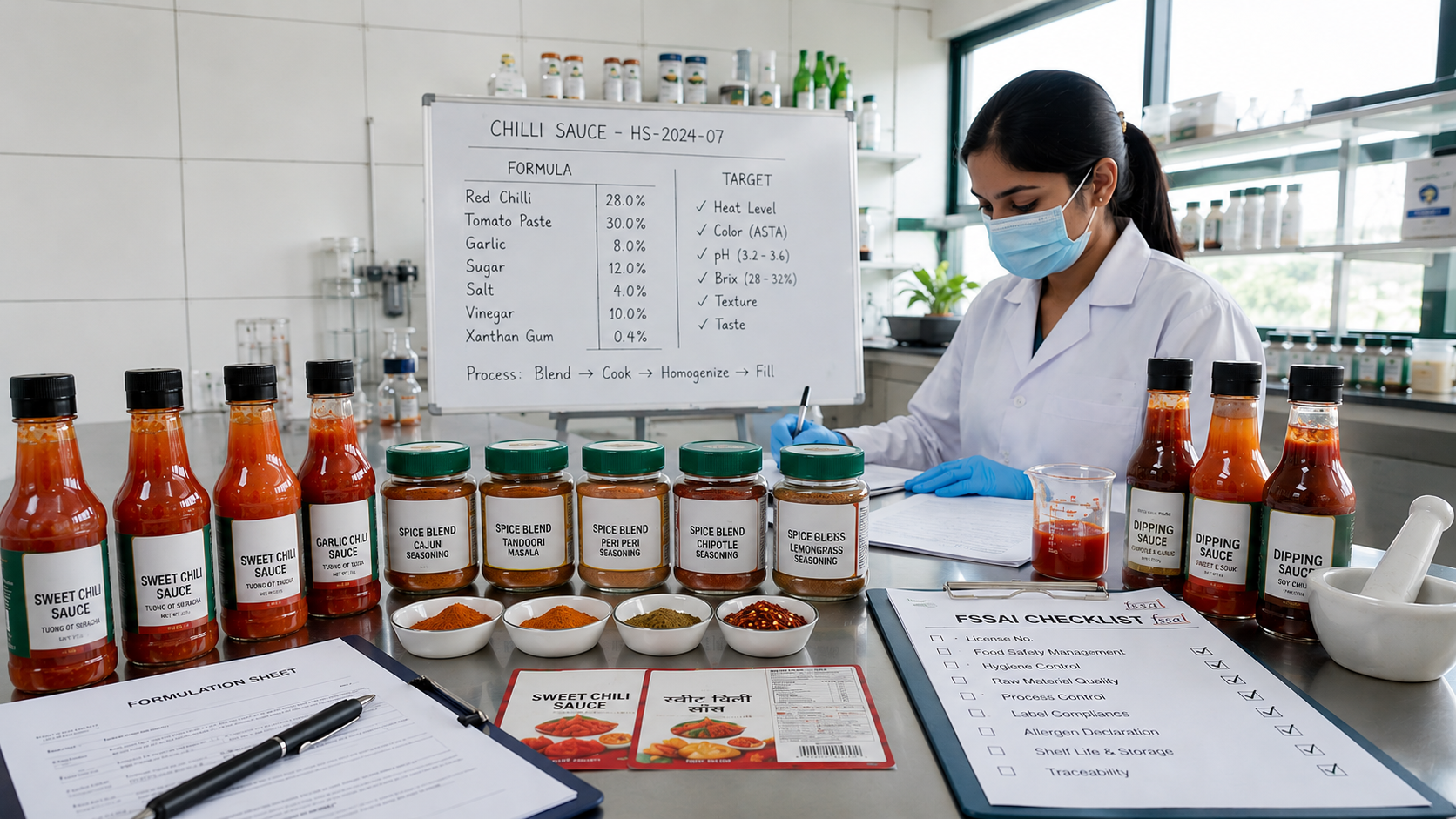
Many clients come to us with a recipe they developed in a commercial kitchen. If you have an existing formula, our food scientists take your exact ingredient list and scale it up for industrial production.
Scaling a recipe isn’t just about multiplying the ingredients by a thousand. Because cooking ten portions of a shawarma rub behaves very differently than mixing two tons of it in an industrial blender, we have to make technical adjustments. We test the moisture levels. We adjust the anti-caking agents carefully. We run trials to ensure the industrial version tastes exactly like your original kitchen prototype.
Scenario B: You Need Us to Create the Formula
Other clients come to us with just a concept. They might bring a competitor’s product and say they want something similar, but spicier and without MSG.
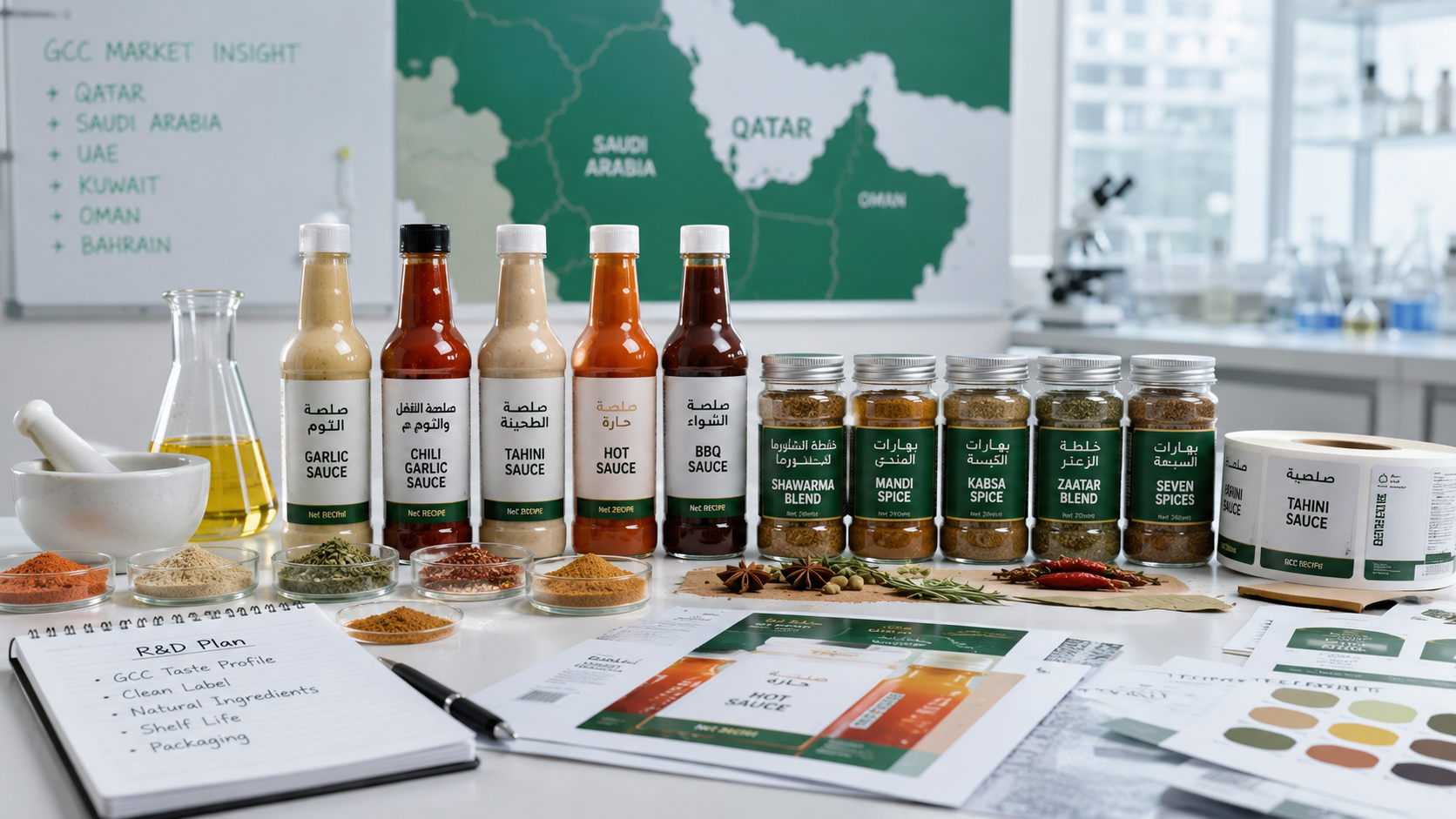
Using our deep industry knowledge, our R&D team builds a completely new formula from scratch based on your brief. We select the specific origins of black pepper. We choose the right grind size for the cinnamon. We balance the salt and sugar ratios perfectly to match the local Middle Eastern palate.
Wondering how long this takes? In a highly efficient OEM spice manufacturing setup, you shouldn’t have to wait months. Because we maintain a vast inventory of raw materials and operate an agile lab, we typically turn around the first physical prototype in just 7 to 21 days.
Knowing how OEM food manufacturing works properly means knowing that R&D is a collaborative effort. We work with your taste buds until the flavor hits the exact note you desire.
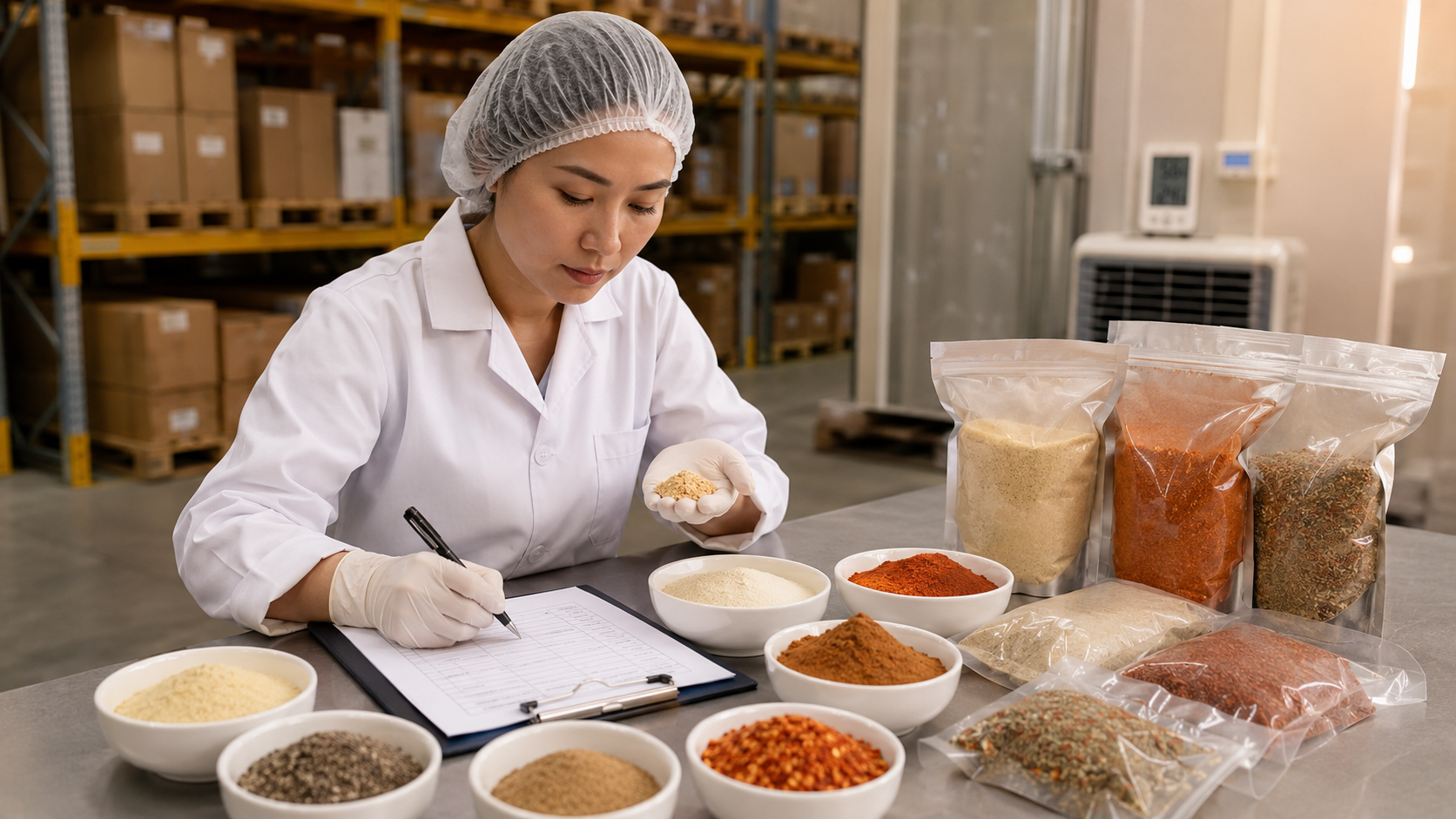
- Placement: Inside the R&D section.
- Visual: A food scientist in a pristine white lab coat carefully measuring spices on a digital scale, illustrating precision and care.
- Alt Text: The R&D phase is a crucial part of how OEM food manufacturing works.
Phase 3: Sample Approval and The Ironclad Contract
Once the lab finishes the prototype, we pack it up and ship it directly to your office.
Tasting your product for the first time is an incredible moment. Finding the perfect flavor, however, often requires a little back-and-forth communication. You might test the sample and realize it needs a bit more garlic. Perhaps the chili heat is too aggressive for your local consumers.
Send us your detailed feedback immediately. We adjust the blend based on your exact notes. We repeat this sampling loop until you are 100% satisfied with the flavor, color, and aroma.
The Importance of Absolute Confidentiality
After finalizing the exact recipe, we move to the paperwork. This is where trust becomes a firm legal reality.
Understanding how OEM food manufacturing works means understanding the immense value of your intellectual property. Your formula is your biggest business asset. If your manufacturer leaks your recipe to a competitor, your business is ruined.
Protect your recipes fiercely.
When you partner with Hoa Sen Foods for OEM spice manufacturing, we put in place incredibly strict Non-Disclosure Agreements (NDAs). We treat your formulas with absolute secrecy.
Look closely at our core commitments. We will never share or sell your custom product formulas to any third party. We do not disclose your production volumes to anyone. We do not even use your brand name in our marketing materials or PR campaigns. Unless you explicitly demand it, you remain the star of the show. We simply remain your silent, reliable engine.
This is the phase where we also finalize pricing. Because we promise the absolute best value, we break down the costs transparently. You will know exactly what you are paying for.
Phase 4: Production and Quality Control (QC)
With the contract signed and the formula locked, the project finally moves to the factory floor.
Proper OEM spice manufacturing requires intense precision at an industrial scale. When handling tons of raw agricultural materials, keeping the facility perfectly clean is a massive operational challenge.
Put in place a closed-loop production system, and you eliminate almost all contamination risks.
At our facility, raw materials enter through designated hygienic zones. We trace every single gram of cinnamon, star anise, and pepper back to its source. Because we believe in transparent sourcing, we categorically refuse to use ingredients with questionable origins. We check the heavy metal content. We screen for pesticide residues.
The spices then move into industrial grinding and blending machines. During this entire process, our Quality Control (QC) team pulls random samples from the line constantly. They test for moisture content. They check for microbial activity. They verify flavor consistency against the approved master sample.
Ensuring Toyyib and Consumer Safety
Remember that a major part of how OEM food manufacturing works for the Middle East revolves around strict Halal compliance.
We don’t just follow Halal as a bureaucratic checklist. We embrace the broader concept of Toyyib, which means creating food that is wholesome, clean, and safe. Refuse to create products that bring harm to the end consumer. Our dedicated lines ensure zero cross-contamination.
Finally, before any batch leaves the blending room, we issue a Certificate of Analysis (COA). This specific document proves that your order meets all safety and quality parameters. You never have to guess about the quality of the goods you are receiving.
If you want to read more about how factories handle these specific compliance rules, review our guide on Halal OEM Manufacturing.
- Placement: After the Production and QC section.
- Visual: A busy but impeccably clean stainless-steel blending facility showing the closed-loop production process.
- Alt Text: Quality control is a vital step in OEM spice manufacturing.
Phase 5: Packaging Design and Export Logistics
You have a great product inside the bag. Now you need a great bag.
The final phase of OEM spice manufacturing involves getting the product ready for the retail shelf and shipping it across the ocean.
Packaging Solutions That Sell
Clients often provide their own pre-printed packaging materials. If you already have your pouches or jars designed and printed locally, you simply ship them to our factory. We fill them up on our automated lines.
If you are starting from scratch, we help you source the packaging locally in Vietnam. We advise you on the best materials to use for your specific blend. Because certain spices contain volatile oils that will eat through cheap plastics, selecting food-grade, multi-layered foil pouches is often necessary for export longevity. We make sure the packaging aligns perfectly with the physical demands of international shipping.
Explore our Private Label Seasoning services if you need to understand how custom branding applies directly to the packaging phase.
Handling the Export Paperwork
Exporting food is notoriously bureaucratic.
Fail to provide a single piece of paper, and your container gets locked at the destination port. A massive advantage of understanding how OEM food manufacturing works with an experienced partner is that we handle this headache entirely for you.
We prepare the thorough documentation required for GCC import:
- Commercial Invoices & Packing Lists: Provide clear, accurate accounting of the shipment.
- Certificate of Origin (CO): Prove the materials were processed in Vietnam.
- Health Certificate / Phytosanitary Certificate: Guarantee the agricultural products are safe and pest-free.
- Halal Certificate: Supply valid, GCC-recognized documentation proving strict religious compliance.
Whether you prefer FOB (Free On Board) delivery where we load it onto a ship at our local port, or CIF (Cost, Insurance, and Freight) where we handle the ocean logistics directly to your destination port, we coordinate the delivery smoothly.
If you want a deeper look into how to navigate different factory models before reaching this stage, read our detailed guide on OEM vs ODM: Which Model Fits Your Spice Business? (Article 14).
The Flowchart of Success
Summarize the journey from an idea to a finished export shipment, and it follows a highly structured path.
Think of it as a continuous, logical flow.
First, we start with the Consultation, defining the exact product, target, and volume. Second, we move into R&D, creating and scaling the formula within 7 to 21 days. Third, we reach Approval, where we test the samples together and sign strict NDAs to protect your business. Fourth, we execute Production & QC, blending the spices under strict Halal conditions with full COA verification. Finally, we handle Packaging & Export, filling the containers and managing the complex international paperwork.
When executed correctly, this entire OEM spice manufacturing process feels incredibly smooth.
At Hoa Sen Foods, we shorten this timeline significantly. Using our rich industry experience and deep understanding of the global supply chain, we prevent the usual delays that plague new brands. We deliver the absolute best value. Optimize your costs without ever sacrificing the quality or safety of your product.
For more details on evaluating potential partners before you start this flowchart, carefully review our 10-Point OEM Manufacturer Checklist (Article 9).
Building a brand is hard work. Manufacturing it shouldn’t be. Act as the visionary for your company, and let us act as the reliable caregiver on the factory floor. We exist to be the launchpad for your ambitions.
Frequently Asked Questions
What exactly is OEM spice manufacturing?
OEM stands for Original Equipment Manufacturer. In the food industry, it means a specialized factory produces custom spice blends, sauces, or condiments using a brand owner’s specific recipe and packaging. This allows the brand to sell the product under its own name without owning a physical factory.
How long does it take to develop a new spice formula?
From what we’ve seen, highly capable R&D teams can turn a concept or brief into a physical, taste-testable prototype in roughly 7 to 21 days. This timeline depends heavily on the complexity of the flavor profile and the availability of specific raw ingredients.
Will my OEM partner steal my custom recipe?
Protecting your intellectual property is critical in understanding how OEM food manufacturing works safely. Reputable manufacturers like Hoa Sen Foods put in place incredibly strict Non-Disclosure Agreements (NDAs). We guarantee that your proprietary formulas are never shared, sold, or leaked to third parties.
Do I need to handle the export paperwork myself?
No. A professional export-focused OEM partner manages the complex documentation for you. We provide the Certificate of Origin, Health Certificates, and the specific GCC-recognized Halal Certificates required to clear customs smoothly.
Is OEM manufacturing only for massive global brands?
Not at all. While large enterprises use OEM spice manufacturing heavily to scale quickly, it is also the perfect solution for startups and regional distributors. Flexible manufacturers offer reasonable minimum order quantities (MOQs) to help smaller brands test the market before scaling up.
How do I know my product is safe and Halal compliant?
Understanding how OEM food manufacturing works involves verifying factory credentials. A proper facility maintains ISO 22000, HACCP, and GCC-recognized Halal certifications. Furthermore, they will provide a Certificate of Analysis (COA) for every batch produced, proving the product is completely safe and fully compliant.