

Quick answer: When looking for a chili sauce manufacturer, do not ask only, “Can you make it?” and “How much does it cost?” Ask 12 verifiable questions covering legal identity, food safety, product capability, R&D, ingredients, production controls, testing, traceability, packaging, export markets, cost structure and formula ownership. Strong answers should come with records, samples or clear contractual terms.
A manufacturer may quickly say that it can produce custom chili sauce. That answer alone does not show whether the factory is suitable for your product, target market or commercial model.
A sauce developed for restaurants is different from a product intended for retail shelves. A chili sauce sold domestically may require a different approach from a project targeting the United States, the European Union or a Halal market. A deeply customized formula should also be assessed differently from a private-label product based on an existing formula.
Before sharing a complete formula, business plan or packaging artwork, brand owners should screen potential partners with an evidence-based question set. The goal is not to catch the factory out. It is to determine whether both sides have enough information to move into detailed R&D and quotation.
Why screen a manufacturer before sending a full brief?
A good product brief can contain sensitive information: product concept, flavor profile, target market, pack size, projected volume and sometimes the formula itself. Sending it too early to multiple companies can make confidentiality harder to manage and produce quotations that are not based on the same scope.
The 12 questions below help you:
- eliminate partners that are not suitable for the product or target market;
- identify which records need to be reviewed before sample development;
- create a consistent basis for comparing contract manufacturers.
The key principle is simple: a certificate, factory photograph or good-tasting sample is only one part of the evidence. You also need to check its scope, validity, connection to the proposed product and the way the factory operates in practice.
1. What legal entity, site and scope does the manufacturer operate under?
Ask for the legal entity that will sign the contract, the address of the R&D facility, the manufacturing site, the packing location and the entity that will issue the invoice. If different sites or subcontractors handle different stages, clarify who is responsible for each part.
Evidence to review: legal entity details, facility addresses, operating scope and the name of the entity that will appear in the contract.
Warning sign: the consultant, contracting party and manufacturing site are three different parties, but their responsibilities are not clearly explained.
2. Which food-safety system is in place, and what does it cover?
Do not record only the name of a certificate. Ask which facility, product group, process and validity period it covers. A valid certificate that does not cover the relevant product or site is not enough for the project.
The Codex General Principles of Food Hygiene provide a foundation based on good hygiene practices and HACCP. The specific implementation, however, must match the product, process and requirements of the relevant authority.
Evidence to review: a current certificate where applicable, its scope, and a policy or description of the food-safety control system.
Warning sign: the factory sends only a certification logo, a wall photograph or a claim of being “internationally certified” without showing the scope.
3. How much relevant chili sauce capability does the factory have?
“We have made sauces” does not mean that a factory is suitable for every type of chili sauce. Describe the proposed product clearly: desired flavor profile, viscosity, user group, use occasion, sales channel and packaging format.
Ask whether the manufacturer has experience with a similar product category or technical challenge, without asking it to disclose confidential formulas or customer names.
Evidence to review: reference samples that may be shared, feasible pack-size options, an R&D capability description and initial technical limitations.
Warning sign: the factory accepts every product and pack format immediately, without reviewing even a preliminary brief.
4. How does the R&D and sample-approval process work?
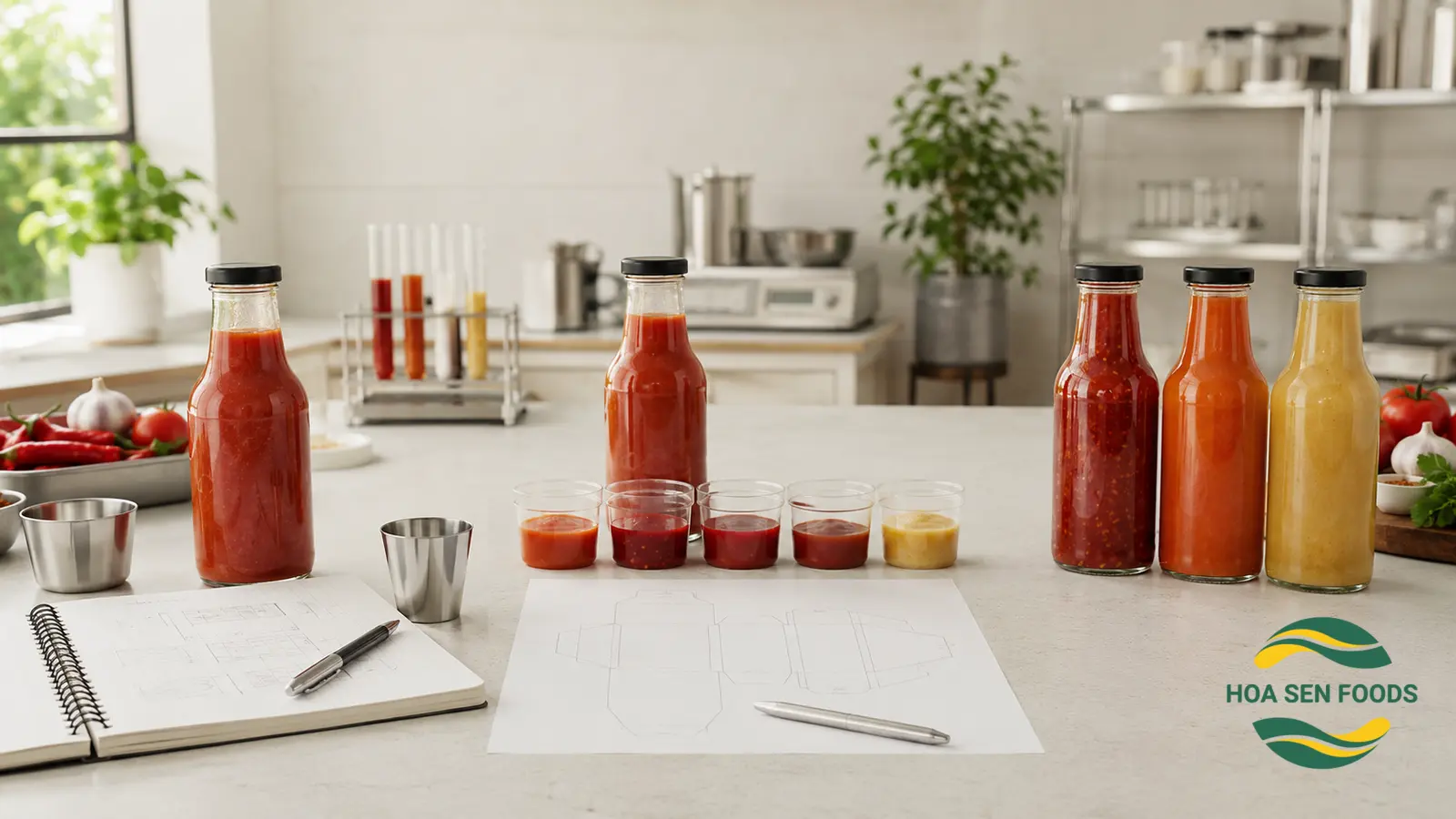
A sample that tastes good but has no version code, approval criteria or adjustment history is difficult to use as a production reference. Ask how the factory receives a brief, develops samples, records feedback, locks a version and handles changes after approval.
Do not assume a fixed number of sample rounds or a fixed timeline. The level of customization, brief quality, ingredients, packaging and target market can all affect the schedule.
Evidence to review: a brief template, sample feedback form, sample-coding method and version-approval record.
Warning sign: the factory sends one sample and moves directly to production without mutually agreed acceptance criteria.
5. How are ingredients, allergens and supplier changes controlled?
Two ingredient lots can differ in sensory properties, documentation, origin or market suitability. For chili sauce, ask how the factory sets incoming-material criteria, controls allergens and determines when a change of ingredient or supplier requires customer approval.
Evidence to review: supplier-approval principles, ingredient specifications at a shareable level, and the procedure for notifying and approving changes.
Warning sign: the factory allows an “equivalent” ingredient to be substituted without defining who assesses the impact on the formula, label and target market.
6. How are production controls and the reference sample defined?
Descriptions such as “good color,” “moderately spicy” or “stable viscosity” are not enough for acceptance. Before production, both sides should agree on a reference sample and suitable control criteria.
Do not set pH, viscosity, Brix, processing time or other parameters independently before R&D and QA approve them. The specifications should be established based on the formula, process, packaging and appropriate safety assessment.
Evidence to review: a draft finished-product specification, reference sample, acceptance criteria and deviation-management procedure.
Warning sign: the factory promises the same technical parameters for every chili sauce formula.
7. What supports testing and release decisions?
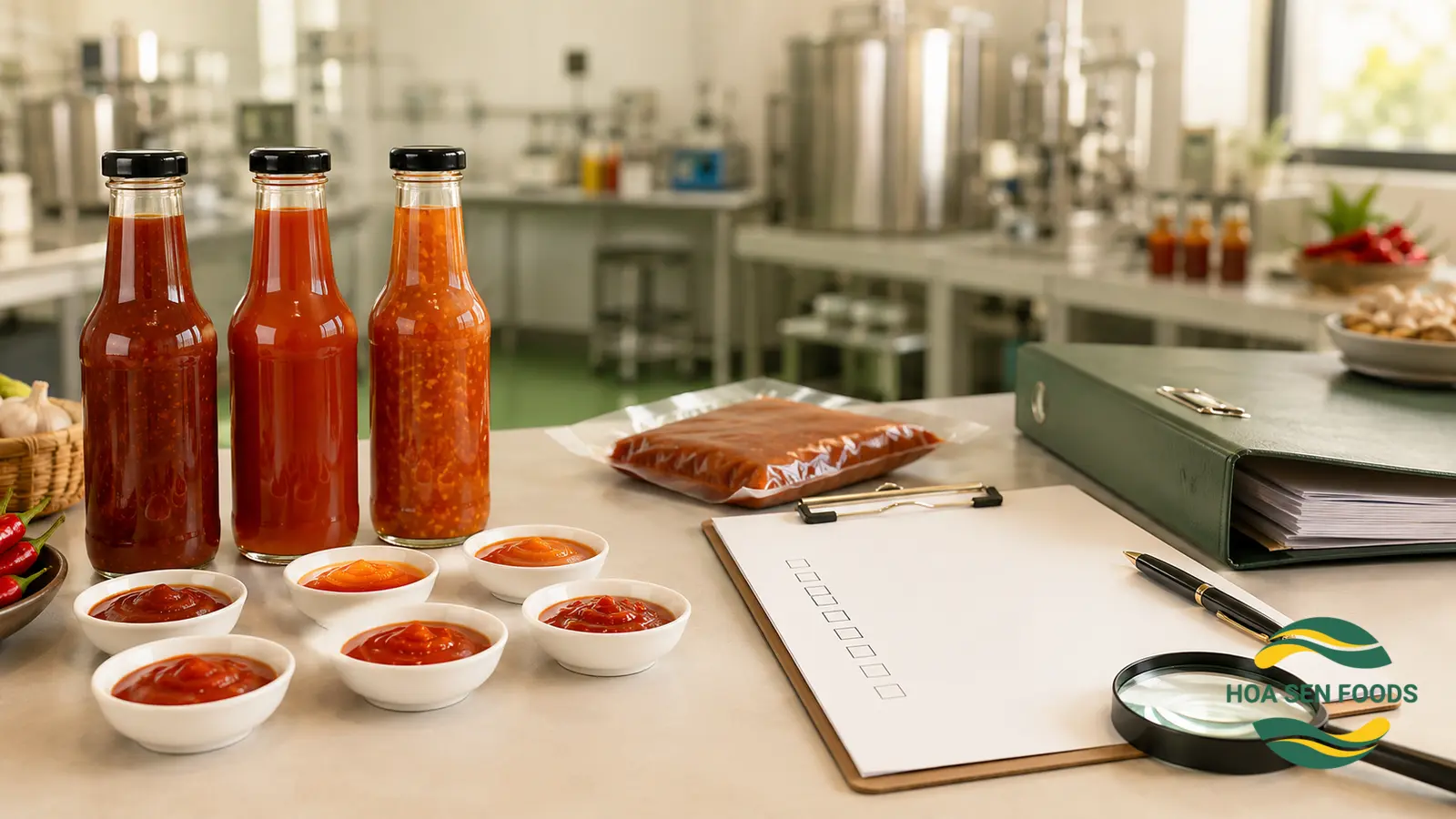
A laboratory report does not automatically prove that every relevant risk has been controlled. Ask how the factory selects test parameters, at which stage samples are taken, which laboratory performs the testing and who has authority to release a batch.
The testing plan should be based on the product, ingredients, process, legal requirements and target market. Do not copy a test list from another product without assessing whether it applies.
Evidence to review: an anonymized COA or test report, a proposed testing plan and the batch-release procedure.
Warning sign: an old test report is used as evidence for every formula, or a fixed shelf life is promised before suitable data exists.
8. How far does traceability and incident management go?
You need to know whether the factory can connect a finished-product lot code to its ingredients, packaging, production date and control records. Ask how it responds when a deviation is found after goods have been delivered.
Article 18 of Regulation (EC) No 178/2002 requires traceability for food, feed and substances intended to be incorporated into food through the stages of production, processing and distribution. For goods entering the United States, additional traceability requirements apply only to foods within the Food Traceability List and the relevant conditions; do not assume that every bottle of chili sauce requires the same documentation.
Evidence to review: a sample lot code, a record-linkage flow, a recall procedure and, where shareable, the results of a drill or internal check.
Warning sign: the factory can identify only the production date but cannot link the lot to ingredients and packaging.
9. How will packaging be selected and tested for compatibility?
Packaging must suit the product, filling equipment, capping process, transport, storage conditions and user experience. Ask who selects the bottle, cap, seal, label and carton; who approves the samples; who pays for compatibility testing; and what happens if the pack is unsuitable.
Evidence to review: feasible packaging options, packaging samples, a compatibility-testing plan and artwork-approval criteria.
Warning sign: a packaging quotation is issued before the volume, product, material, quantity and transport requirements are confirmed.
10. For export, which parts does the factory support and who owns the rest?
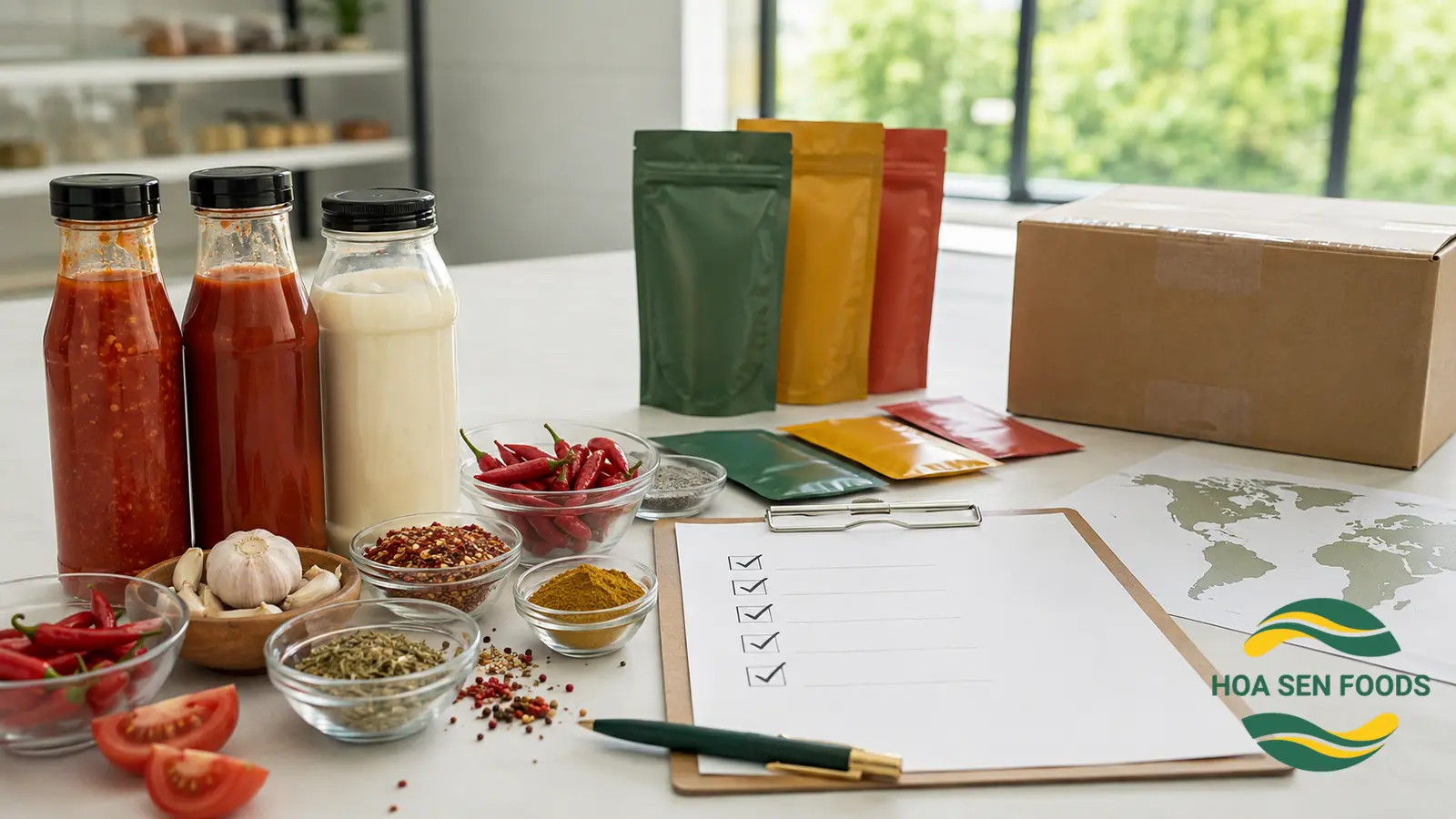
Do not ask only, “Can you export?” Specify the target market, importer, sales channel and formula status. Then separate what technical data the factory will provide, what the brand owner must approve, what the importer must confirm and which body is responsible for issuing a certification.
For the United States, the Foreign Supplier Verification Program places responsibility on the importer to evaluate food risks, the performance of the foreign supplier and appropriate verification activities. A single registration or certificate does not replace the full evaluation process.
Evidence to review: a list of available records, a sample technical-information pack, the scope of relevant certifications and a market-specific responsibility matrix.
Warning sign: the factory promises that the product can enter “every market” without asking about ingredients, labeling, the importer or the specific requirements involved.
11. What does the quotation include, and what can change the cost?
Do not compare two prices when their scopes are different. Ask for separate cost groups covering sample development, ingredients, production, packaging, molds or printing cylinders where applicable, testing, documentation, storage, transport and change management.
MOQ, lead time and price depend on the level of customization, batch size, packaging materials, production schedule and market requirements. This article does not state a fixed figure because a quotation is meaningful only after the brief has been assessed.
Evidence to review: a scoped quotation, validity conditions, volume assumptions and a list of excluded items.
Warning sign: the price is unusually low, but the quotation does not clarify the formula, specifications, testing, packaging or responsibility for ingredient changes.
12. How are formula ownership, confidentiality, changes and exit terms defined?
Clarify from the beginning: who provides the formula, who develops it, which party may use it, the scope of any exclusivity, what information is confidential and what happens when the relationship ends.
Also define how changes are approved, how reference samples are managed, how remaining packaging is handled and how customer-owned records are handed over. This is not only a legal issue; it affects the ability to maintain the product when the business scales or changes manufacturing partners.
Evidence to review: a confidentiality agreement, formula-use terms, a change-control procedure and exit provisions.
Warning sign: the factory promises “absolute confidentiality” but does not define the protected information, authorized access or duration of the obligation.
How to score the answers quickly
| Level | How the manufacturer answers | Recommended business action |
|---|---|---|
| 1 — General promise | Says it can do the work but provides no scope or evidence | Do not send the full brief yet |
| 2 — Preliminary evidence | Provides records, samples or procedures, but some project-relevant points remain unclear | Send a shortened brief and continue due diligence |
| 3 — Project fit | Evidence has a clear scope and both parties’ responsibilities are defined | Consider an NDA, detailed brief and sample development |
Do not add the scores mechanically. A gap in a critical area such as food safety, formula ownership or market suitability may matter more than several positive points in presentation or communication.
What to include in a short brief after screening
Once a manufacturer passes the 12-question screening, the business can send a shortened brief covering:
- the type of chili sauce and intended use;
- user group, sales channel and target market;
- flavor profile, color and viscosity described through references and samples;
- proposed packaging format;
- phased volume expectations rather than only a maximum number;
- the desired level of customization and control;
- labeling, allergen, ingredient or certification requirements to be assessed;
- the target launch date and dependent milestones.
Share the full formula or sensitive data only after you have identified the receiving party, defined the permitted use and put suitable confidentiality protection in place.
Where can Hoa Sen Foods support the project?
Hoa Sen Foods is positioned as an R&D and manufacturing partner that helps customers turn a product idea into a product brief that can be assessed and developed. Before sample development, both sides should clarify the product, user, market, packaging, projected volume and level of customization.
A brand owner can submit a shortened brief for an initial review. Information about capacity, MOQ, timing, specifications, certifications or export scope should be confirmed for the specific project and against current records.
Learn more about Hoa Sen Foods’ R&D and contract manufacturing services and custom chili sauce manufacturing.
Frequently asked questions
Should you visit the factory before signing a contract?
A visit can help you understand the operational flow and controls, but it does not replace reviewing certification scope, records, reference samples and contractual terms. Any visit should follow the facility’s hygiene, safety and confidentiality rules.
Which certification is most important when choosing a chili sauce manufacturer?
There is no single certificate that fits every project. Review the food-safety system, certification scope, product, facility, target market and the requirements of the customer or importer.
Should you send your formula to several factories for quotations?
Screen manufacturers first with a shortened brief. Share the detailed formula only after you have identified the receiving party, defined the purpose of use and put suitable confidentiality terms in place.
Is a good-tasting chili sauce sample enough to choose a factory?
No. A good sample must also be supported by repeatability, quality criteria, ingredient controls, packaging, traceability, testing and change-control terms.
Can the same documentation be used for domestic and export markets?
Do not assume so. Requirements depend on the market, ingredients, label, importer and applicable regulations. Prepare a documentation matrix for each target market.
When should you request an NDA?
Before sharing a formula, exclusive sample, sales data or sensitive business information. The NDA should define the information covered, permitted use, authorized access and duration of the obligation.
References
- Hoa Sen Foods, Services.
- Hoa Sen Foods, Custom chili sauce manufacturing.
- Codex Alimentarius, General Principles of Food Hygiene — CXC 1-1969, checked on August 28, 2026.
- U.S. FDA, Foreign Supplier Verification Programs — Final Rule, updated May 1, 2026; checked on August 28, 2026.
- EUR-Lex, Regulation (EC) No 178/2002, Article 18 — Traceability, checked on August 28, 2026.
- U.S. FDA, Food Traceability List, updated July 24, 2026; checked on August 28, 2026.
Note: This article is a partner-screening framework. It does not replace technical assessment, legal review, supplier auditing or confirmation from the relevant authority. Specific requirements must be determined according to the formula, process, packaging and target market.