

Export Spice Manufacturing Brief Checklist: 8 Essentials Before Contacting a Manufacturer
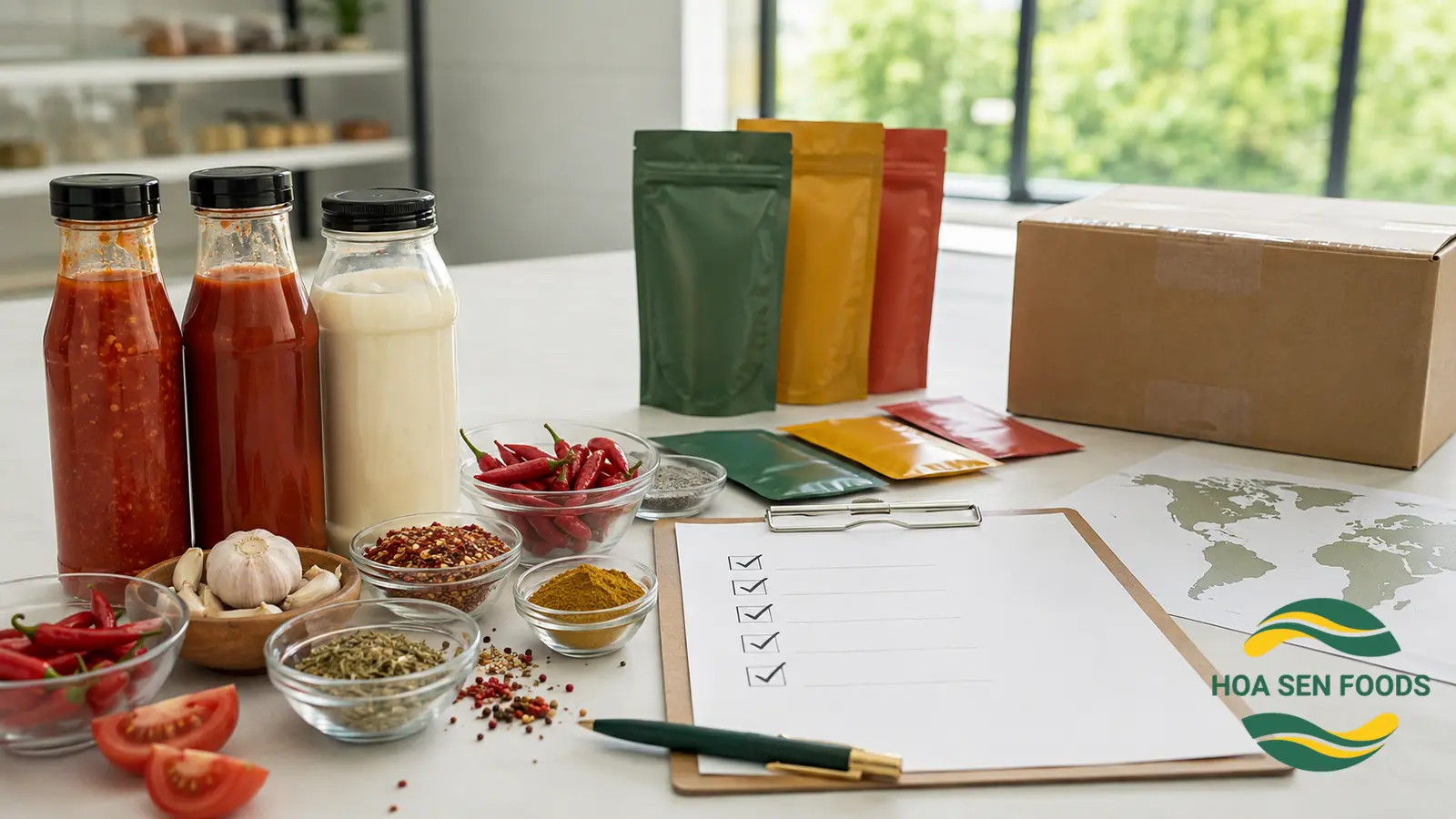
Quick answer: Export spice contract manufacturing is a process in which a brand works with an R&D and production partner to develop a formula, create samples, manufacture, package and prepare documentation for a target market. Before sending an inquiry, a business should clarify eight areas: market, product, ingredients, technical specifications, packaging, testing, commercial planning and documentation responsibilities.
A good-tasting sauce sample is not yet a good production brief.
When developing chili sauce, ketchup, mayonnaise, dipping sauce or a private-label seasoning product, many businesses begin with a short request: “I want a product like this sample for export.” That sentence can start the conversation, but it is not enough for an R&D team to determine the right formula, packaging, testing scope, documentation and production approach.
For export products, a lack of clarity at the beginning often returns as several rounds of sample revisions, late ingredient changes, redesigned labels or a quotation that no longer fits after the specifications are finalized. Reducing risk does not require a very long document. What matters more is answering the questions that determine the project.
This article focuses on the information a business should prepare before contacting a contract manufacturer. Requirements for standards, certifications and market-specific procedures should be checked separately in the article export spice manufacturing: standards, certifications and process requirements.
What Is Export Spice Contract Manufacturing?
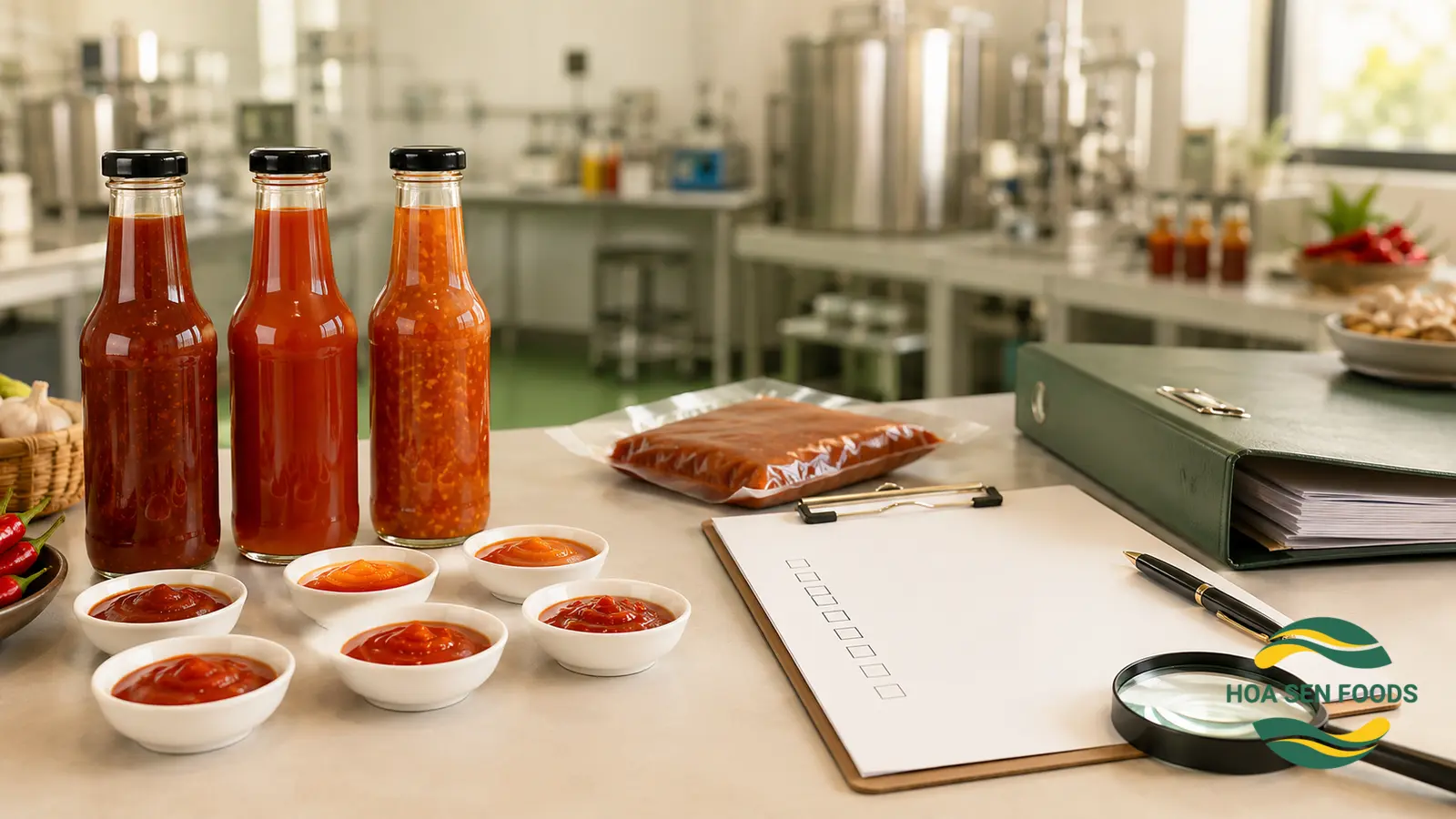
Export spice contract manufacturing is a cooperation model in which a brand owner or buyer assigns a manufacturer to perform some or all of the following activities: product consultation, formula R&D, sample development, production, quality control, packaging and the provision of technical documentation within the agreed scope.
“Export” is not only the destination of a shipment. The target market affects the formula, ingredients, allergens, additives, label language, packaging specifications, import documentation and the way the brand owner, manufacturer and importer work together.
Hoa Sen Foods describes its service scope as including consultation, spice research, processing and manufacturing, and packaging. Businesses can therefore use the checklist below to prepare for an initial discussion with the spice food contract manufacturing team.
Summary of the 8 Essentials to Prepare
| Area | Questions the business should answer | Recommended output |
|---|---|---|
| 1. Market and sales channel | Where will the product be sold, to whom and through which channel? | A short description of the market, customer and distribution channel |
| 2. Target product | Is it chili sauce, ketchup, mayonnaise, another sauce or a dry seasoning? | A product brief and a reference sample, if available |
| 3. Ingredients and constraints | Are there requirements related to allergens, additives, Halal, plant-based or clean label positioning? | A list of mandatory, preferred and prohibited requirements |
| 4. Technical criteria | When is a sample approved? How should taste, colour, aroma and viscosity be assessed? | A sample approval scorecard and formula version record |
| 5. Packaging and label | What retail or foodservice format, material, language and dimensions are needed? | A packaging brief, draft label and transport requirements |
| 6. Testing and shelf life | What must be tested before a shelf-life claim is made? | A testing, retention-sample and stability-monitoring plan |
| 7. Commercial plan | What are the target price, trial volume, forecast and launch date? | A target cost range, forecast and realistic timeline |
| 8. Documentation and responsibilities | Who approves the label, works with the importer and owns the formula? | A responsibility matrix, document list and confidentiality terms |
1. Confirm the Market, Customer and Sales Channel Before Finalizing the Formula
A bottle of chili sauce intended for restaurants may need a different format, usage profile and cost structure from a retail bottle sold on a supermarket shelf. A product sold through a distributor also has different carton, item-code and inventory-life requirements from a product being tested through e-commerce.
The brief should answer at least the following:
- The country or region where the product is expected to be sold.
- The end-customer group: general consumers, children, plant-based consumers, spicy-food consumers, restaurants or households.
- The sales channel: retail, foodservice, F&B chains, distributors, e-commerce or private label for another business.
- The expected selling price and desired position on the shelf.
- Whether an importer has been identified or is still being sought.
A general phrase such as “export internationally” should not replace a specific target market. Each market has its own requirements. In the United States, for example, the Foreign Supplier Verification Program, or FSVP, places responsibility on the importer to verify foreign suppliers through a risk-based approach. In the European Union, mandatory food information and language requirements are governed by a separate regulatory framework. This is why the importer should be involved early rather than appearing only when the shipment is nearly ready.
2. Write a Product Brief That Helps R&D Understand What the Product Must Become
A product brief is not a detailed formula. It describes the product’s intended destination.
For chili sauce, the business can describe the desired heat profile, acidity, sweetness, garlic aroma, colour, mouthfeel and dishes with which the sauce will be served. For ketchup, the brief should clarify sweetness, acidity, colour, viscosity and the target user group. For mayonnaise, it should specify whether the product contains egg or is plant-based, how it will be used, storage requirements and allergen constraints.
A useful product brief usually includes:
- Product type and intended use.
- A reference sample or a description of the desired sensory profile.
- Three criteria that must be achieved.
- Three areas that can remain flexible when optimizing cost or manufacturability.
- Preferred ingredients and ingredients that must not be used.
- Expected pack size and target selling price.
If a business only has a kitchen sample or a benchmark product, it can still begin. However, it should state which aspects of the sample matter most. “Exactly the same” is usually not a sufficiently clear R&D approval criterion because ingredients, processing, packaging and storage conditions may differ.
3. List the Ingredients, Additives, Allergens and Label Claims to Be Checked
This area requires coordination among the brand owner, contract manufacturer, quality team and importer.
The business should create three groups of requirements:
- Mandatory: for example, excluding a specific allergen, requiring a plant-based formula or meeting Halal requirements through the certification body selected for the target market.
- Preferred: for example, reduced sugar, reduced sodium, a shorter ingredient list or ingredients supported by clear traceability records.
- Prohibited: ingredients, additives or claims that the target market does not accept or that the brand has decided to exclude.
A substance permitted in Vietnam should not automatically be assumed to be suitable in every country. Additive names, permitted levels, food categories, declaration methods and supporting evidence can differ by market. For Halal products, the business should also distinguish between a manufacturer’s support in reviewing ingredients, documentation and processes and the act of issuing a certificate, which belongs to an authorized certification body.
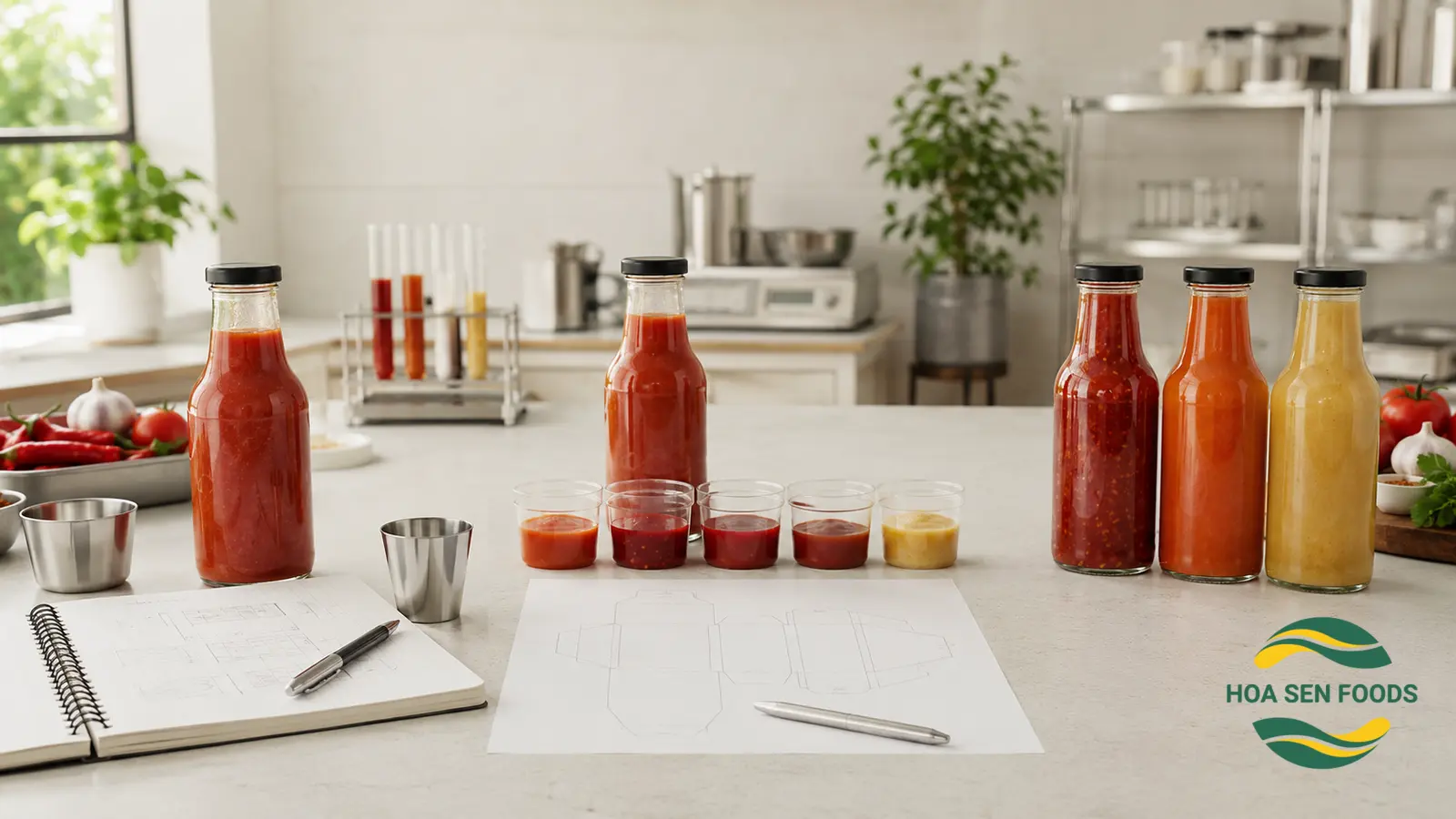
4. Set Sample Approval Criteria and Manage Formula Versions
A sample has value only when both sides know how it will be assessed.
Instead of giving feedback such as “it does not taste right” or “make it stronger,” agree on criteria such as:
- Overall taste and aftertaste.
- Heat, acidity, saltiness and sweetness.
- Characteristic aroma and undesirable odours.
- Colour.
- Viscosity and performance when poured, dipped or spread.
- Condition after a defined storage period within the approved testing plan.
- Suitability for the intended dish and usage channel.
Each adjustment should have a sample code, date, change description and approver. This prevents a situation in which the sales team is discussing version A while R&D and the importer are evaluating version B.
Technical parameters such as pH, water activity, Brix or viscosity should become fixed criteria only after the technical team confirms their relevance to the product and agrees on the measurement method. A number copied from another product should not be applied to a new project without verification.
5. Select Packaging at the Same Time as Product Development
Packaging is not merely decoration to be completed at the end. It affects filling, use, transport, display, storage and the buyer’s experience.
The packaging brief should state:
- Whether the product will use a bottle, jar, pouch, single-use sachet or foodservice pack.
- Expected weight or volume.
- Packaging material and closure requirements.
- Units per carton, pallet arrangement and expected transport conditions.
- Label area, language and mandatory information.
- Item-code, barcode or GTIN requirements from the retail partner.
GS1 defines GTIN as an identifier for trade items that are priced, ordered or invoiced at any point in the supply chain. However, the code required and the data structure to be displayed depend on the retailer, importer and distribution system. The business should confirm these requirements before printing large quantities.
6. Agree on Testing, Shelf Life and Traceability
A shelf-life period should not be assigned simply because a reference product states 12 or 18 months. Shelf life must relate to the actual formula, process, packaging, storage conditions, safety and quality criteria, and an assessment plan approved by the responsible technical team.
At the principles level, the Codex General Principles of Food Hygiene covers hazard control, facility conditions, operational controls, product information, transport and the application of HACCP. For a contract manufacturing project, these principles should become practical questions:
- How are ingredients and suppliers identified, checked and documented?
- How is each finished-product lot coded and traced?
- Have retention samples, release criteria and deviation handling been agreed?
- Who approves the testing and stability-monitoring plan?
- Are packaging and transport conditions included in the assessment scope?
The business should reconfirm the testing plan with R&D/QA, a suitable laboratory, the importer and the relevant authority before making a shelf-life or compliance claim.
7. Include the Commercial Plan in the Brief: Volume, Target Cost and Launch Date
R&D cannot be separated from the business case. A very good formula that exceeds the target price, depends on ingredients that are difficult to source consistently or requires packaging unsuitable for the trial volume may not move forward.
The business should divide the plan into two stages:
- Market-testing stage: a cautious volume that prioritizes reducing inventory risk and collecting feedback.
- Scale-up stage: a clearer forecast that prioritizes consistency, efficiency, ingredient planning and packaging planning.
Information to send to the manufacturer may include expected volume by production run, a six-to-twelve-month forecast if available, target cost, sample deadline, desired launch date and dependencies such as label approval or packaging orders.
MOQ and lead time should not be treated as one fixed number for every project. They often depend on the degree of customization, ingredients, packaging, specifications, production plan and testing scope. A clear brief helps the manufacturer explain these variables more transparently.
8. Define Documentation, Responsibilities, Ownership and Confidentiality from the Start
An export project usually involves at least three parties: the brand owner, the contract manufacturer and the importer. Without clear roles, important questions can remain unanswered.
| Party | Responsibilities to clarify |
|---|---|
| Brand owner | Approve product positioning, formula/sample, design, target cost, business plan and brand ownership |
| Contract manufacturer | Perform the agreed R&D, production and packaging scope; provide lot records and technical documents within the committed scope |
| Importer or market partner | Confirm import, label and documentation requirements, legal responsibilities and distribution conditions in the target market |
In the United States, the FDA states that an importer covered by FSVP must establish and perform supplier-verification activities for each imported food, subject to applicable exemptions. In the European Union, Regulation (EU) No 1169/2011 sets principles and requirements for mandatory food information; that information must appear in a language consumers in the relevant Member State can easily understand. These examples show why the importer should not receive the documentation package only at the end of the project.
Alongside legal responsibilities, the contract or project appendix should clarify:
- Who owns the original formula and adjusted versions.
- The confidentiality scope, authorized access and duration.
- How changes to ingredients, packaging or suppliers are approved.
- Which documents are handed over for each lot.
- How to handle samples, labels, timelines or quality results that do not meet the approved criteria.
A Short Brief to Prepare Before Contacting Hoa Sen Foods
A business can prepare a one-page document containing the following questions:
- What product do you want to manufacture?
- What are the target market and sales channel?
- Who is the end customer and what is the target selling price?
- What flavour profile, reference sample and mandatory criteria apply?
- Are there ingredients, additives, allergens or special requirements to consider?
- What packaging format and expected volume are needed?
- What are the sample deadline, launch date and forecast, if available?
- Has the importer confirmed the label and documentation requirements?
- Which information or formulas must remain confidential?
- Who has final approval for the product, quality and commercial decisions?
With this information prepared, a discussion with Hoa Sen Foods can move directly to feasibility, R&D direction, sampling, packaging and the facts that still need to be verified. A business does not need a fully developed formula to begin; it can start with the target market and a description of the desired product.
Conclusion: A Good Brief Is the First Step Toward Transparent Contract Manufacturing
Export spice contract manufacturing does not begin on the production line. It begins when all parties understand the same product, target market and success criteria.
Hoa Sen Foods positions itself as a trusted production and R&D partner behind the brand. This role is most valuable when the customer shares its objectives, constraints and commercial plan honestly, while the manufacturer clearly explains what can be done, what must be verified and which points require an accountable approver.
If you are preparing chili sauce, ketchup, mayonnaise, dipping sauce or a private-label seasoning product, send the product type, target market, packaging format, expected volume and formula requirements. Hoa Sen Foods can discuss the next step within the scope of consultation, R&D, manufacturing and packaging.
Frequently Asked Questions
Can I Contact a Contract Manufacturer Without a Formula?
Yes. The business should prepare its target market, users, sales channel, reference sample, flavour profile, target cost and ingredients that must not be used. The manufacturer can use this brief to discuss the R&D and sampling scope.
What Is the Minimum Information Needed Before Requesting a Sample?
At minimum, provide the product type, intended use, market, end customer, reference sample or sensory description, expected packaging format, trial volume and the date by which the sample is needed.
Who Is Responsible for Checking Export Requirements?
Responsibility is usually shared among the brand owner, manufacturer, importer and any relevant consultant or certification body. The business should create a responsibility matrix for each market rather than assuming that the manufacturer carries every legal and procedural obligation.
Can Shelf Life Be Finalized in the Initial Brief?
A number should not be finalized based only on an idea or a reference product. Shelf life must be based on the formula, process, packaging, storage conditions and a testing or stability-assessment plan approved by the responsible technical team.
Should Packaging Be Selected Before or After the Formula?
Packaging should be discussed in parallel with R&D. The format and material can affect filling, transport, use, labelling and the product’s stability-assessment plan.
How Can the Risk of Formula Disclosure Be Reduced?
Define formula ownership, permitted use, authorized access, version control and the change-approval mechanism in a confidentiality agreement or contract. Do not send sensitive data to parties whose role has not been established.
References
- Hoa Sen Foods, Spice food contract manufacturing services.
- Hoa Sen Foods, Contract-manufactured products.
- FAO & WHO, General Principles of Food Hygiene, CXC 1-1969, 2023 edition, amended up to 2022.
- U.S. FDA, FSMA Final Rule on Foreign Supplier Verification Programs, updated May 1, 2026.
- European Commission, Mandatory food information.
- European Commission, Language and presentation of food information.
- GS1, Global Trade Item Number (GTIN).
Note: Export requirements may change according to the product, ingredients, HS code, target market, importer and regulatory authority. Businesses should reconfirm requirements with the importer, certification body and relevant authority before implementation.